
The Machine
Images and Story by Maya Kolton
Go behind-the-scenes with the team whose precision and long hours ensure every game day is seamless for the Michigan State Football program and its athletes.
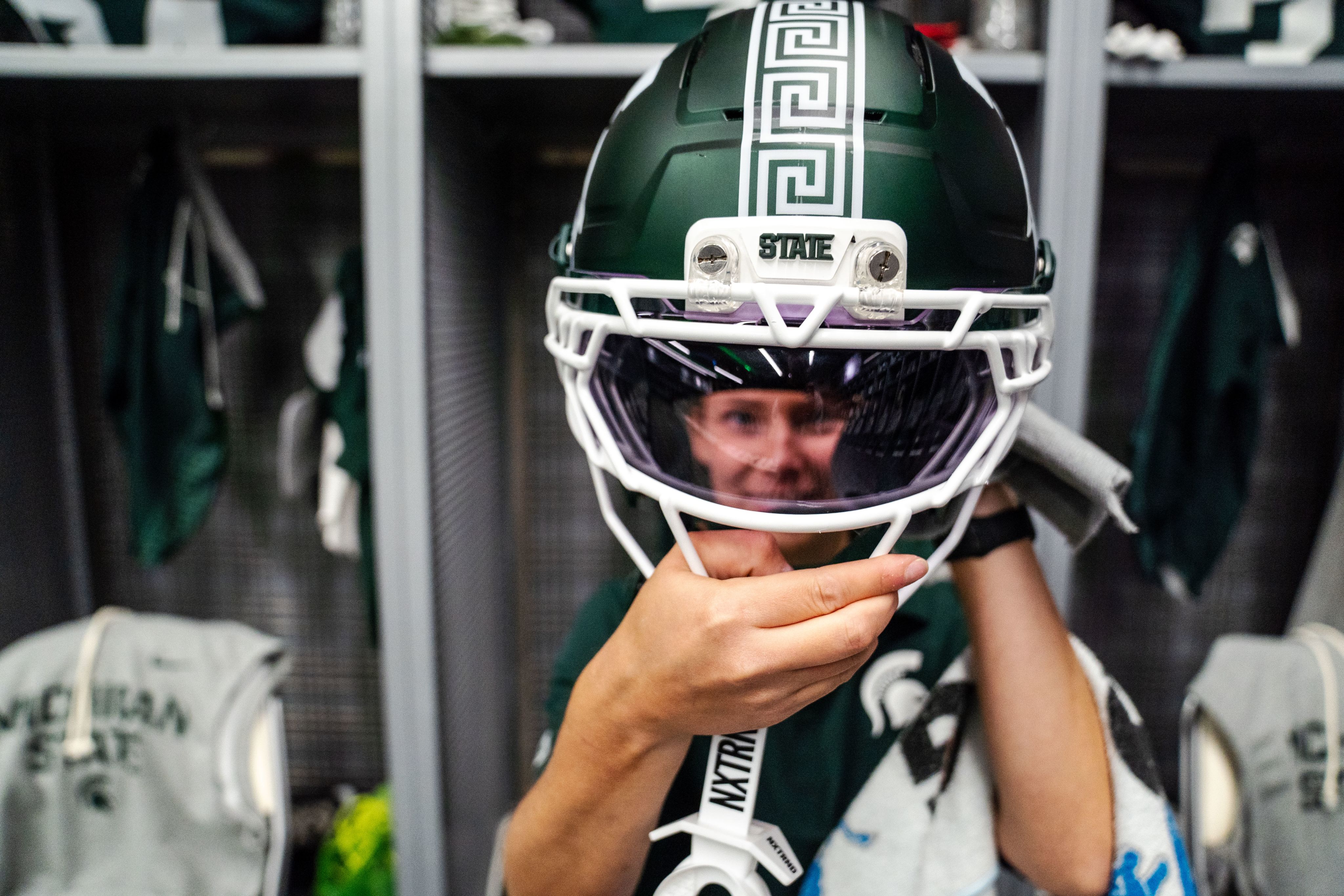

Emma Colby carries a first-in, first-out mentality often reserved for elite athletes. Her days begin before most people arrive to the facility and end long after the seats at Spartan Stadium have emptied.
“Sometimes for 7:30 p.m. kickoffs, we’re not done till about 2 a.m.,” Colby said.
For Colby, a junior kinesiology major and one of Michigan State football’s head student equipment managers, those hours are not unusual. They are part of the responsibility that comes with keeping The Machine running.
No one sees the hours of preparation the equipment staff put in, and that is almost the point. Equipment managers are to the football program what stagehands are to a Broadway production, and when their job is done perfectly, every detail of the game runs flawlessly and no one thinks about them.
You never stop to think about who set up the sidelines, who laid out every jersey, or who triple-checked the equipment trunks to make sure each player had what they needed. A helmet cracks. A glove tears. A cleat needs to be swapped. Each issue is addressed quickly, without drawing attention. Their work is meant to be invisible, though no play on the field could happen without it.
If game day is a performance, rehearsals take place Sunday through Friday, with football Saturdays headlining opening night. Every day, every inescapable detail arranged up to that moment, is built around preparing for victory.

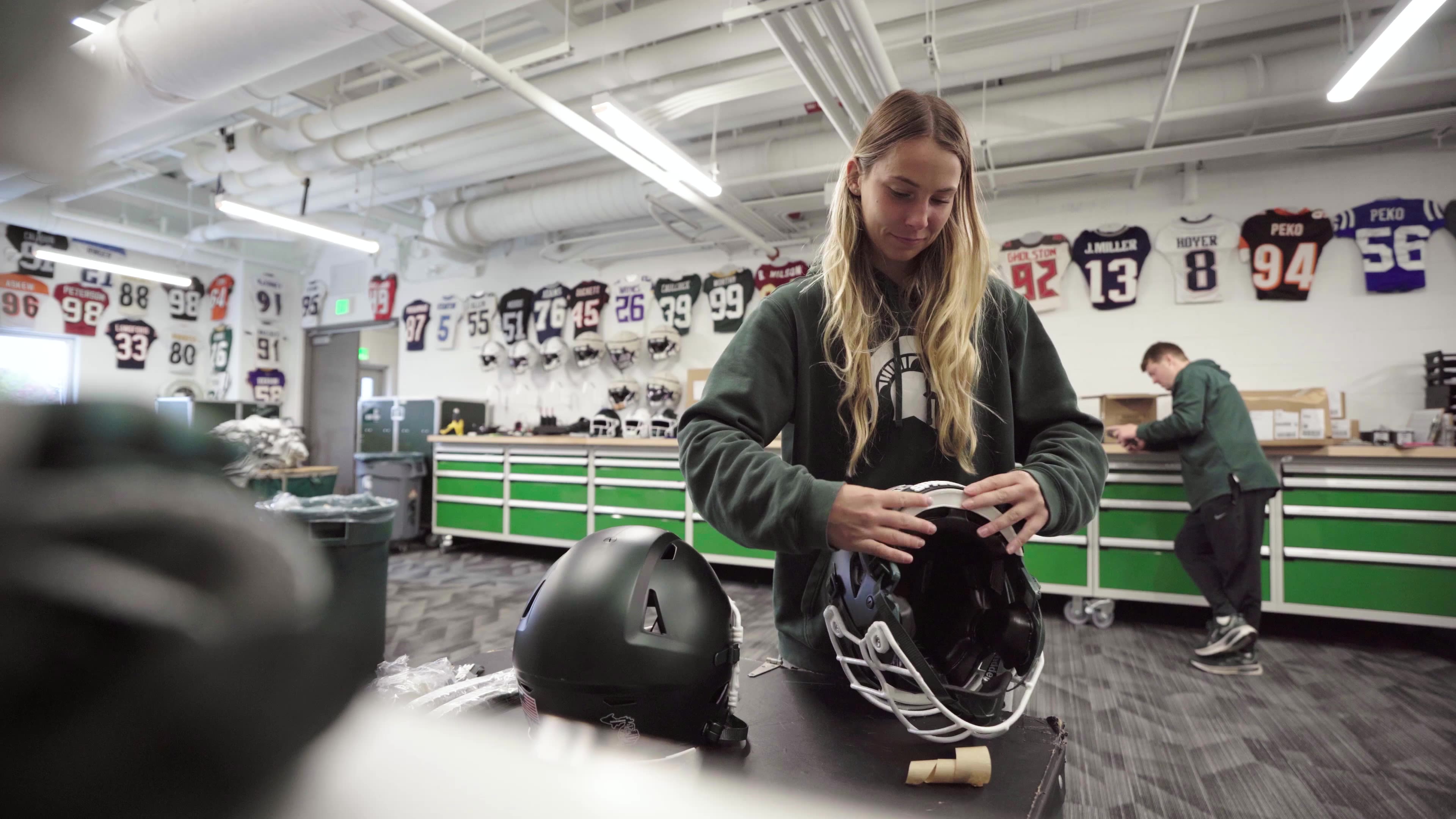

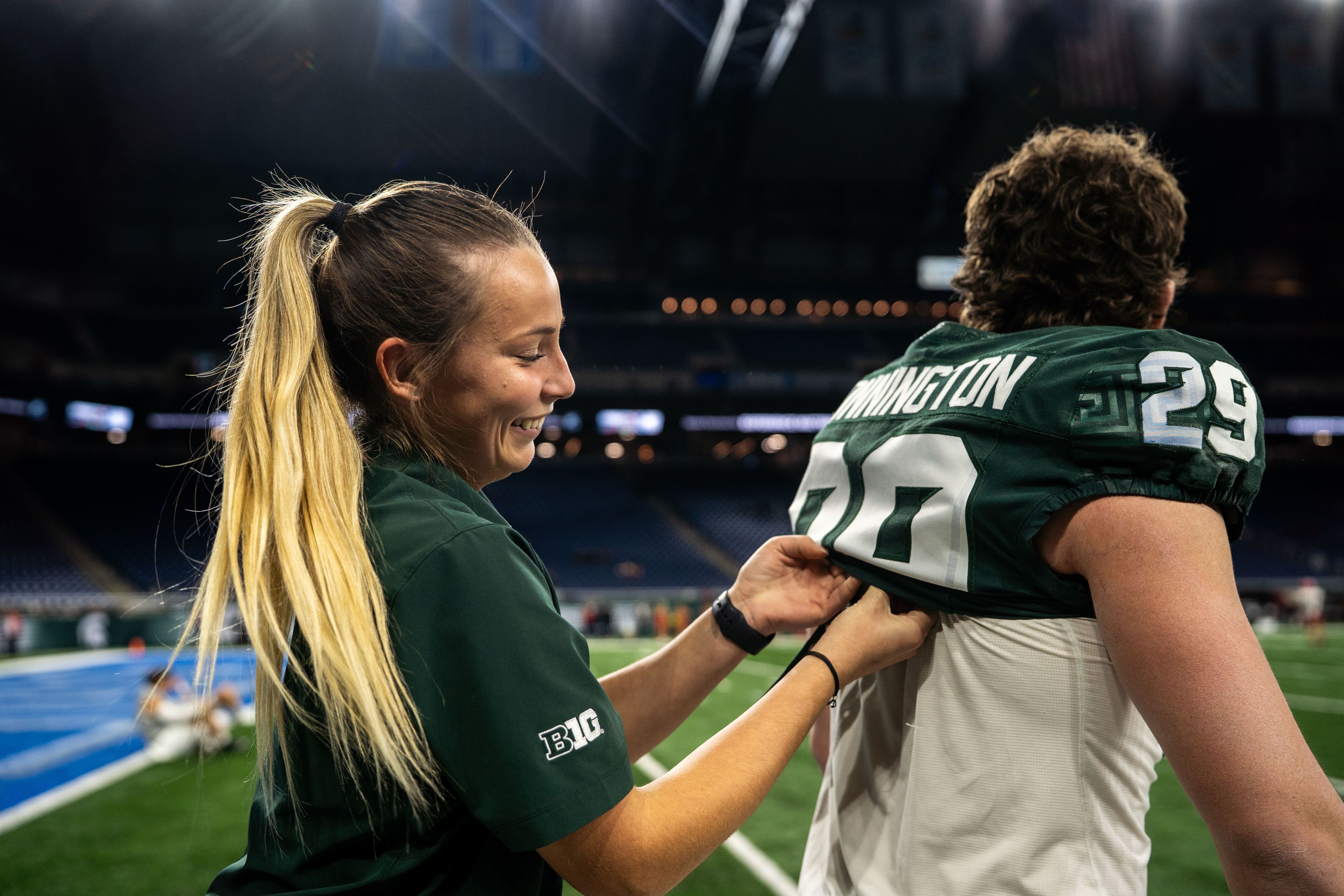

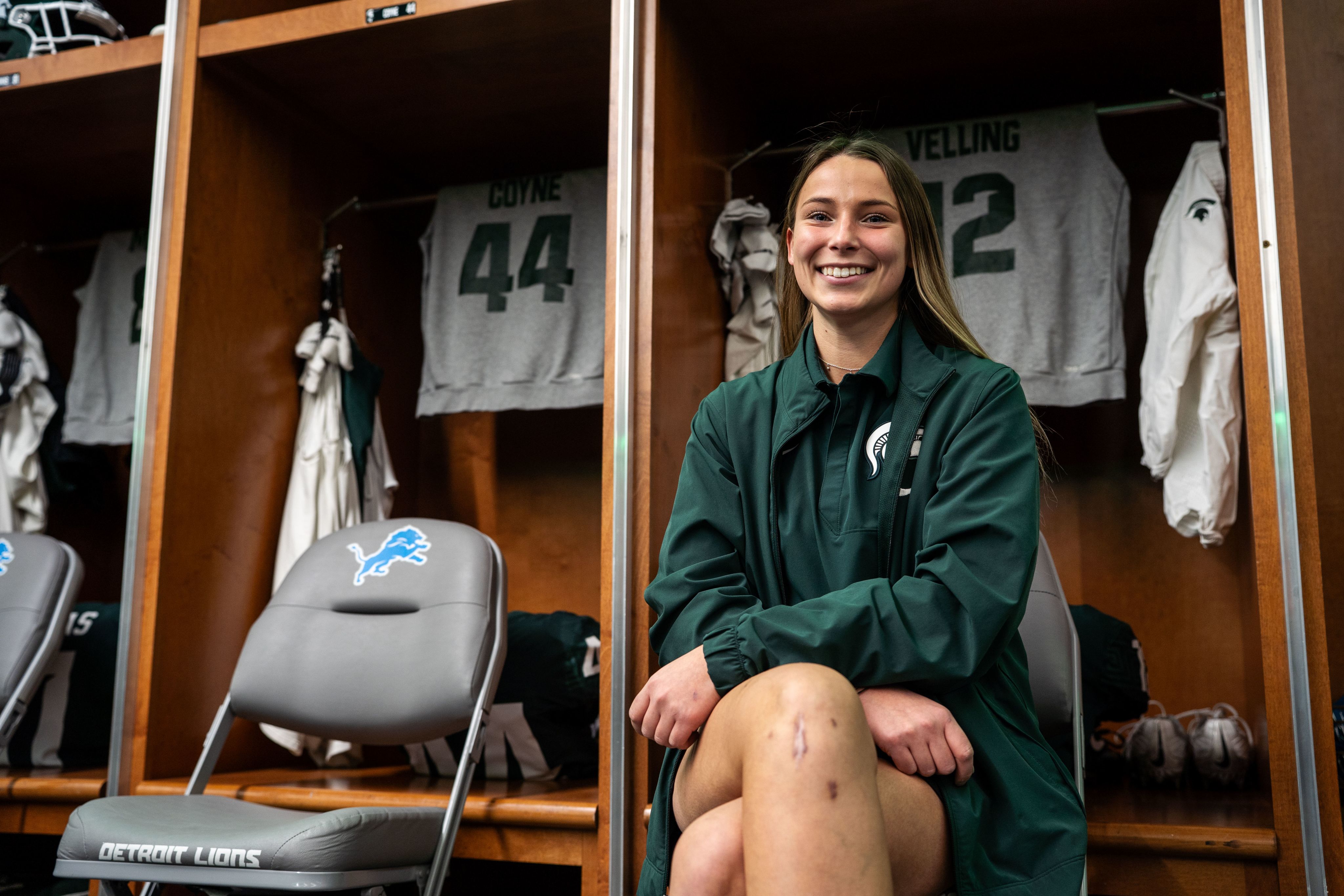


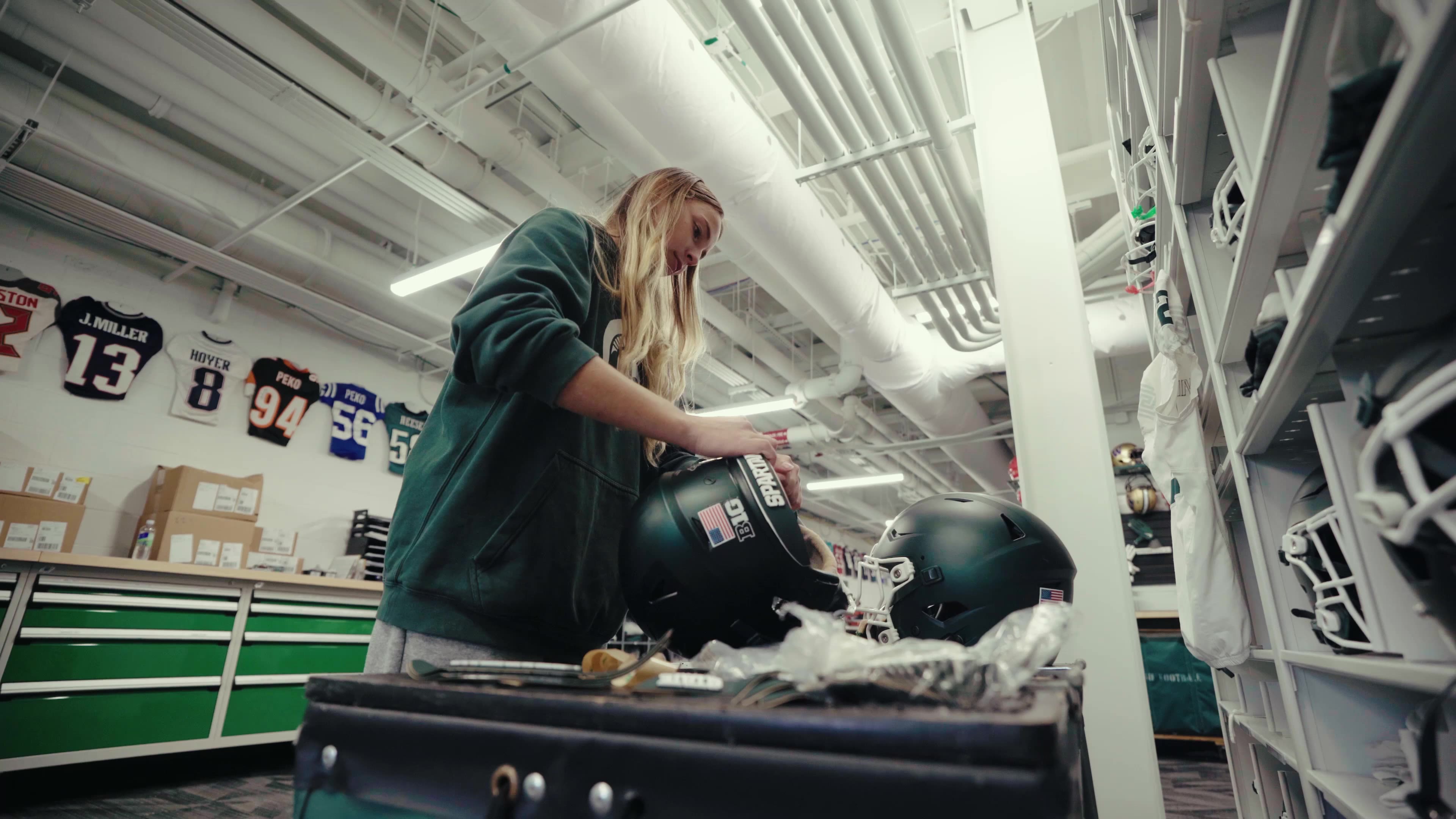
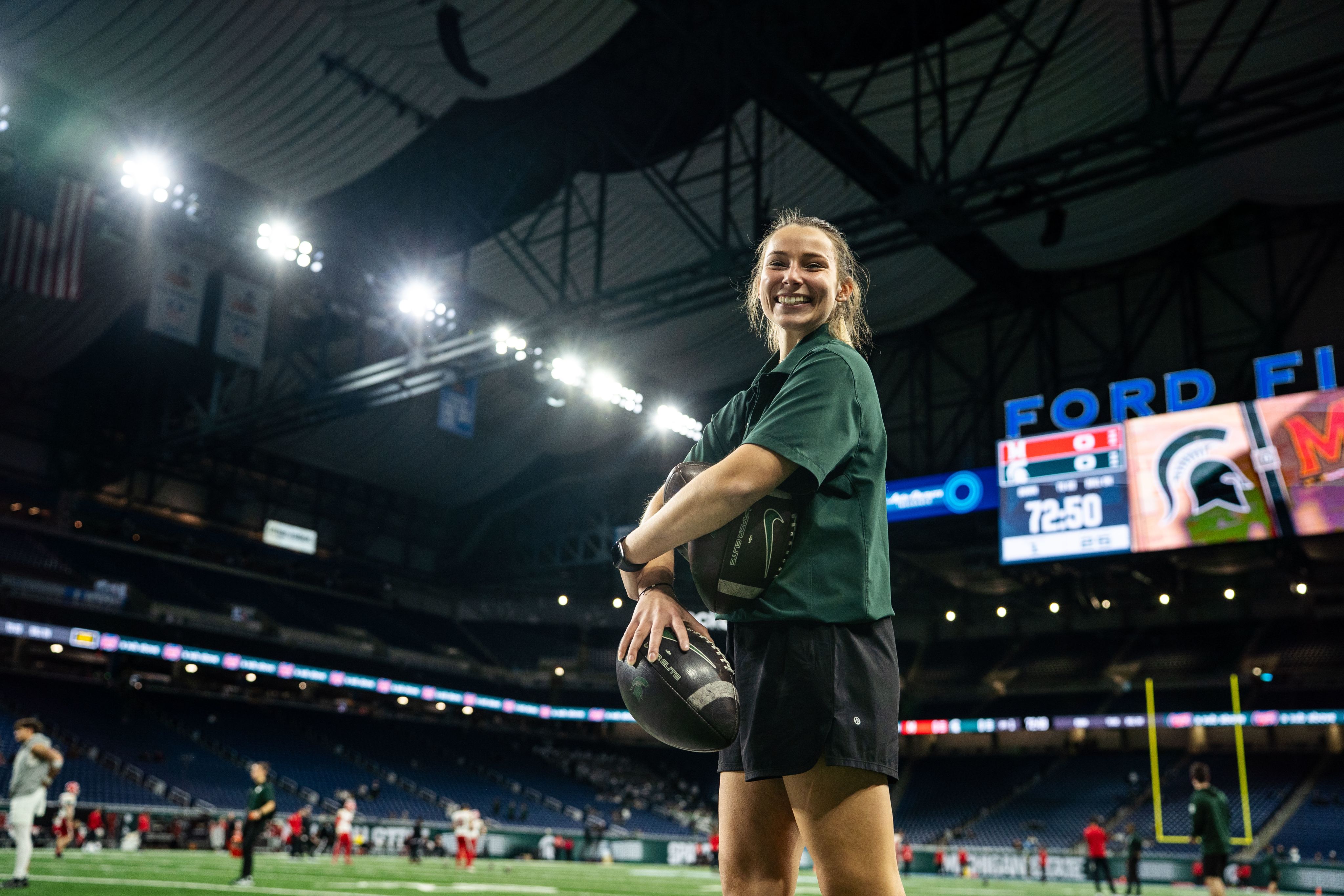
Emma Colby is one of Michigan State University football’s head student equipment managers. She works primarily with the tight ends and special teams, handling everything from helmet preparation and locker room setup to the day-to-day details that keep practices and games running smoothly.
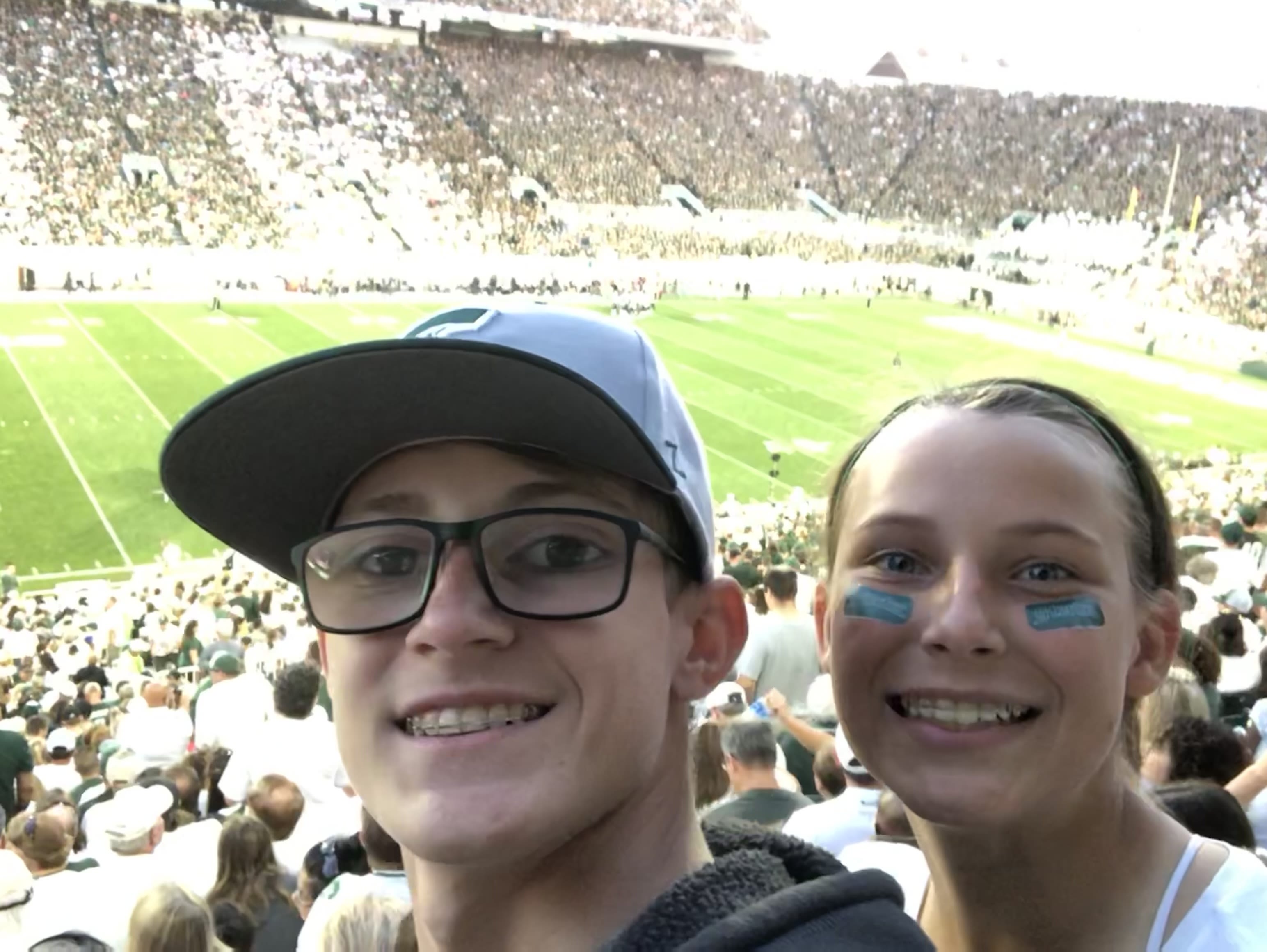
Colby’s connection to Michigan State football began long before she ever stepped onto the field.
“I grew up watching Michigan State football,” Colby said. “My family has had season tickets generationally. We all bleed green and white, and sharing those moments together is something I’ll always remember.”
Click to play: Hear Colby talk about her love for Michigan State football.
Colby no longer watches from the stands, but from the sidelines, where she helps manage equipment for the team's Tight Ends and Special Teams. She is one part of a multifaceted operation that makes those moments possible for other MSU fans.
"Post-grad, I'm looking to go to med[ical] school, hopefully here at Michigan State's College of Osteopathic Medicine," said Colby, "so being here really builds that base and that connection for those connections that I can use in my future."
The Operation



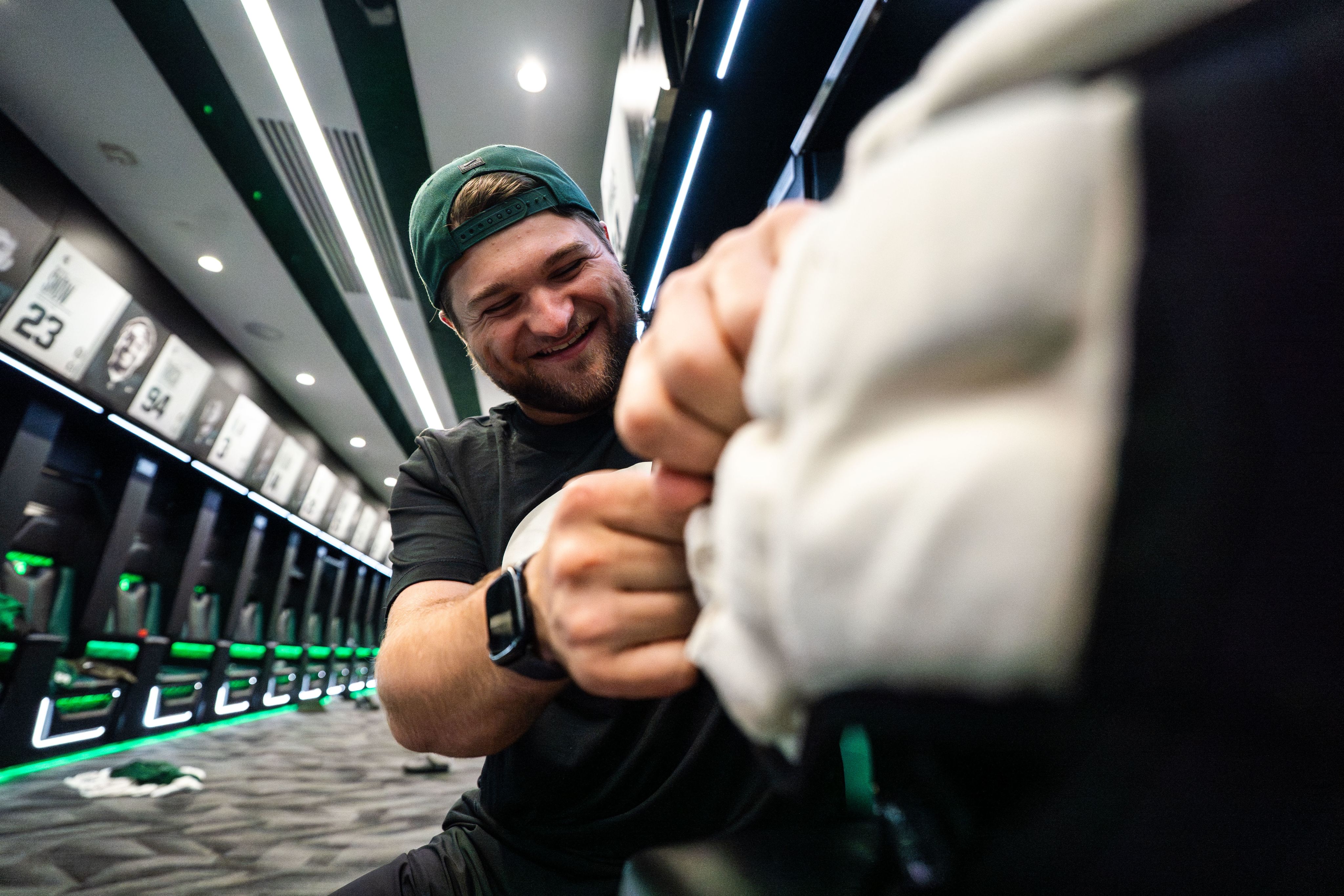

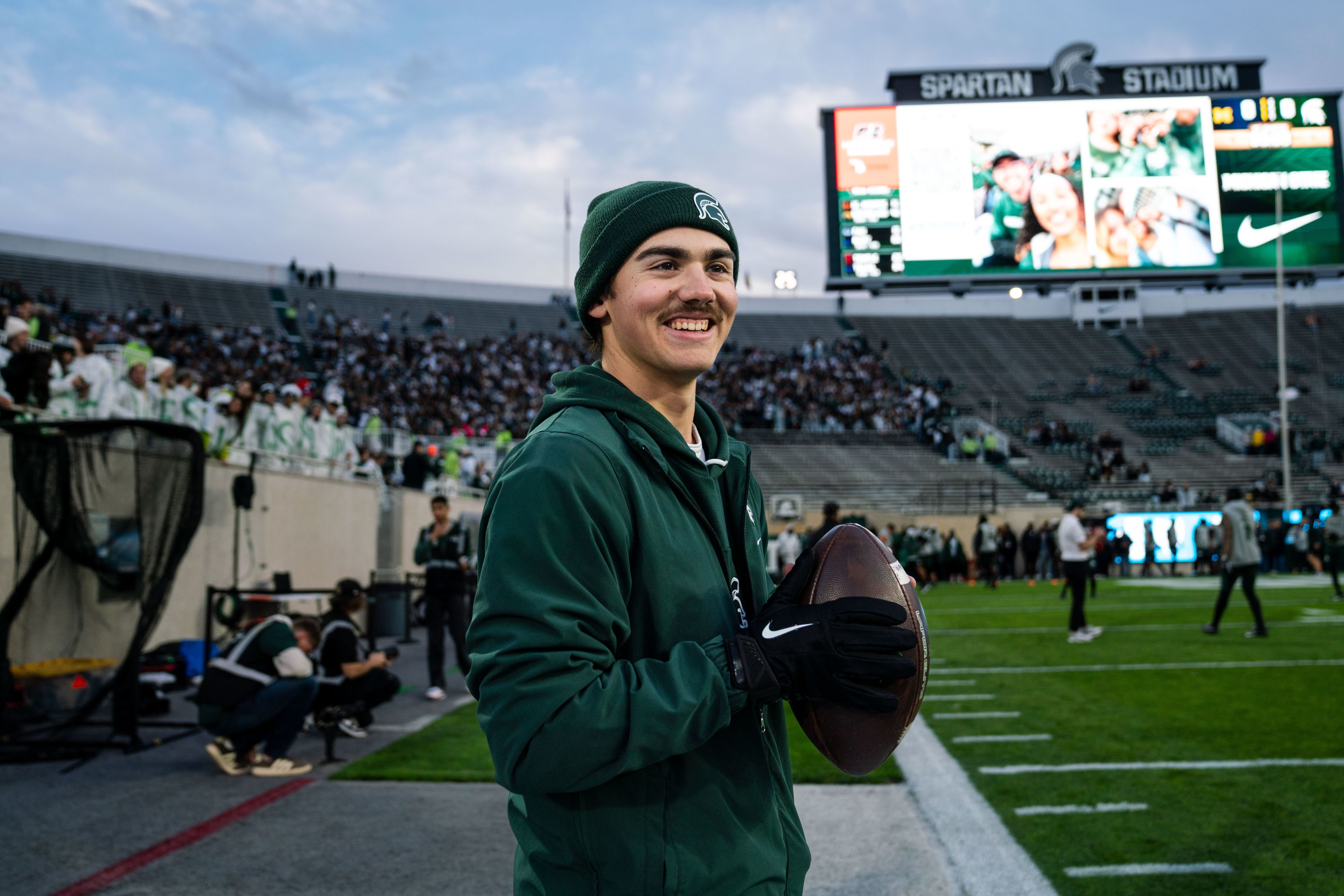

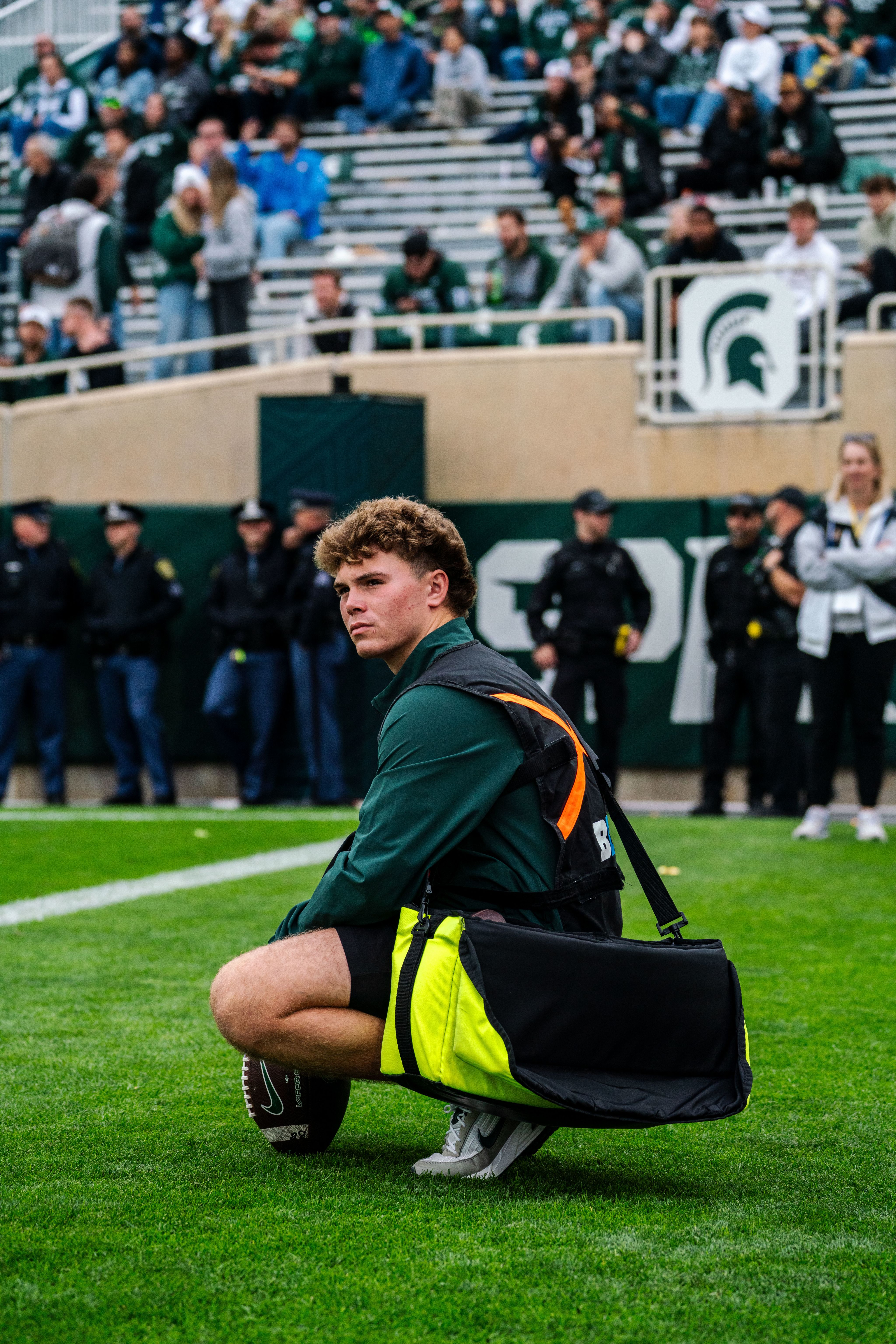

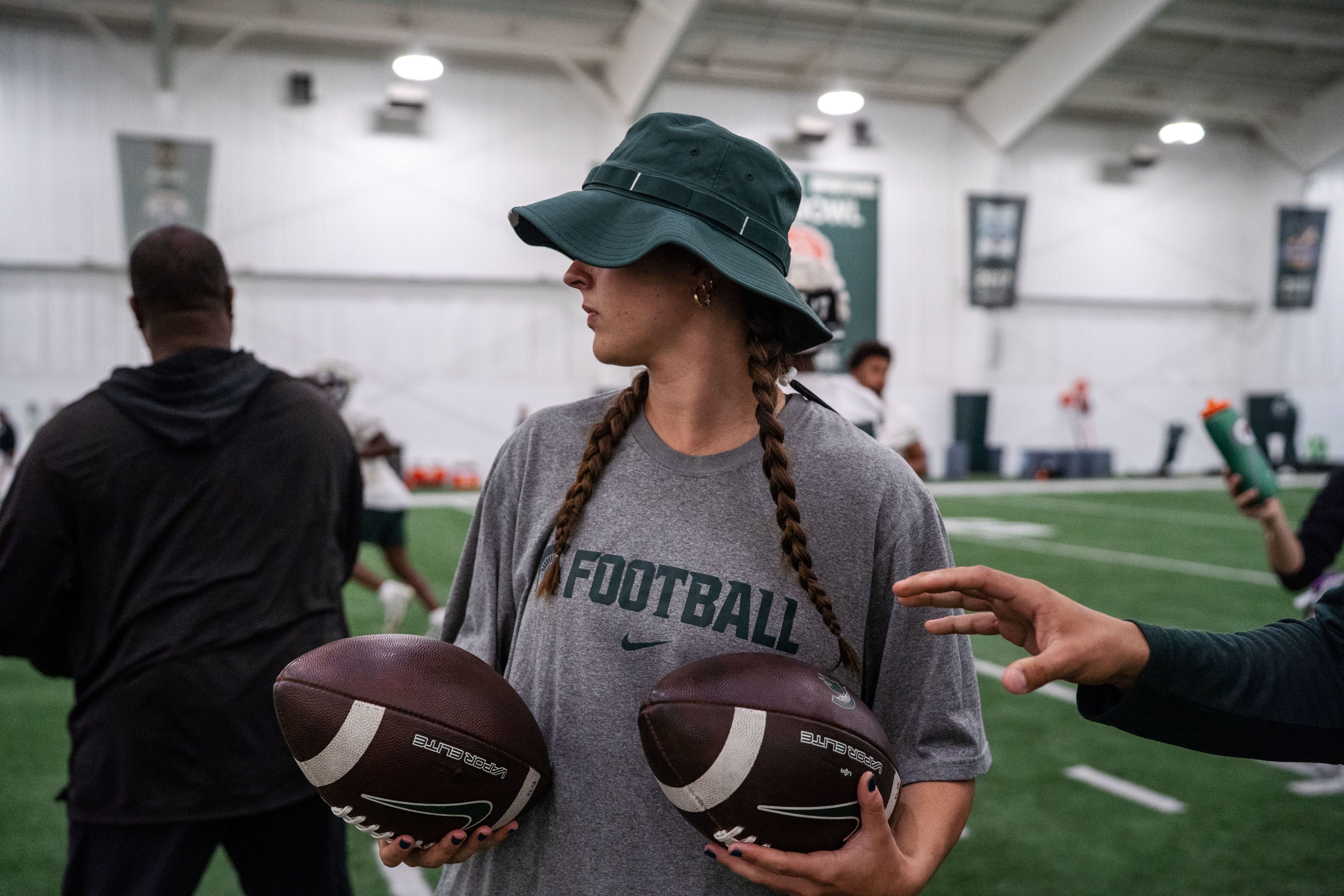





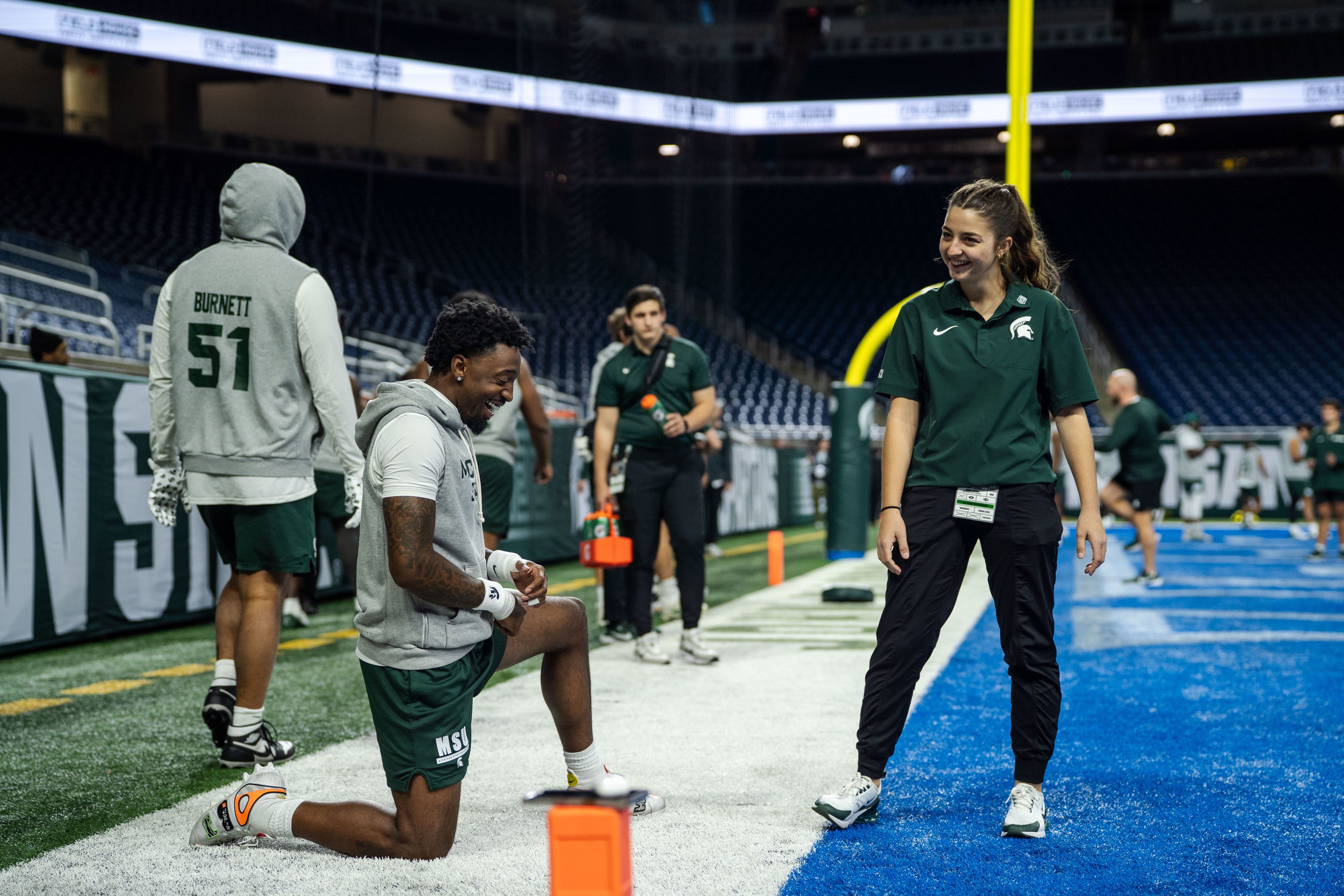

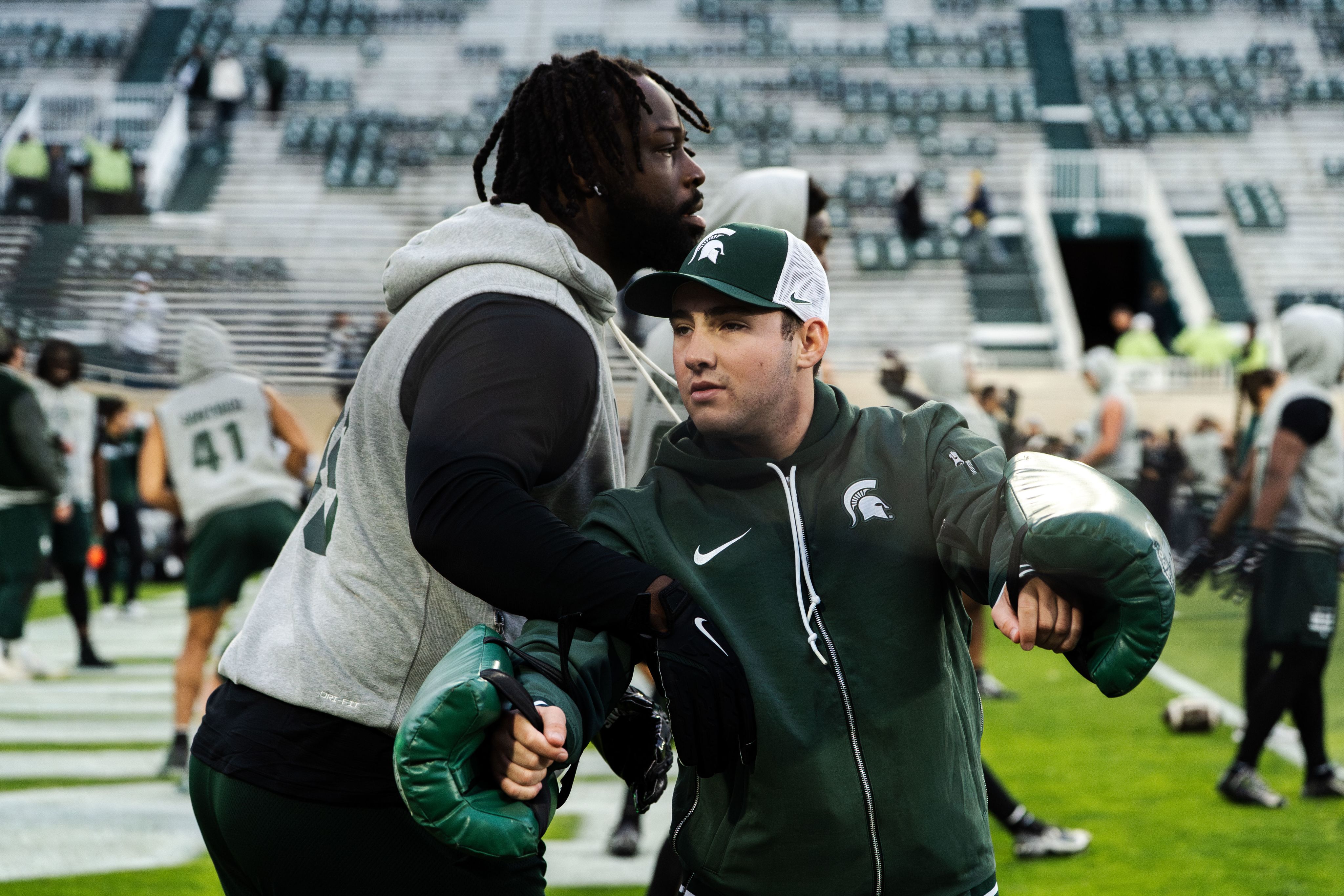

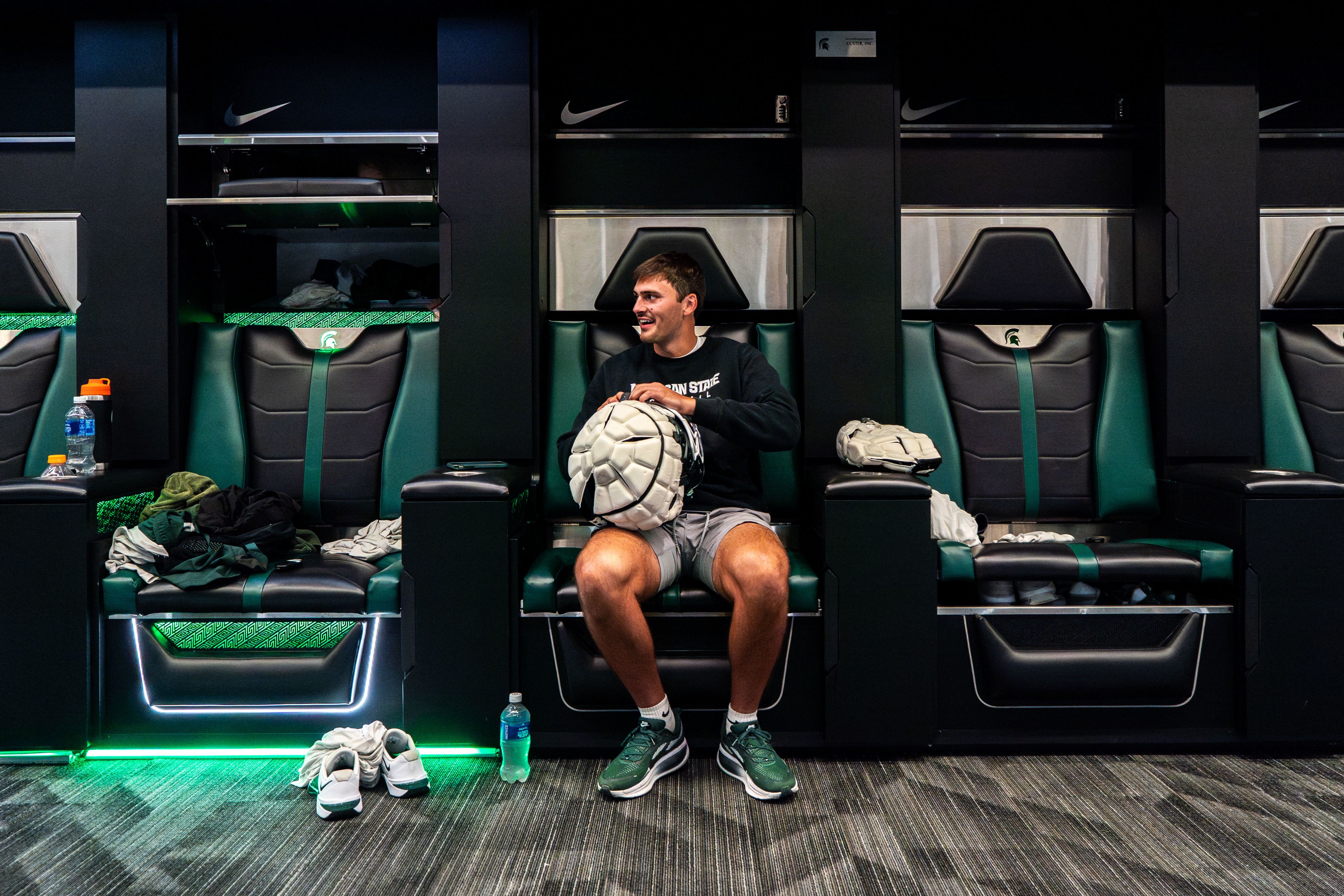

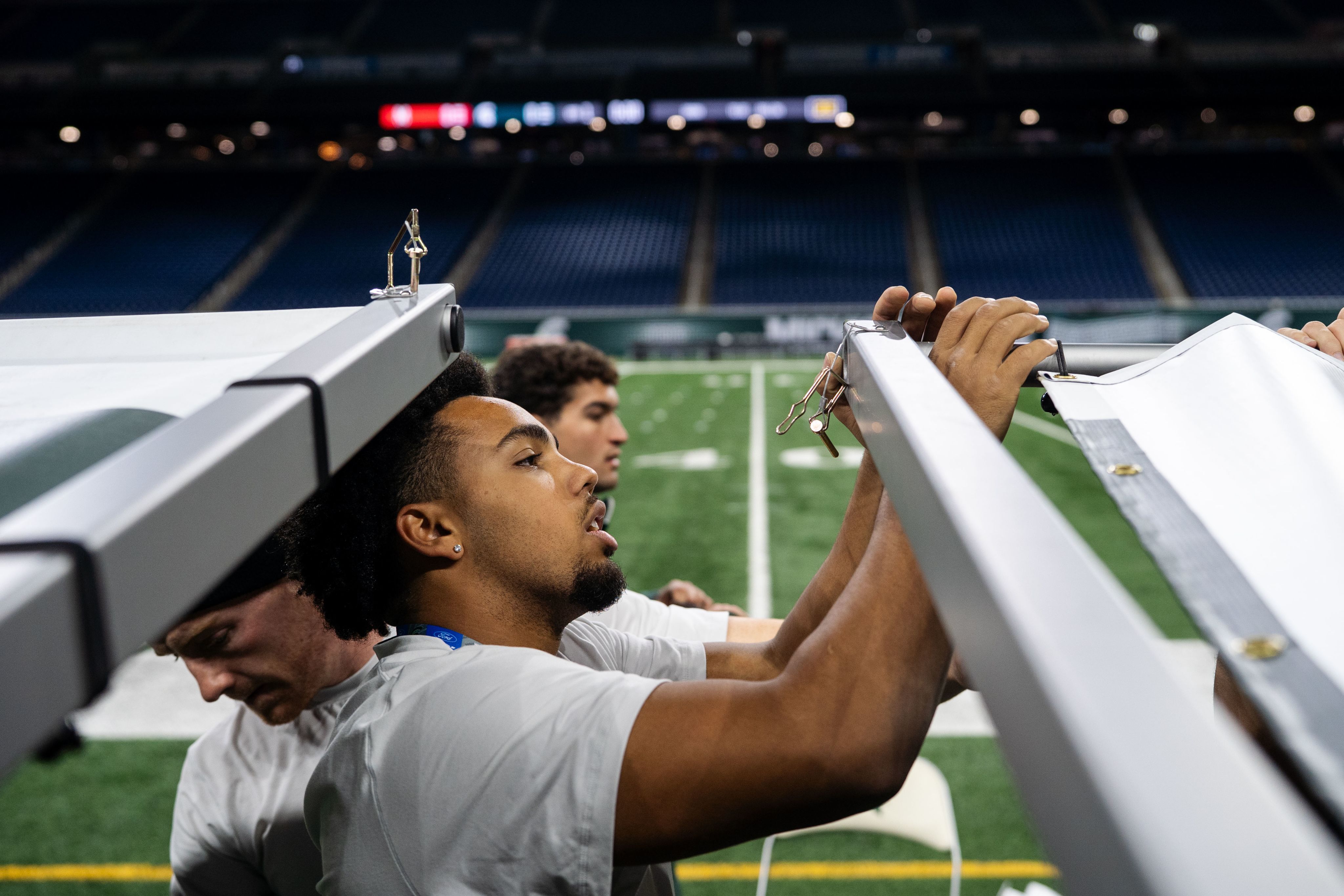


Alex Zsigo | Offensive Line Manager.
Alex Zsigo | Offensive Line Manager.

Aidan Placer | Corner Back Manager.
Aidan Placer | Corner Back Manager.

Quin Scott | Corner Back Manager.
Quin Scott | Corner Back Manager.
Maggie Kirchmeier | Running Back Manager.
Maggie Kirchmeier | Running Back Manager.
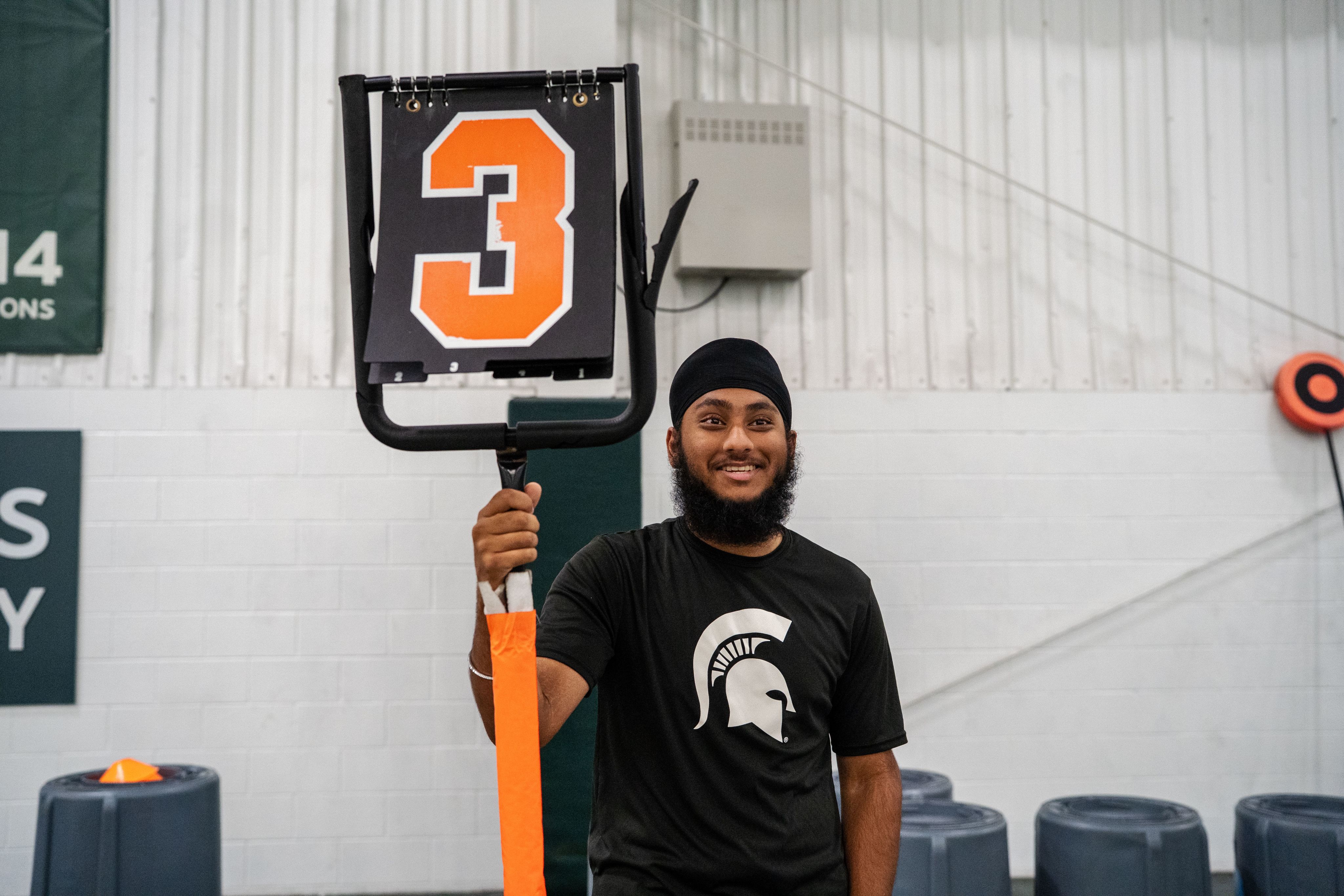
Jaspreet Singh | Defensive Line Manager.
Jaspreet Singh | Defensive Line Manager.
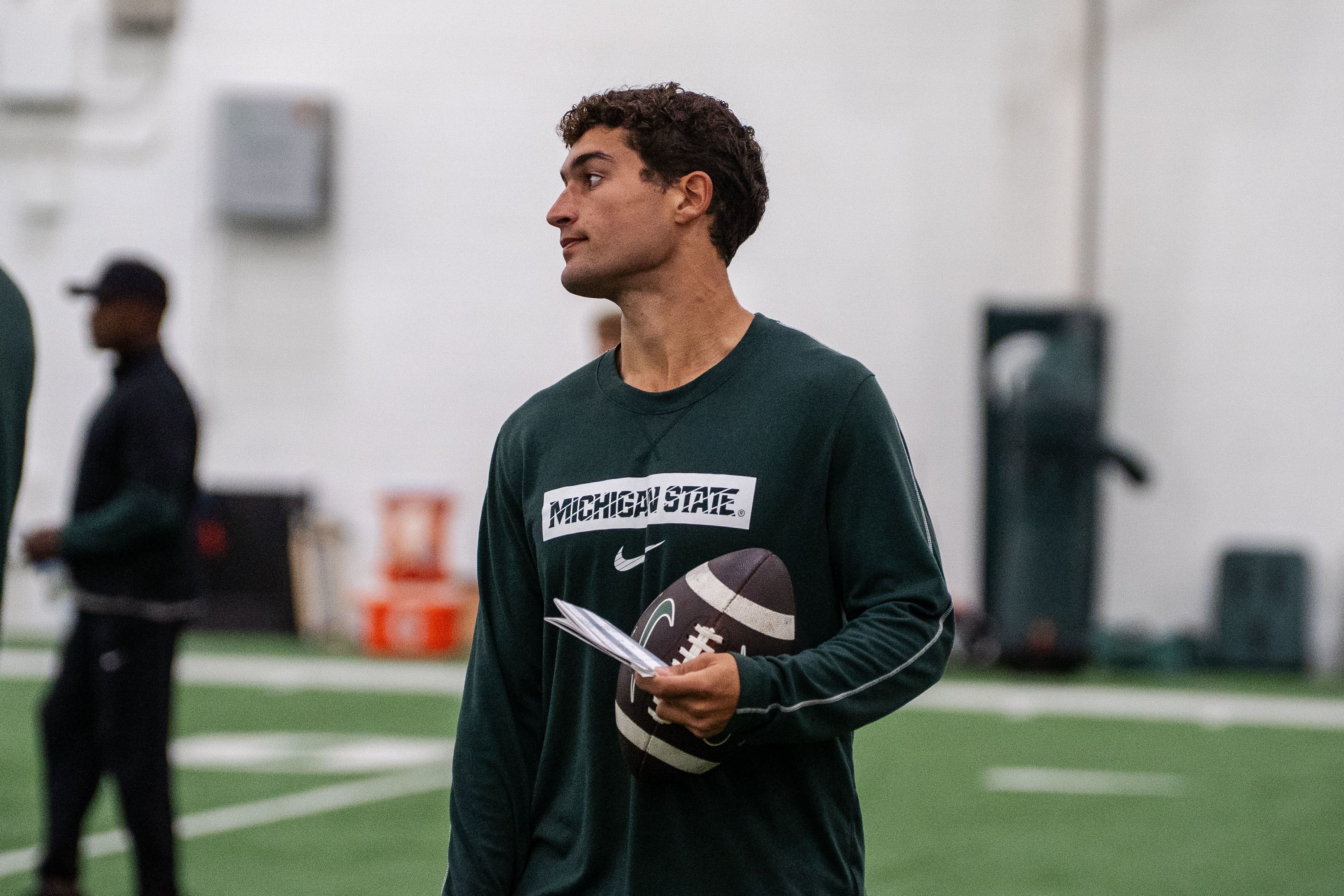
Mark O' Connor | Line Backer Manager.
Mark O' Connor | Line Backer Manager.
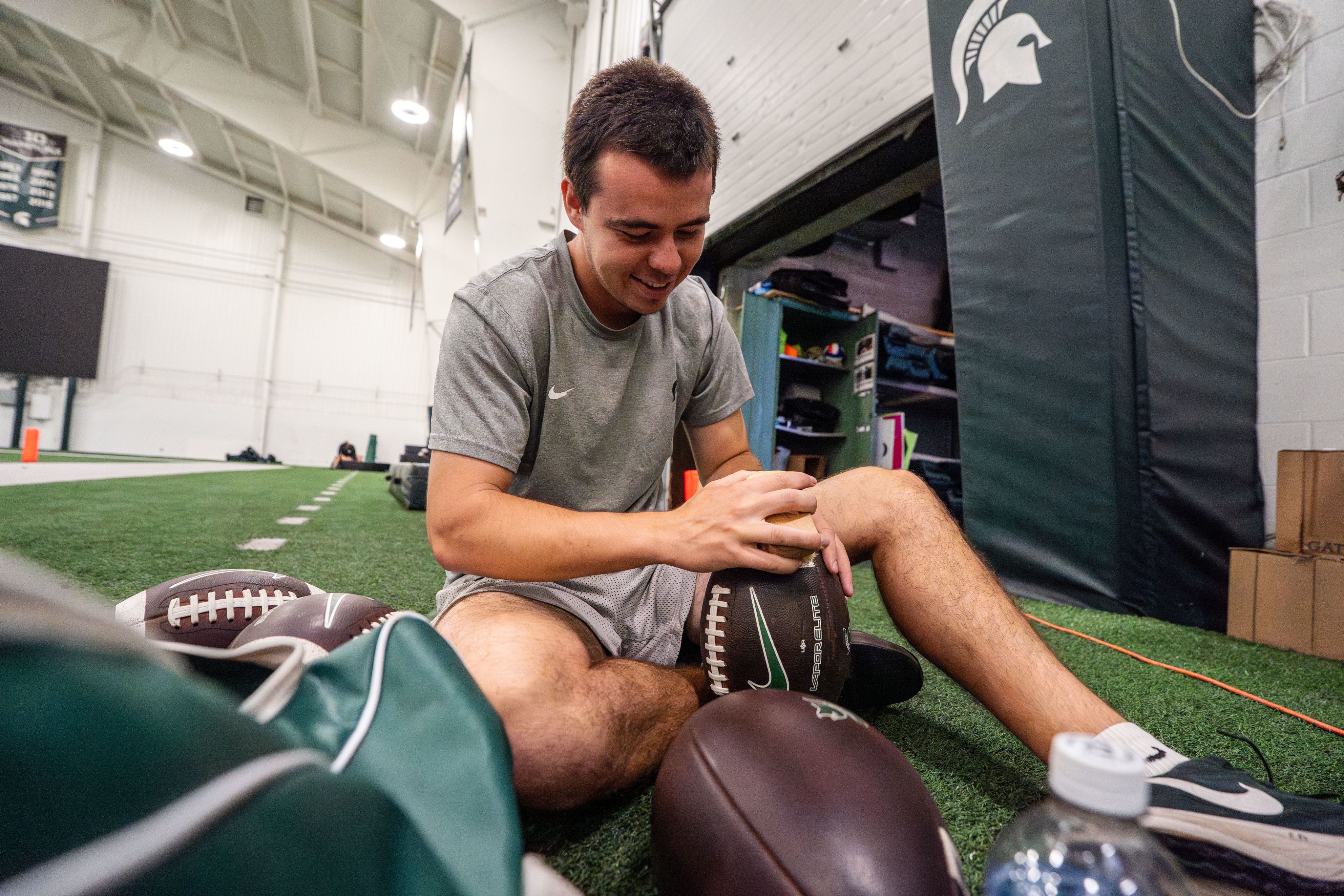
Cam Deuel | Quarterback Manager
Cam Deuel | Quarterback Manager

Jack Fischer | Running Back Manager.
Jack Fischer | Running Back Manager.
Gabby Greenlaw | Wide Receiver Manager.
Gabby Greenlaw | Wide Receiver Manager.
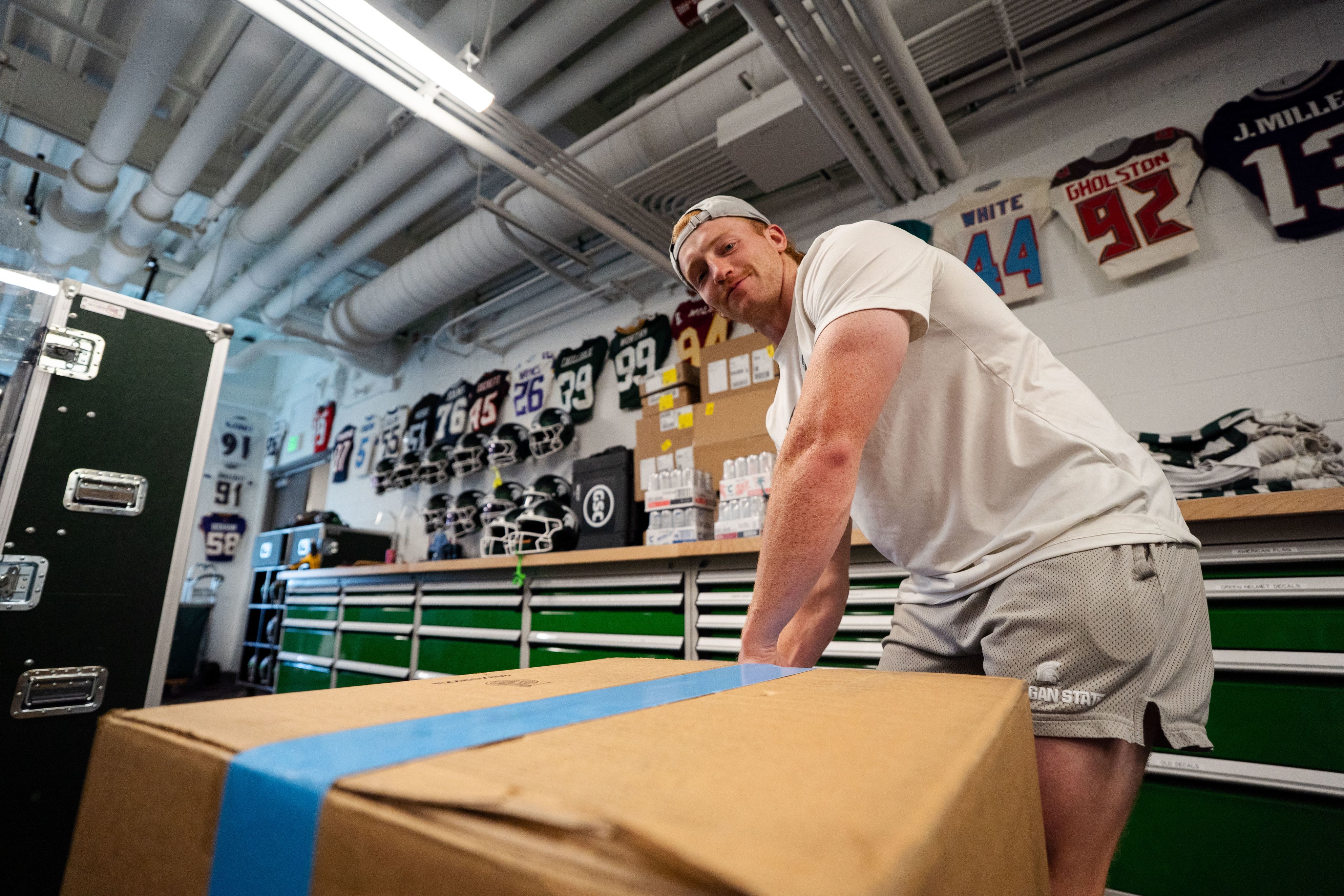
Matt Bove | Defensive Line Manager.
Matt Bove | Defensive Line Manager.
Marek Beckering | Wide Receiver Manager.
Marek Beckering | Wide Receiver Manager.
Dionte Harris | Running Back Manager.
Dionte Harris | Running Back Manager.
Emma Colby | Tight End and Special Teams Manager.
Emma Colby | Tight End and Special Teams Manager.

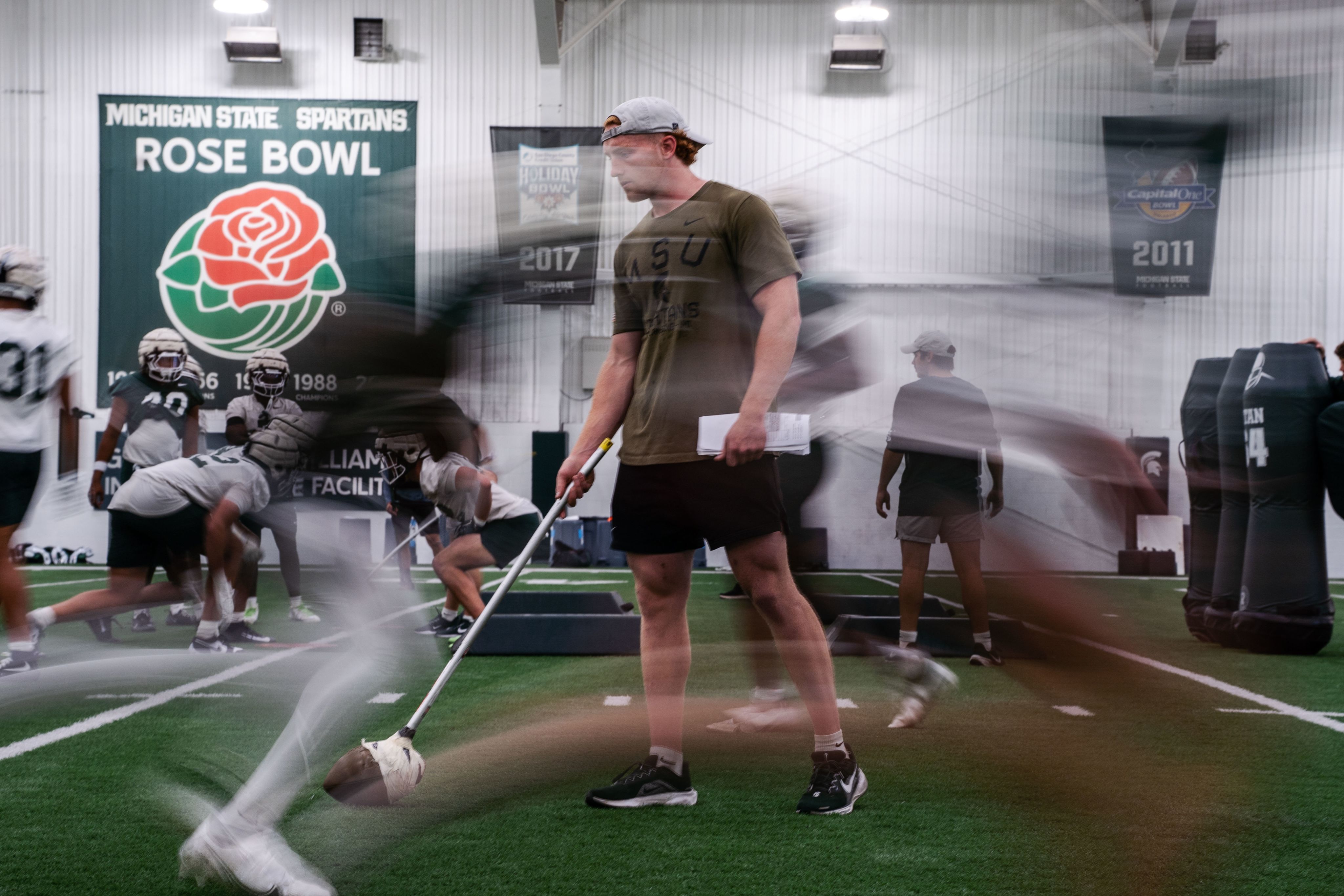

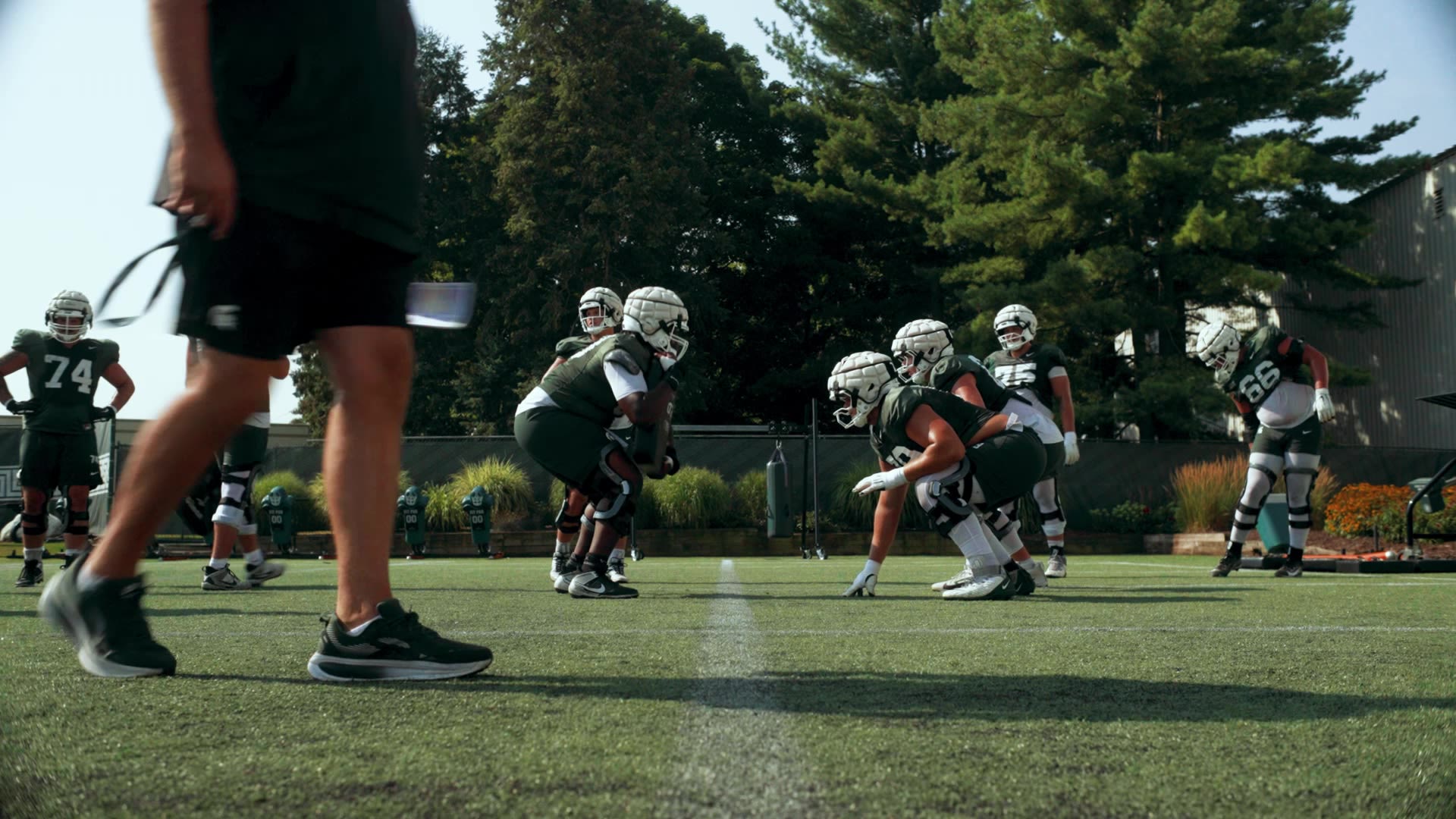

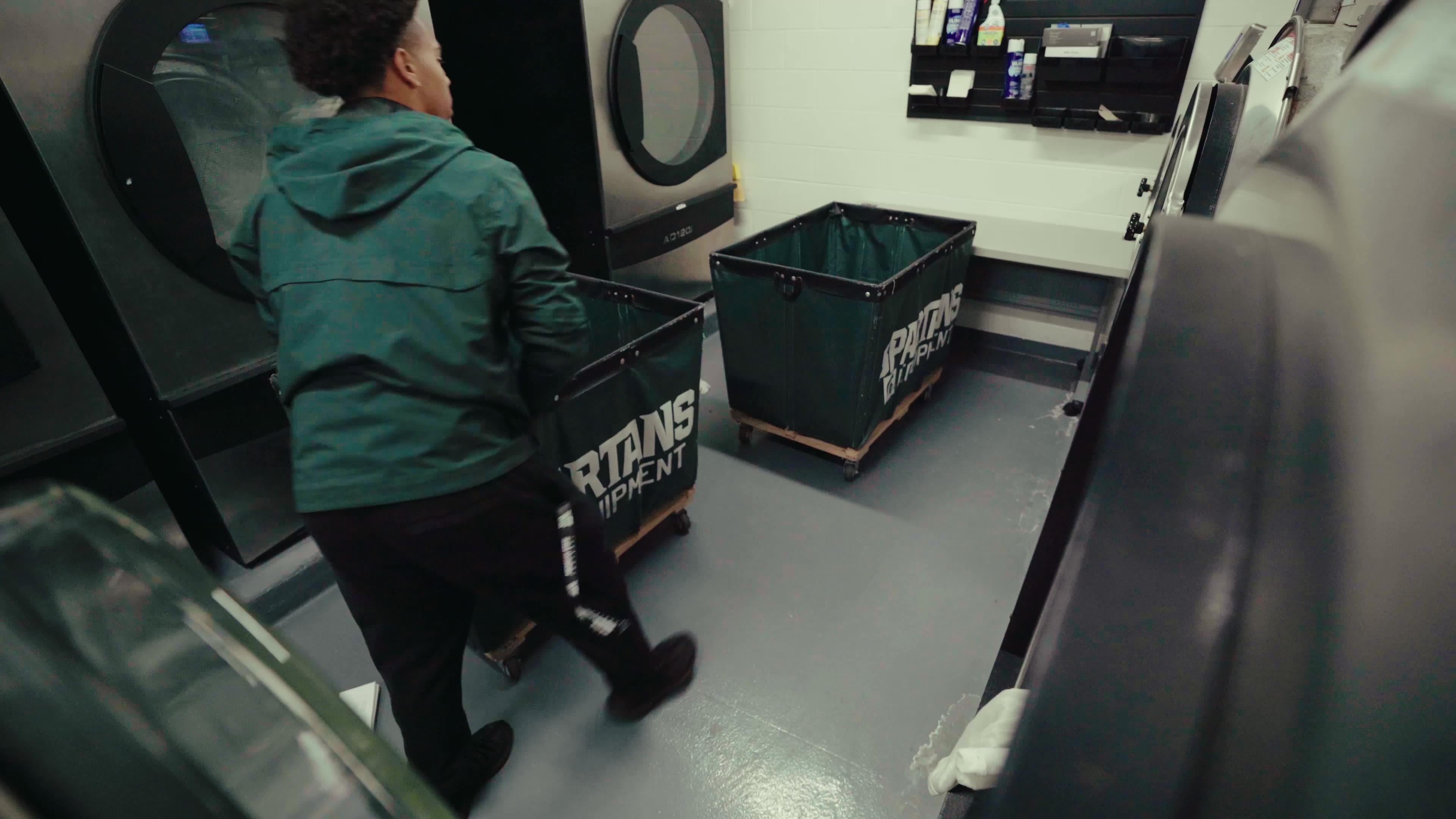
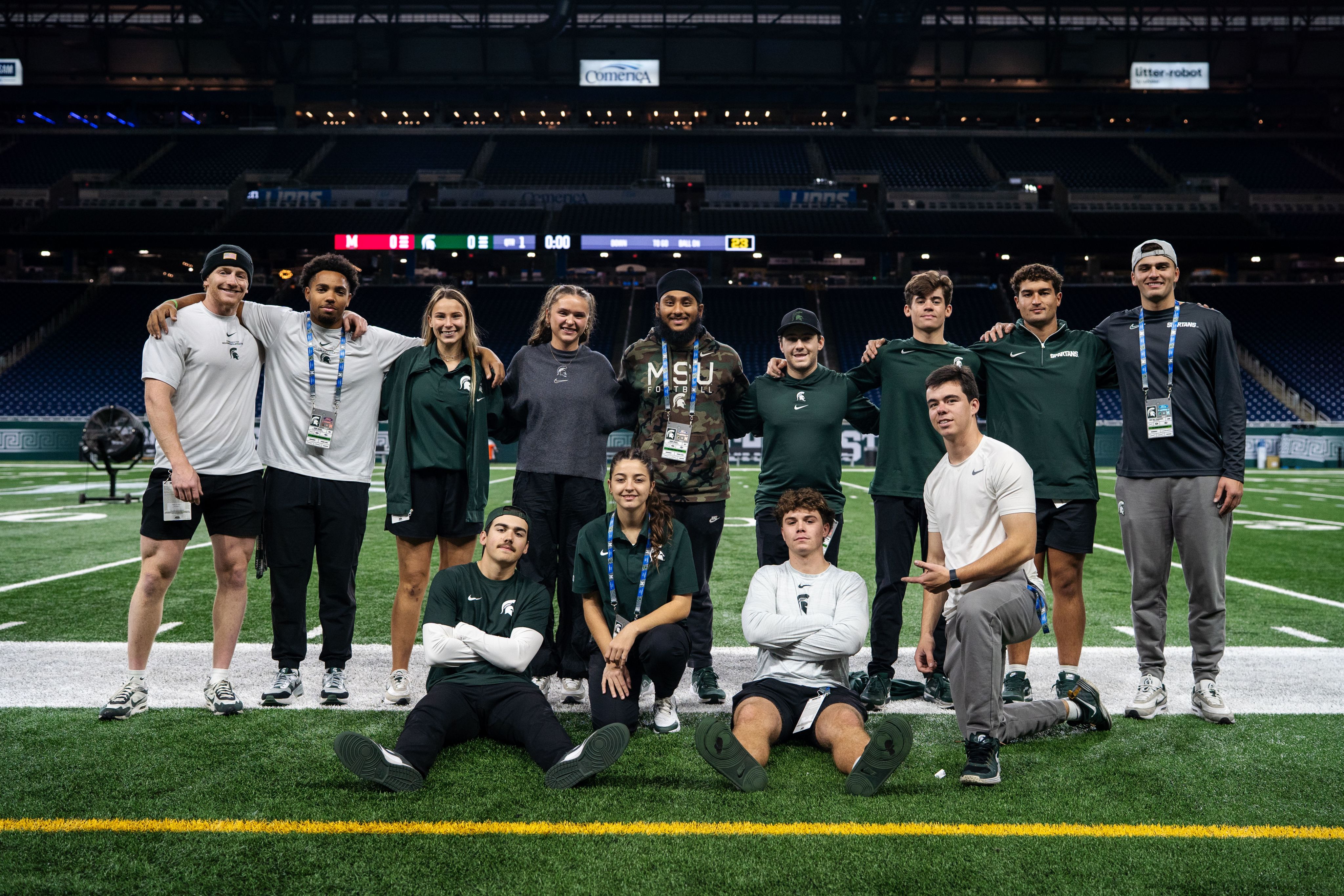
The Michigan State football equipment staff is comprised of 14 student managers and four full-time staff members who support a roster of over 100 athletes throughout practices, travel, and game days.
Together, they are responsible for preparing, maintaining and transporting all the equipment used by the team, handling daily practice setup, uniform care, equipment repair and game day operations so players and coaches can focus solely on football. To understand how this operation works, you have to understand the people inside it.
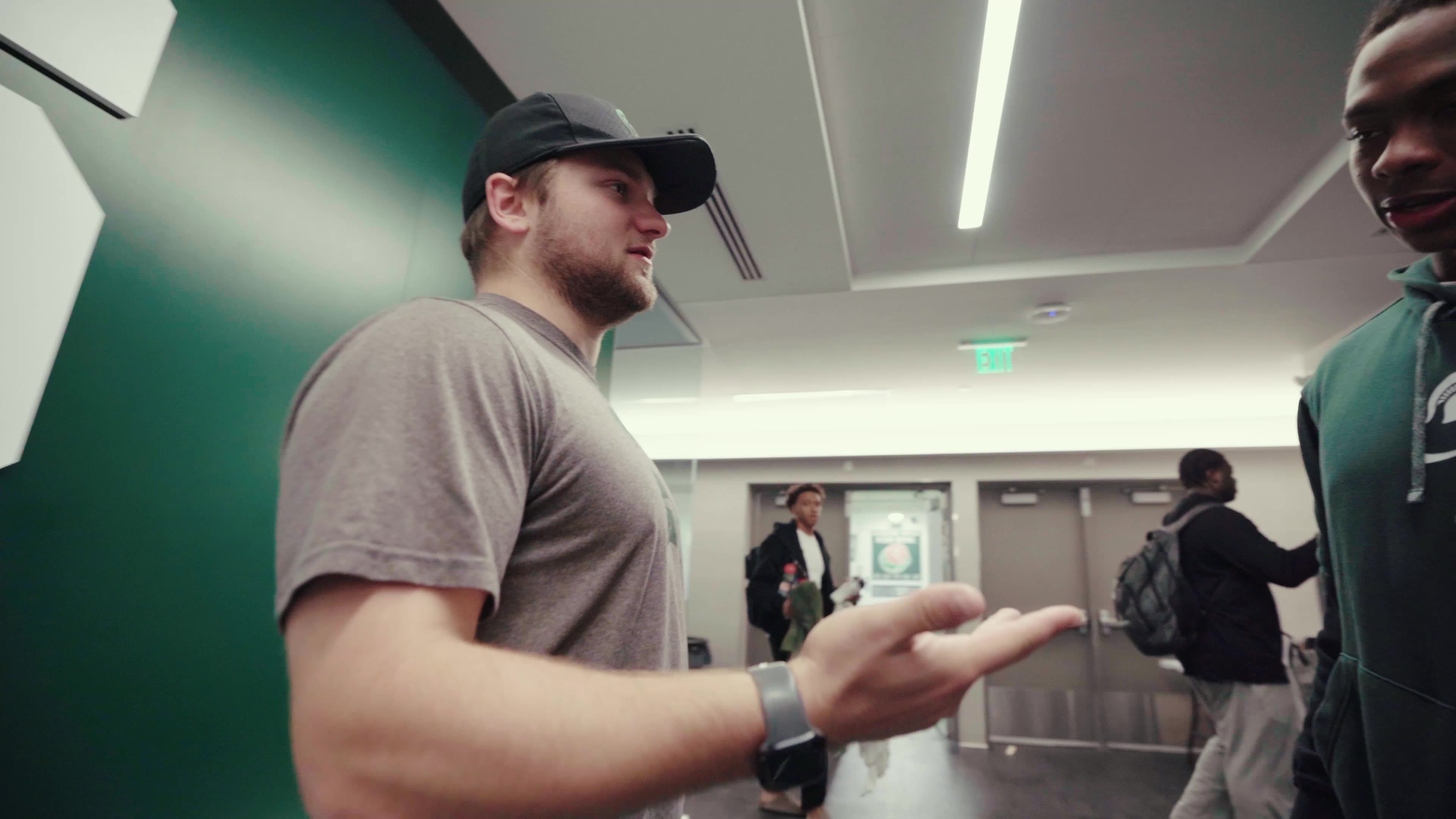
For first-year student equipment managers like Dionte Harris, his path to joining the equipment staff began after a high school injury altered his relationship with sports. Unable to continue competing the way he once had, he looked for another way to stay connected.
“That kind of led me into sports,” Harris said. “I still wanted to be around it and be a part of it in some way.”
It all begins on Sunday, barely after the last game has ended.
Each student manager is assigned a specific position group, which determines where they are on the field and who they work with.
“We all kind of get split up,” Harris said. “We all kind of have our different position groups we work with. I work with rush (defensive) ends.”
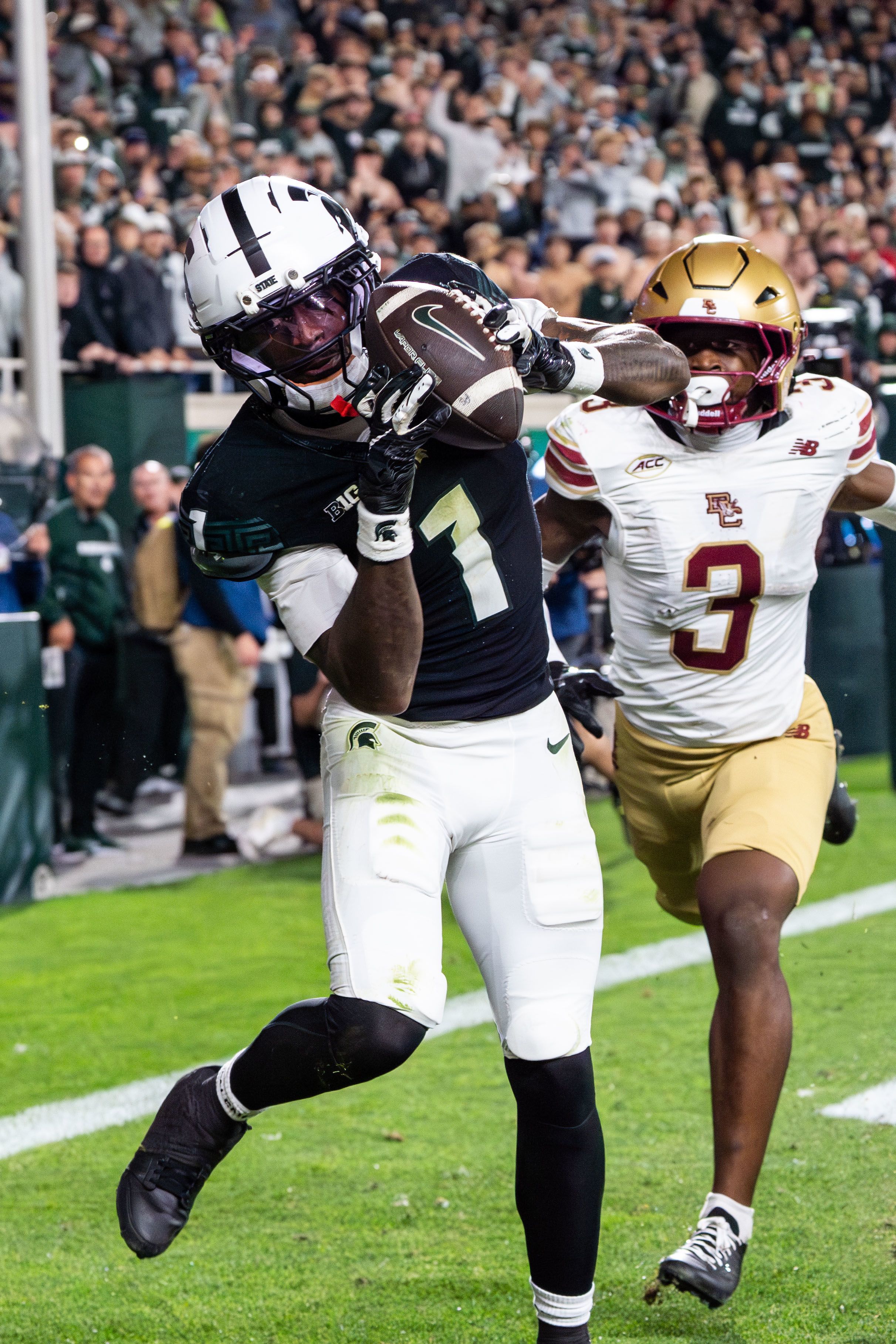
Caption: Michigan State wide receiver Omari Kelly (1) heads to his spot on the line before the snap against Boston College at Spartan Stadium on Sept. 6, 2025. Kelly scored the game-winning touchdown in double overtime.
Helmets and the communications systems are among the most important responsibilities handled by the equipment staff.
Helmets must be decaled, inspected, and fitted correctly, with padding and hardware adjusted to match player preferences and NCAA safety standards.
For Colby, helmet work is her favorite part of the job. “I would say for equipment room work, I definitely like working on helmets,” Colby said. “It’s just, it’s like an art. And I can be so precise with it. It takes a little longer to be precise with it, but knowing it’s even on both sides and symmetrical on both sides, and just knowing that that helmet is decaled perfectly.”

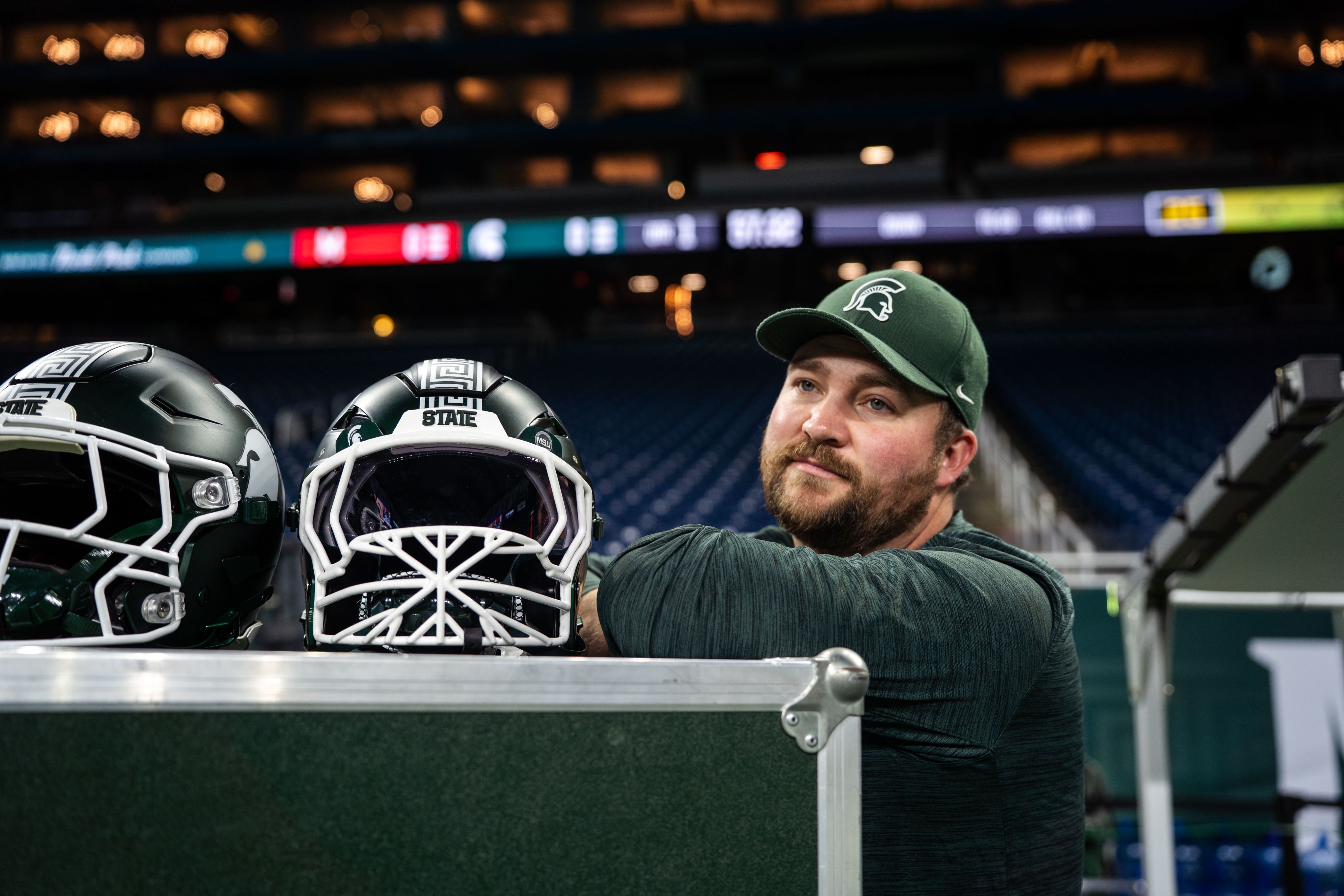
Equipment manager Jacob Crane watches warm ups before their game against University of Maryland at Ford Field on Nov. 29, 2025.
Equipment manager Jacob Crane watches warm ups before their game against University of Maryland at Ford Field on Nov. 29, 2025.
On game day, Jacob Crane, a full-time equipment staff member for Michigan State football, manages the Coach-to-Player (C2P) system, which enables players and coaches to communicate during games. This is the only way the coaches, defensive and offensive coordinators, can communicate with their players once they hit the field. Losing communication in the C2P system makes it tougher for teams to manage play calling during the game.
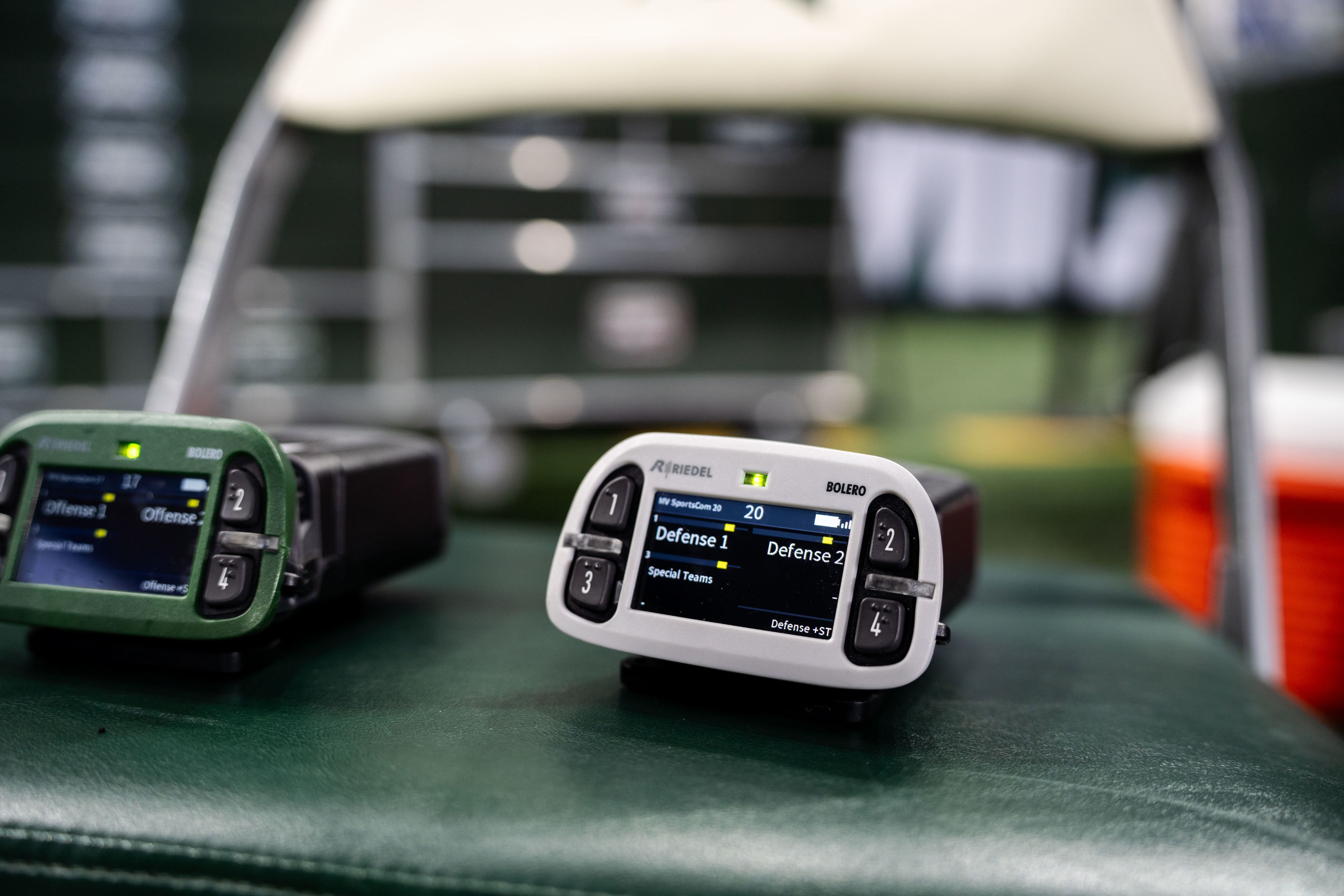
A MSU Coach-to-Player (C2P) communication system sits on a trainer's table along the sidelines before Michigan State's game at Ford Field on Nov. 29, 2025.
A MSU Coach-to-Player (C2P) communication system sits on a trainer's table along the sidelines before Michigan State's game at Ford Field on Nov. 29, 2025.
After games played on grass fields, one of the first priorities staff address is uniform treatment. Grass stains do not come out in a standard wash and must be treated by hand before the gear can be used again.
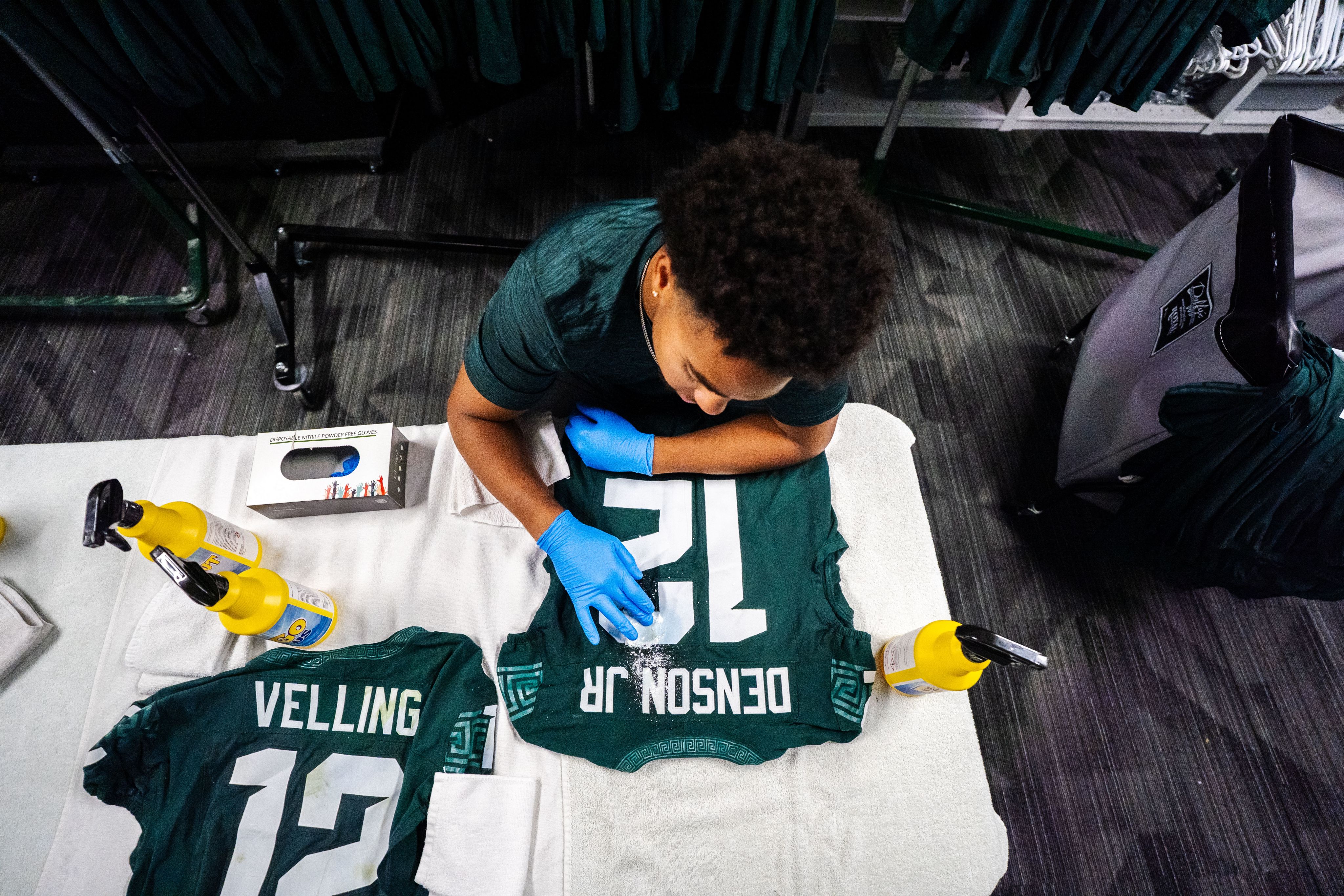
Dionte Harris treat stains on jerseys after a home game against Youngstown State at the Duffy Daugherty Football Building on Sept. 15, 2025.
Dionte Harris treat stains on jerseys after a home game against Youngstown State at the Duffy Daugherty Football Building on Sept. 15, 2025.
“You asked me earlier what my least favorite thing to do might be,” Dionte said. “It is probably stain treating. I think everybody here would say that. Stain treating can be a little annoying and a little frustrating, but it is one of those parts of the job that has to get done at the end of the day.”
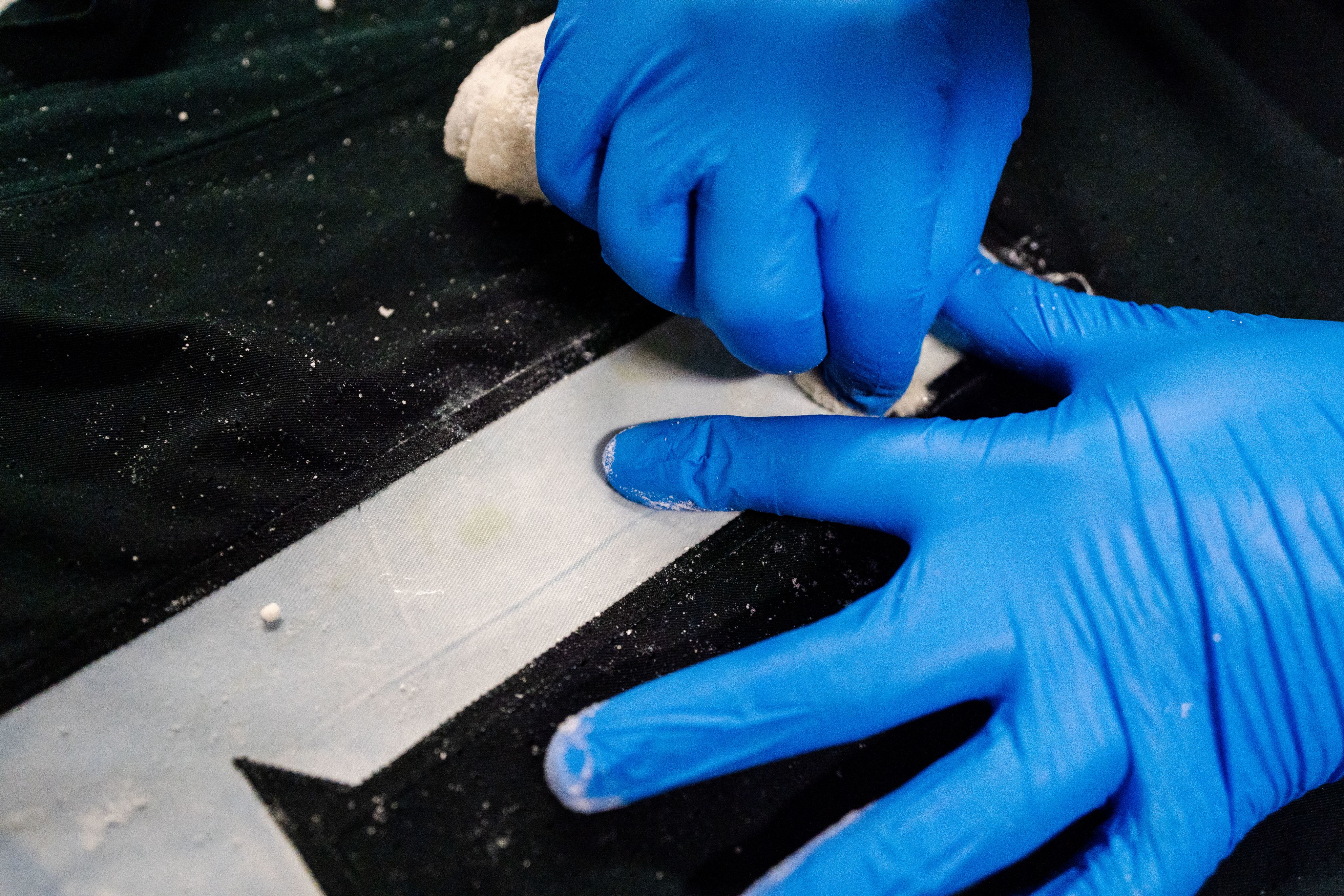
Dionte Harris treats stains on jerseys after a home game against Youngstown State at the Duffy Daugherty Football Building on Sept. 15, 2025.
Dionte Harris treats stains on jerseys after a home game against Youngstown State at the Duffy Daugherty Football Building on Sept. 15, 2025.
One of the most critical responsibilities the crew has is running practice.
Student managers arrive early to set up drills, move crash pads, distribute position-specific equipment, and prepare the field according to each coach’s plan.
“There’s a lot of moving parts,” Colby said. “We’re all doing something different, but we’re all making practice run smoothly.”
During practice, equipment managers run clocks, move gear between periods and adjust setups as drills change.
Practice does not always go as planned.
“Sometimes it’s hard,” Colby said. “Practice gets all crazy and we’re all flying around, and you still have to stay focused. You can’t get mad or upset. You just gotta keep going, keep going, keep going.”
They all have to keep trekking forward, even though they are busy, full-time Michigan State students. Most of their work happens between classes. Student managers juggle leaving the equipment room for lectures, then return to help finish tasks for the team.
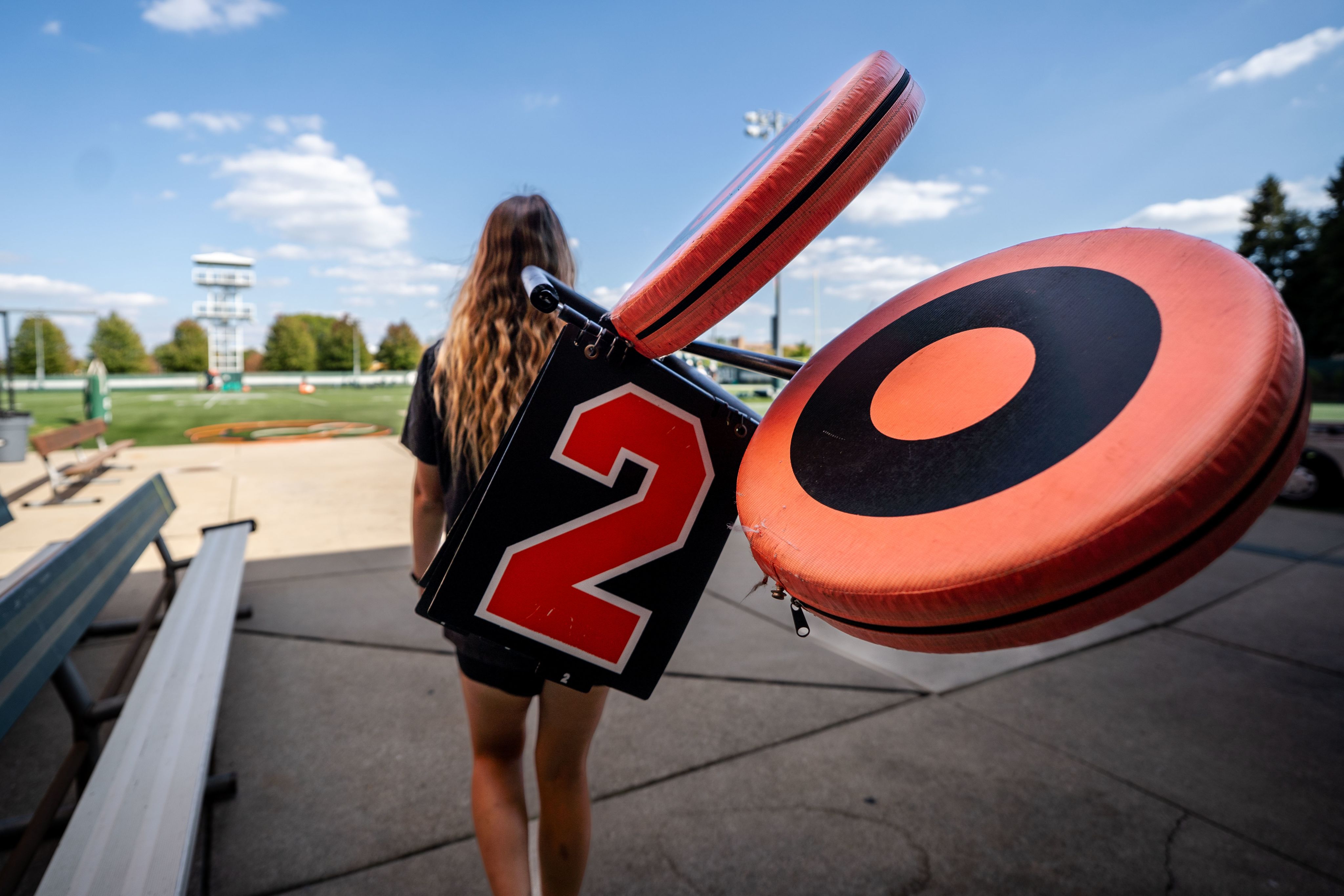
Emma Colby heads out to set up practice at the outdoor practice facility on Sept. 15, 2025.
Emma Colby heads out to set up practice at the outdoor practice facility on Sept. 15, 2025.
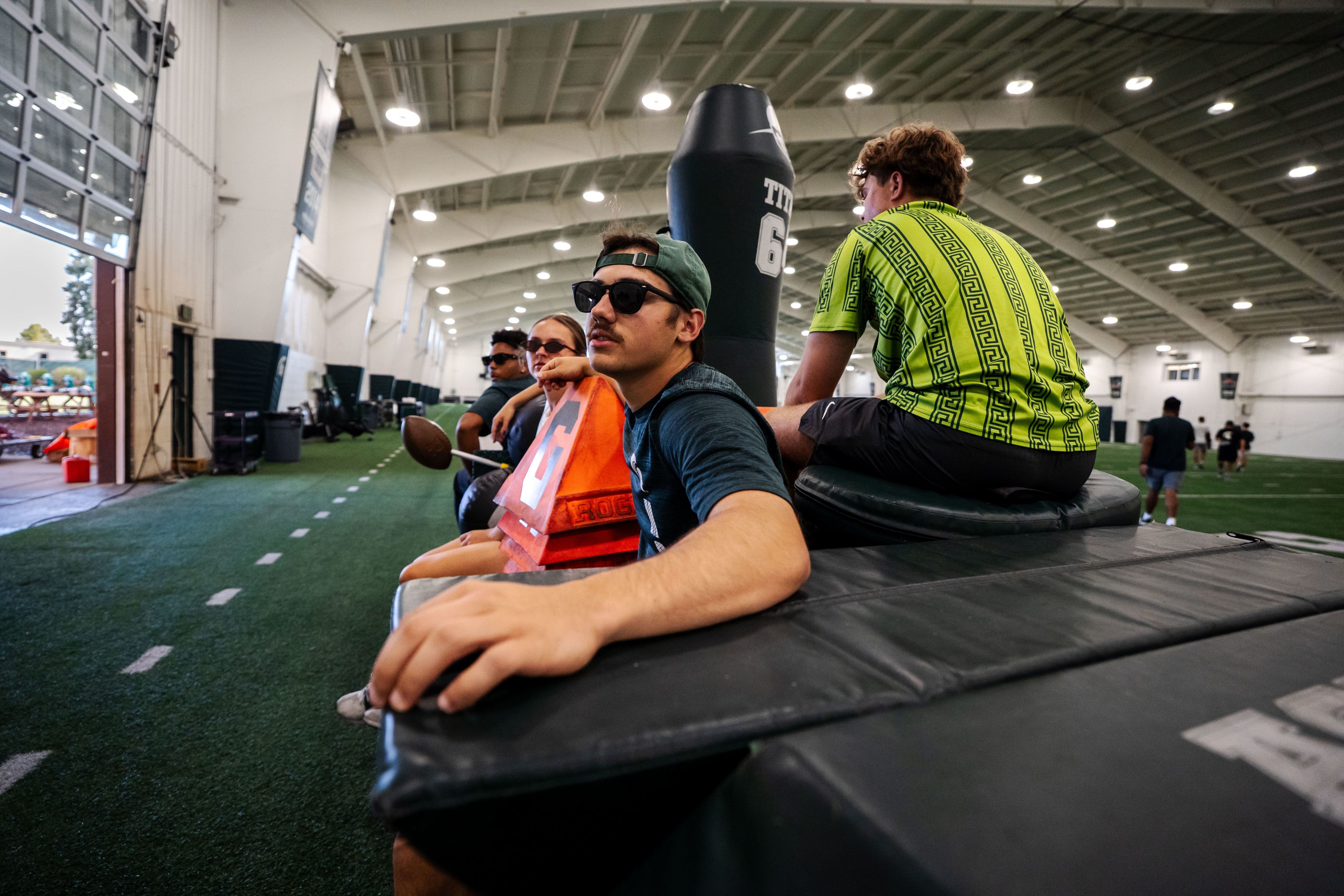
Student equipment managers Aidan Placer, Maggie Kirchmeier, Quin Scott and Dionte Harris head outside to set up practice at the Duffy Daugherty Building on Sept. 15, 2025.
Student equipment managers Aidan Placer, Maggie Kirchmeier, Quin Scott and Dionte Harris head outside to set up practice at the Duffy Daugherty Building on Sept. 15, 2025.
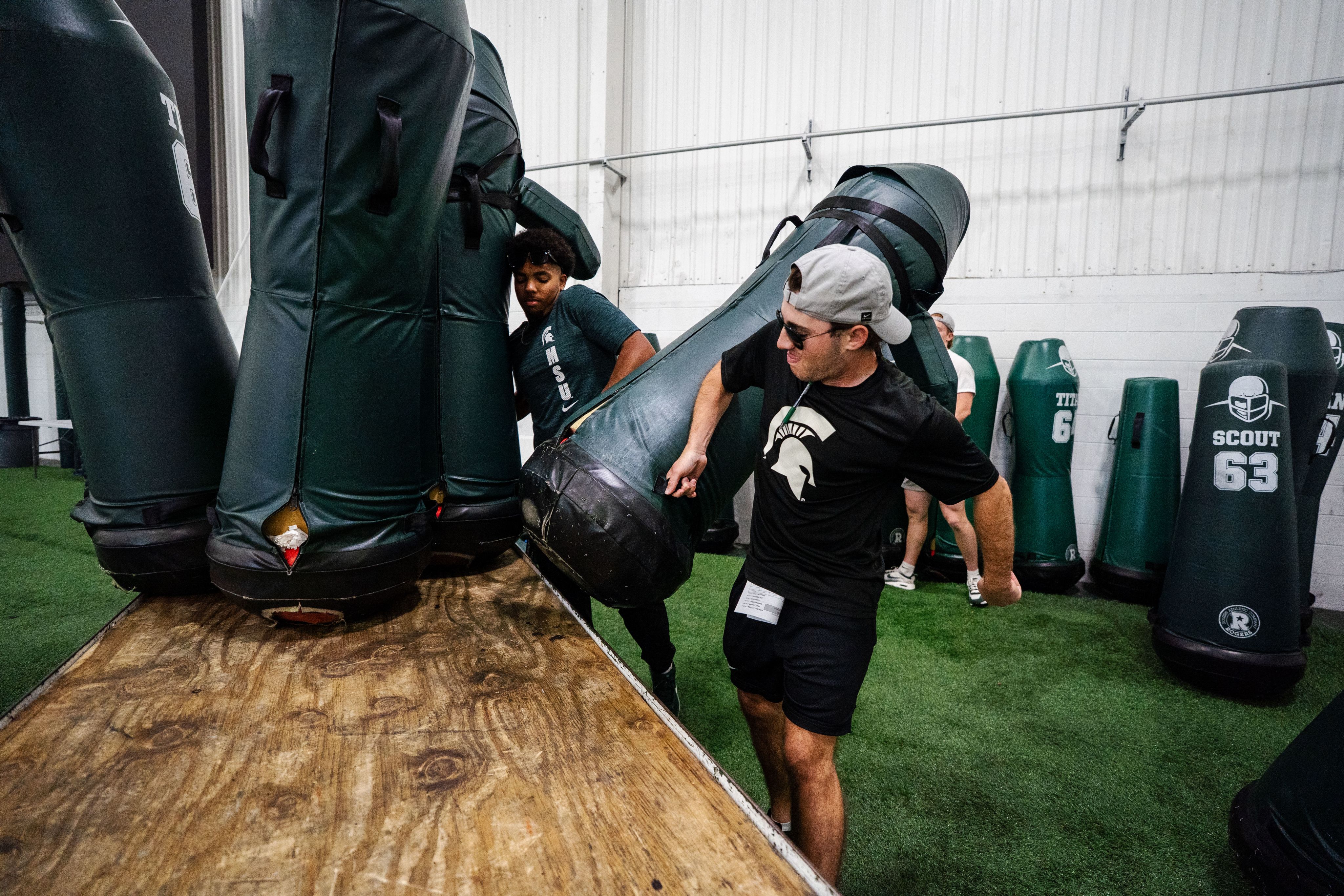
Student equipment managers Matt Bove and Dionte Harris load the cart with tackling dummies during practice at the Duffy Daugherty Building on Sept. 15, 2025.
Student equipment managers Matt Bove and Dionte Harris load the cart with tackling dummies during practice at the Duffy Daugherty Building on Sept. 15, 2025.
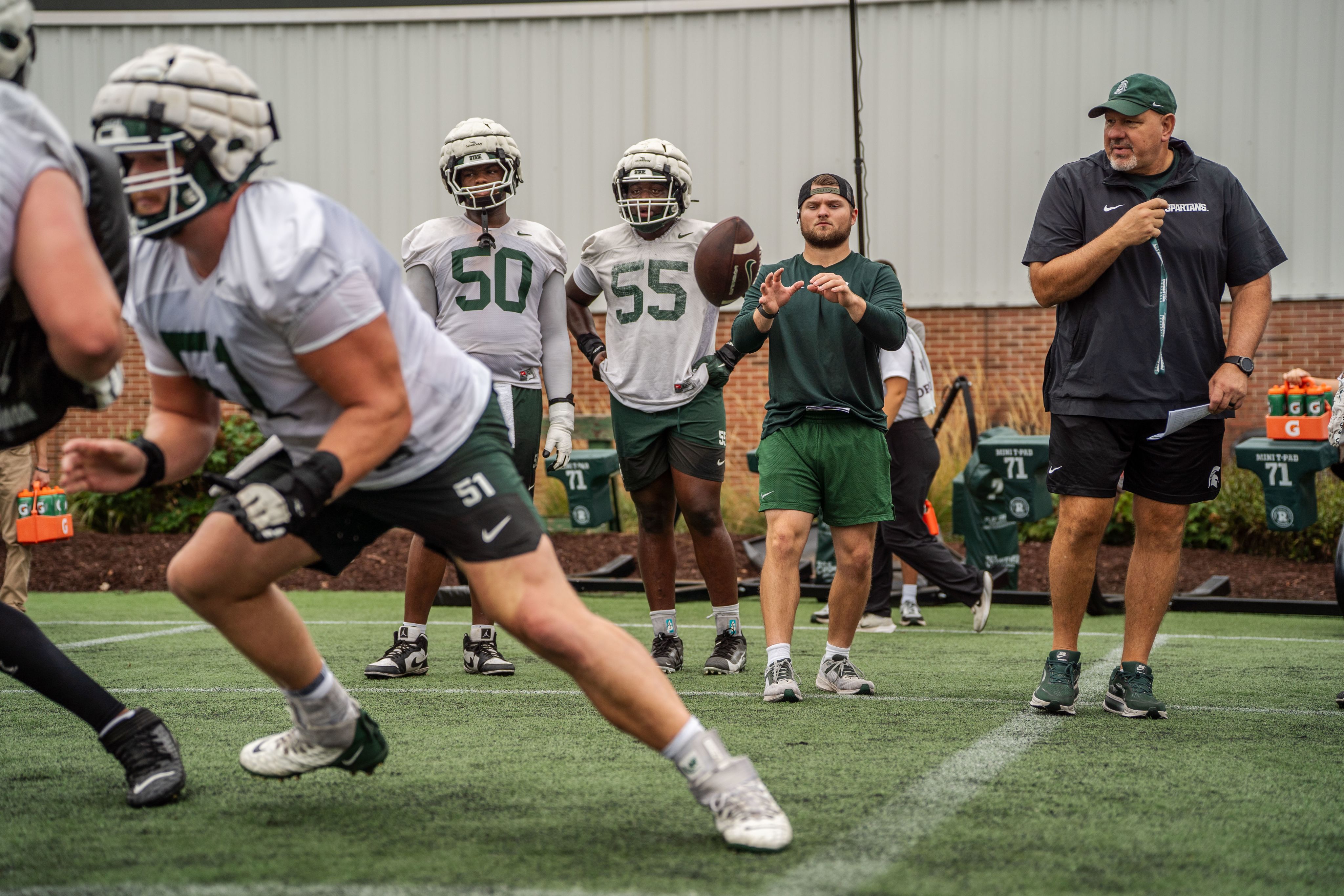
Student equipment manager Alex Zsigo helps run practice drills with coach Jim Michalczik and the linebackers at the outdoor practice facility on Sept. 24, 2025.
Student equipment manager Alex Zsigo helps run practice drills with coach Jim Michalczik and the linebackers at the outdoor practice facility on Sept. 24, 2025.
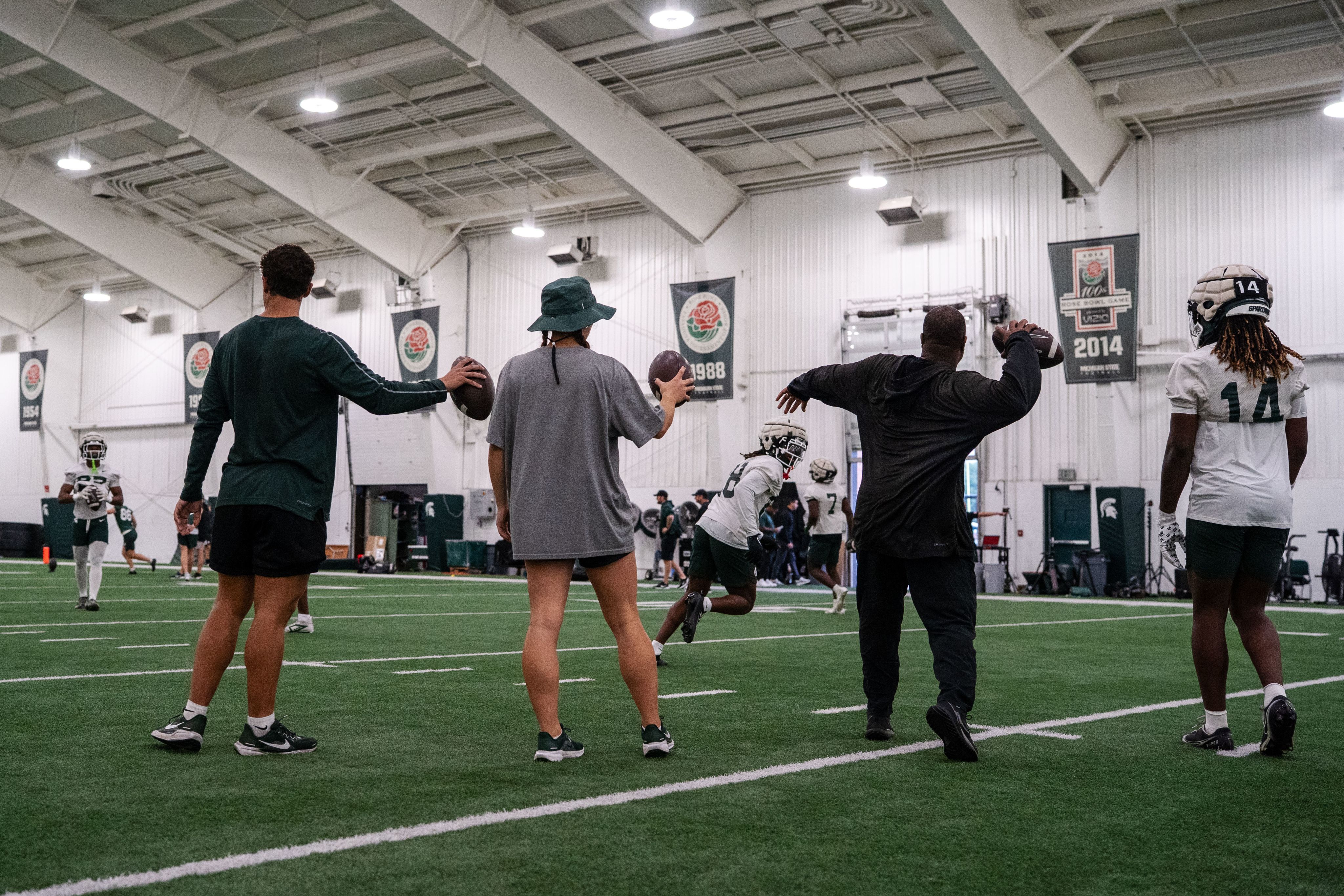
Student equipment manager Jack Fischer and Maggie Kirchmeier help run the running backs practice at the Duffy Daugherty Building on Sept. 24, 2025.
Student equipment manager Jack Fischer and Maggie Kirchmeier help run the running backs practice at the Duffy Daugherty Building on Sept. 24, 2025.
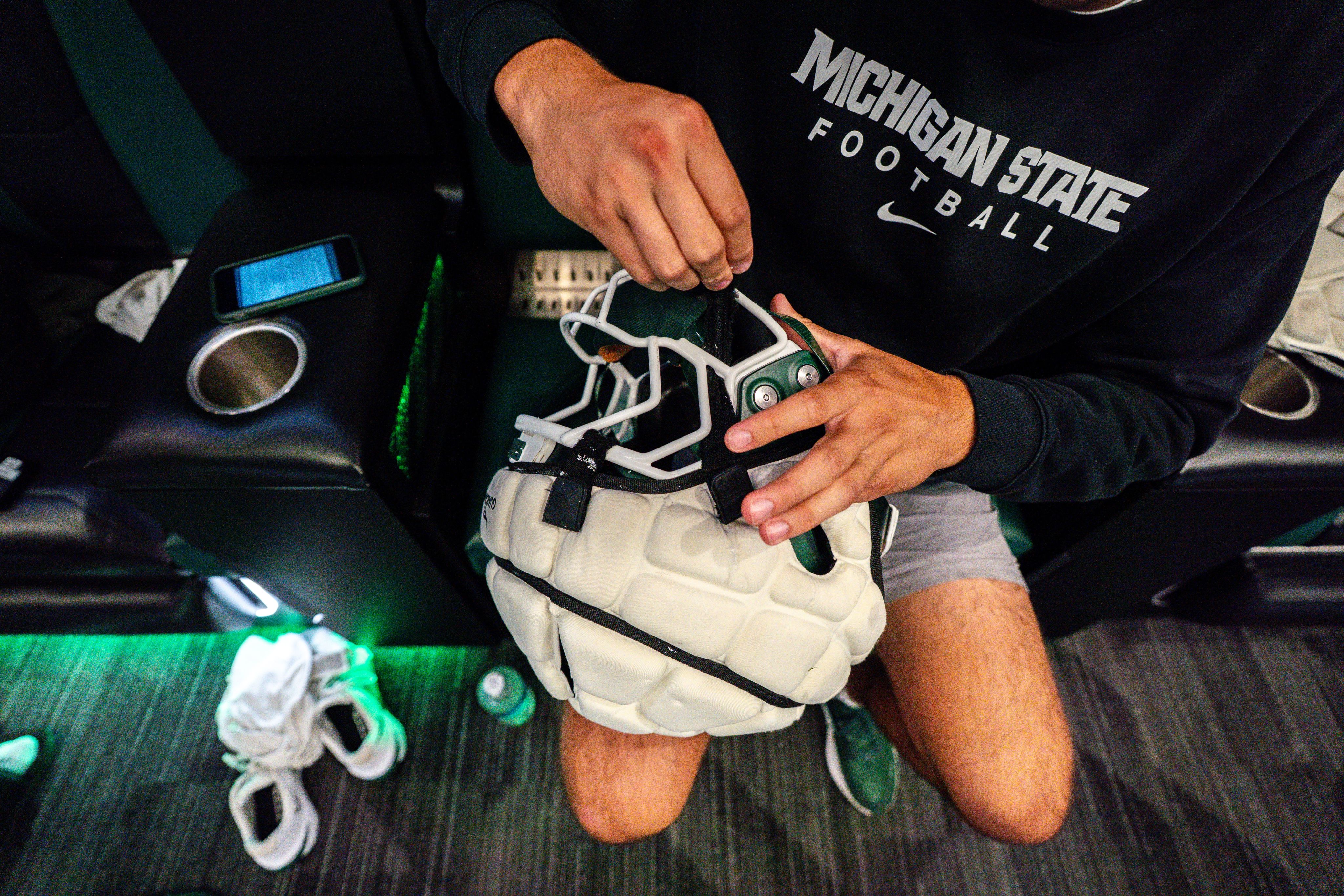
Student equipment manager Marek Beckering puts guardian caps on defensive line helmets before practice. Guardian caps are soft shell helmet covers designed to reduce head impact during practice and are required by the NCAA during certain preseason and contact periods to help limit the risk of head injuries.
Student equipment manager Marek Beckering puts guardian caps on defensive line helmets before practice. Guardian caps are soft shell helmet covers designed to reduce head impact during practice and are required by the NCAA during certain preseason and contact periods to help limit the risk of head injuries.
Before The Snap
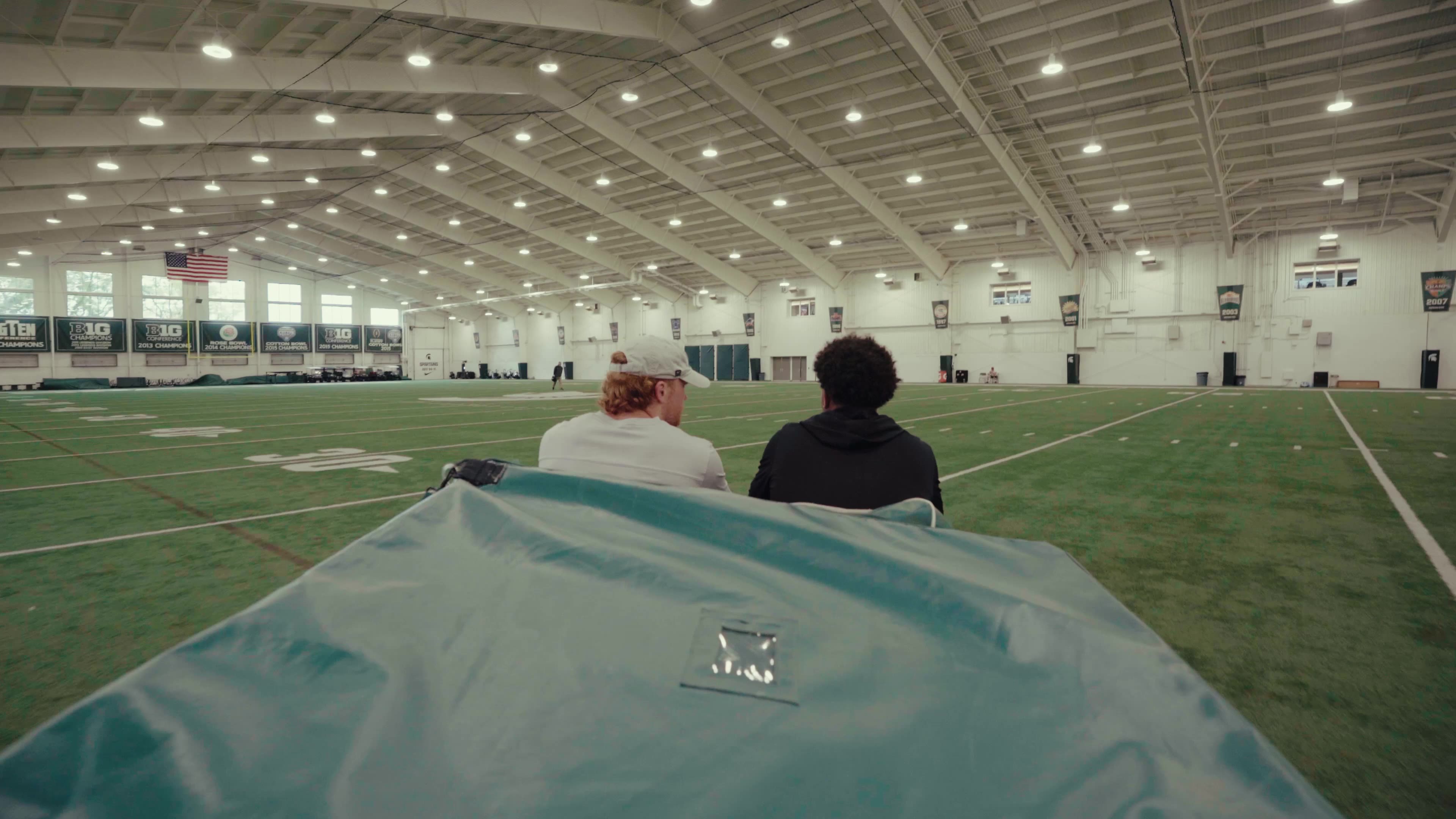

Over the course of a season, Michigan State football plays six or more away games, not including postseason travel. Each road game requires the program to recreate its home environment miles away from East Lansing.
At the center of that operation is Andrew Kolpacki, Michigan State’s head football equipment manager.

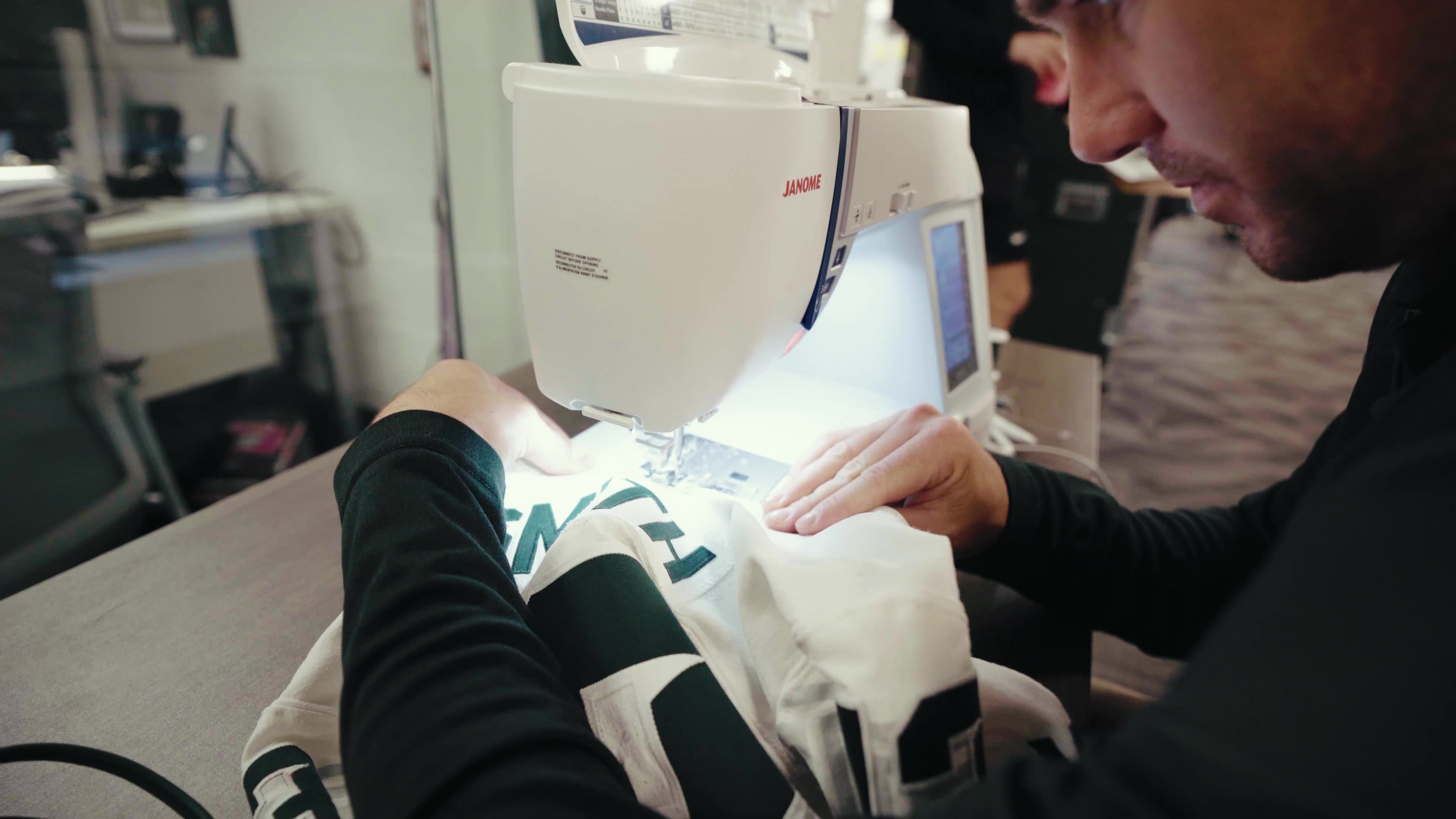

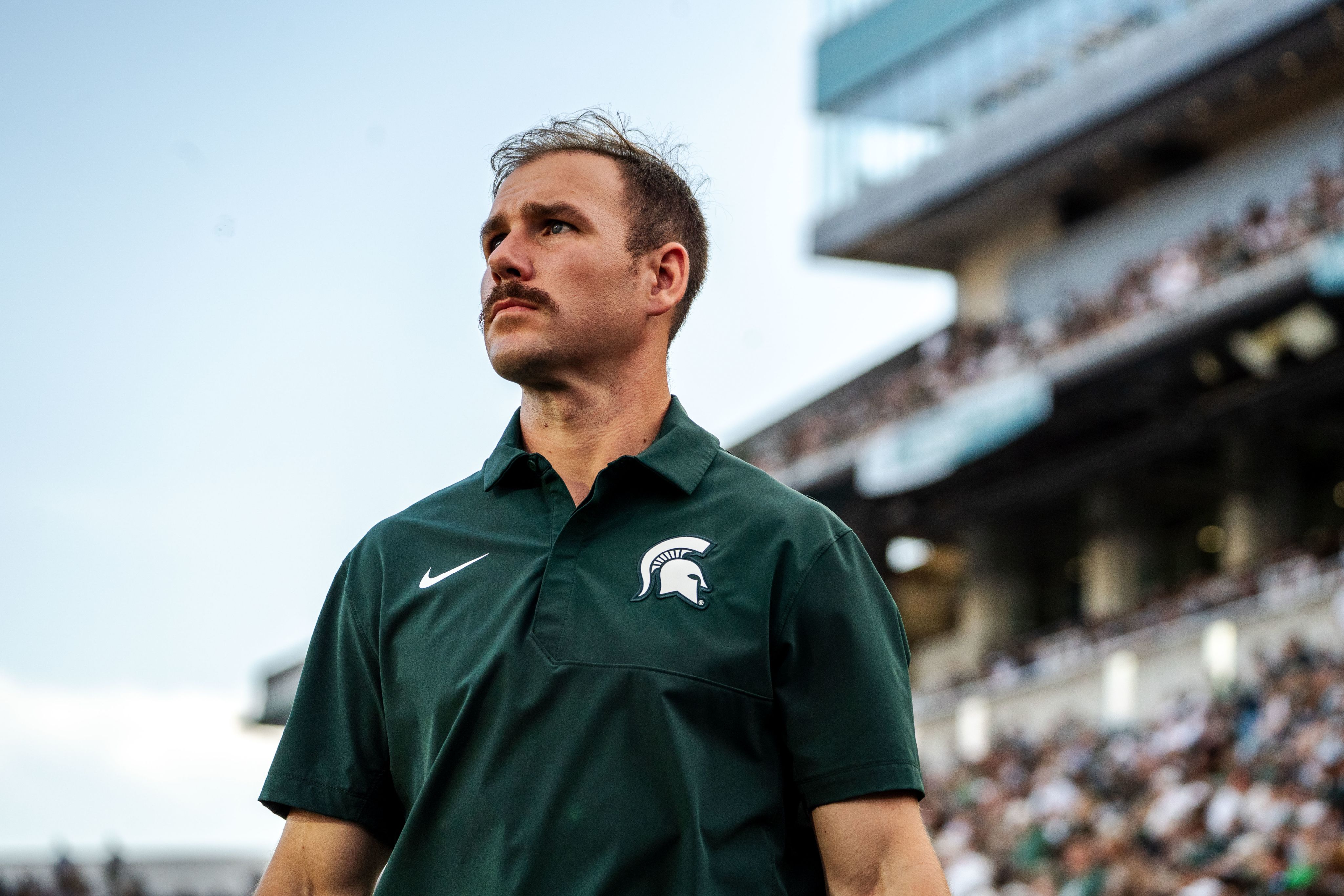

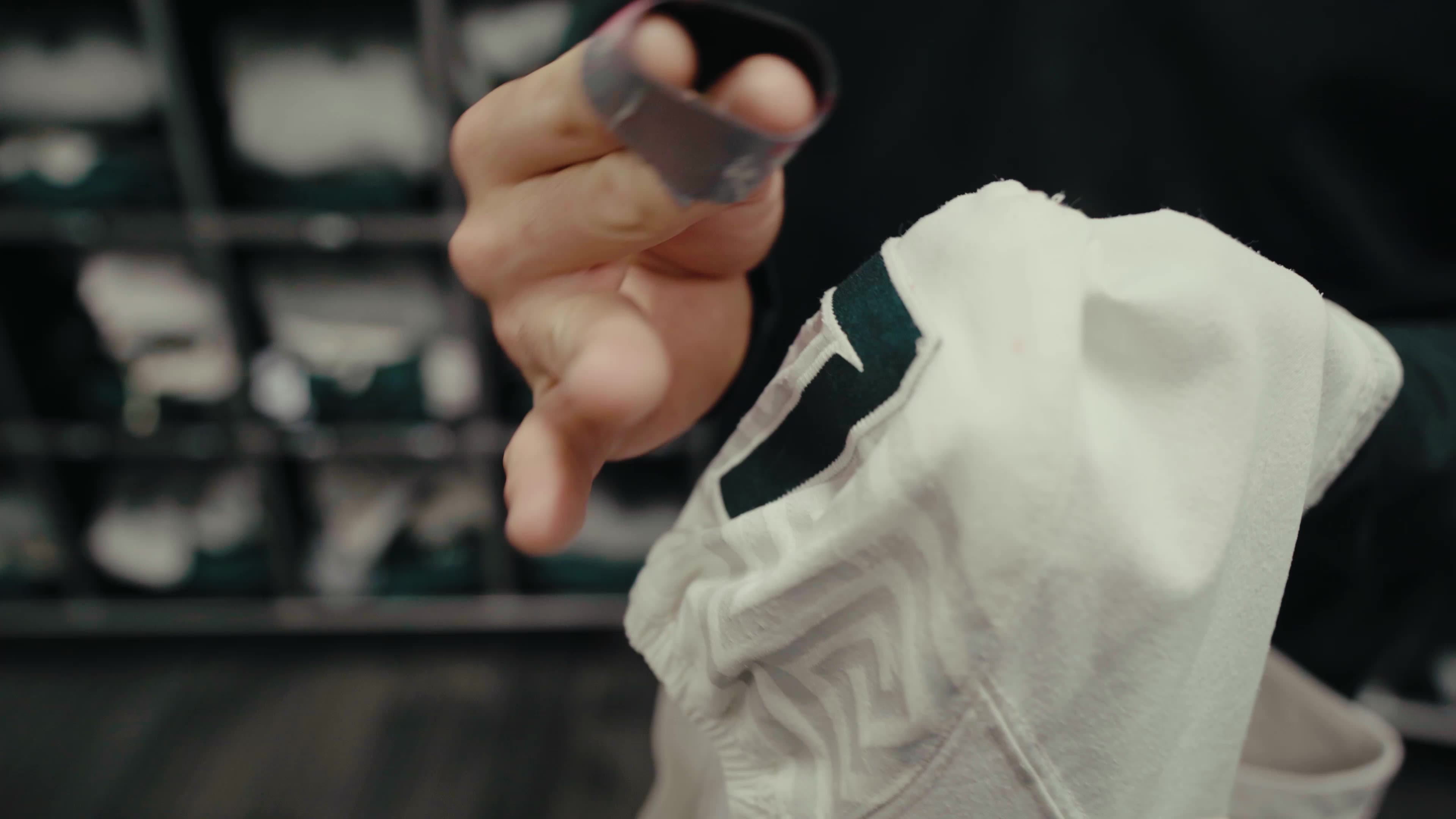

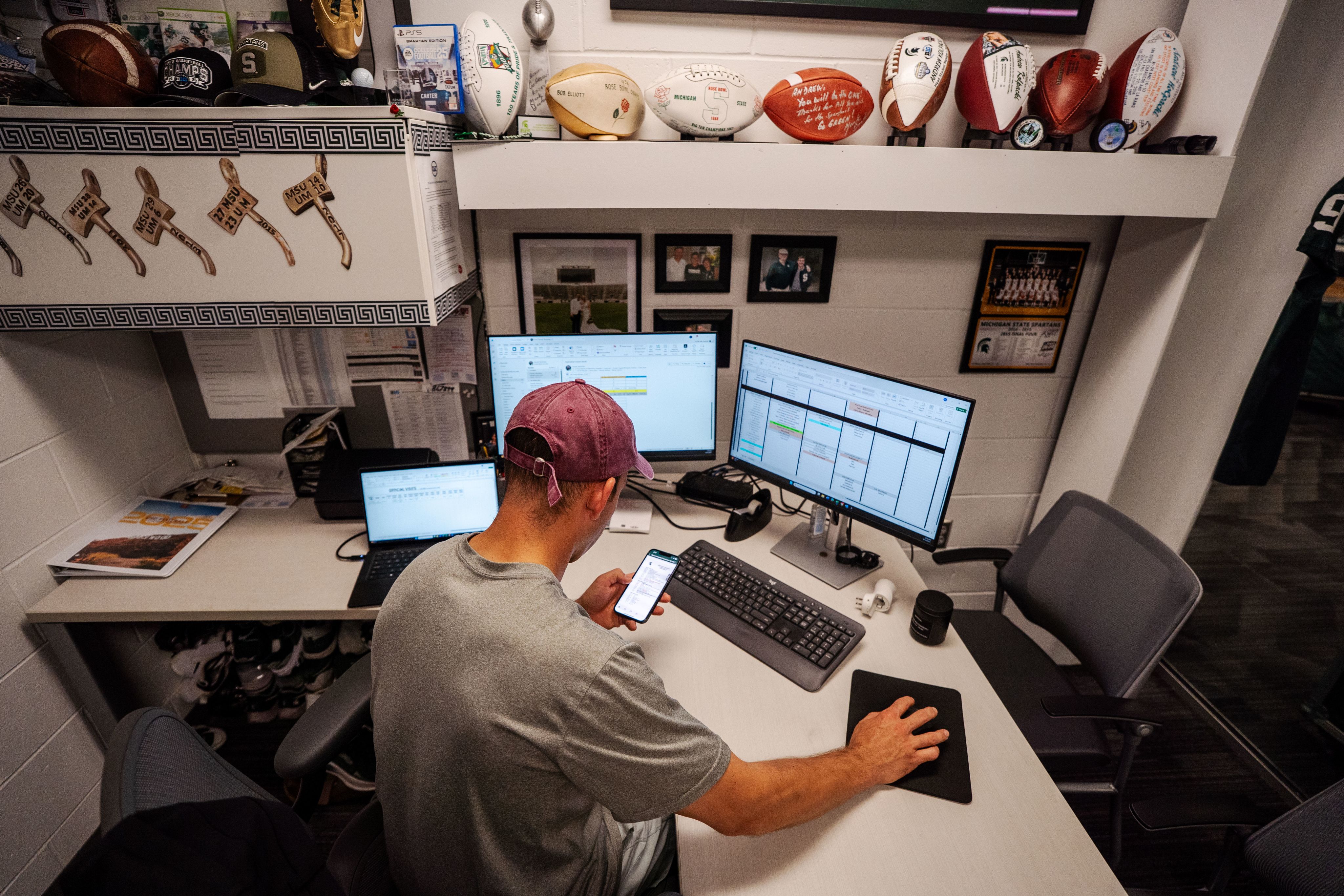

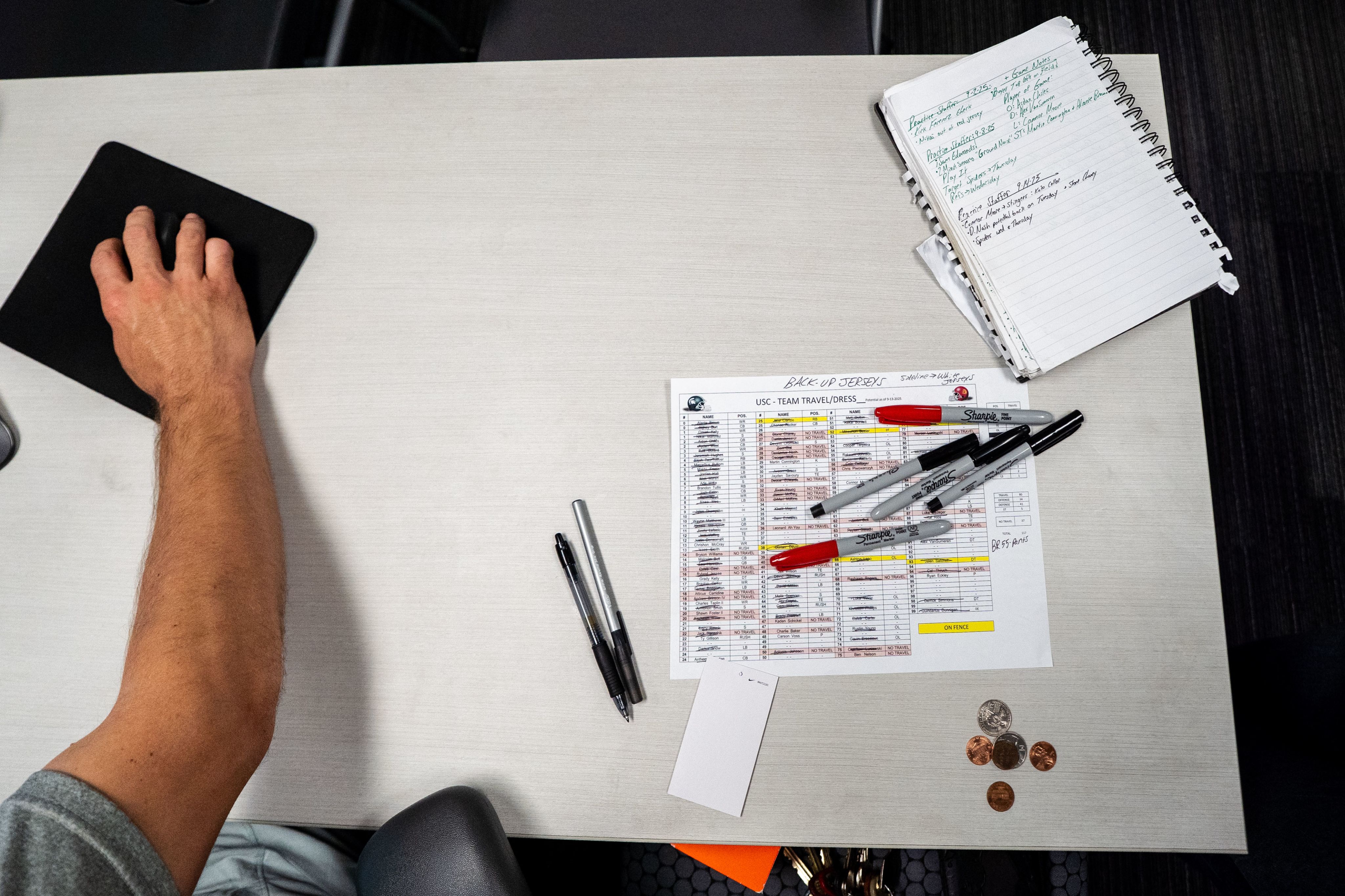
Kolpacki oversees every moving part, from daily logistics to long-term planning. What began as a student opportunity grew into a career built around preparation and problem solving. Along the way, he learned skills he never expected would be part of the job, including sewing and uniform repair.
“I didn’t come to Michigan State thinking this was what I was going to do,” Kolpacki said. “I just wanted to be part of a team.”
“There’s really no day that’s the same as the last,” Kolpacki said. “You can try to plan everything out, but something always changes, and you have to be ready to react.”
For Kolpacki, success is defined by what goes unnoticed.
“If we’re not noticed, that’s a good day,” he said. “That means the players and coaches were able to focus on what they needed to do.”
That responsibility becomes more visible during travel weeks.
The Path of the Season
USC (Week 4 – Sept. 20, 2025)
The longest trip of the season begins with a 4,500-mile journey to Los Angeles, which requires equipment to be packed nearly a week before the team ever boards the plane.

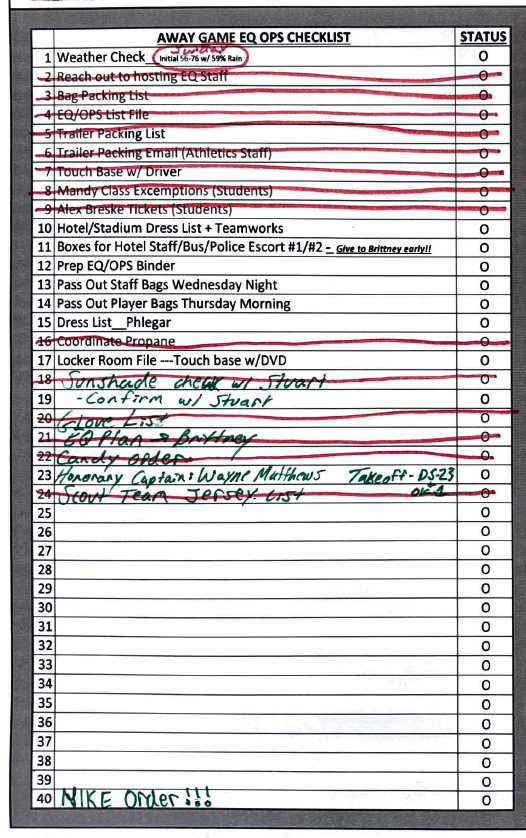
Depending on where the Spartans are headed dictates what goes into the equipment trunks and how it is organized. “That’s one of the other fun things I do,” Kolpacki says. “Making sure for whether it’s a road game outdoors later in the season or we’re going to L.A. for an early season game with warm weather, how that changes how we pack.” The truck, carrying upward of 20,000 pounds of equipment, does not head straight to the stadium. Instead, it meets the team at the hotel first, unloading and setting up temporary workspaces before shifting to Los Angeles Memorial Coliseum.
For trips like USC, members of the equipment staff arrive days ahead of the team, building an environment that feels familiar before the team arrives.
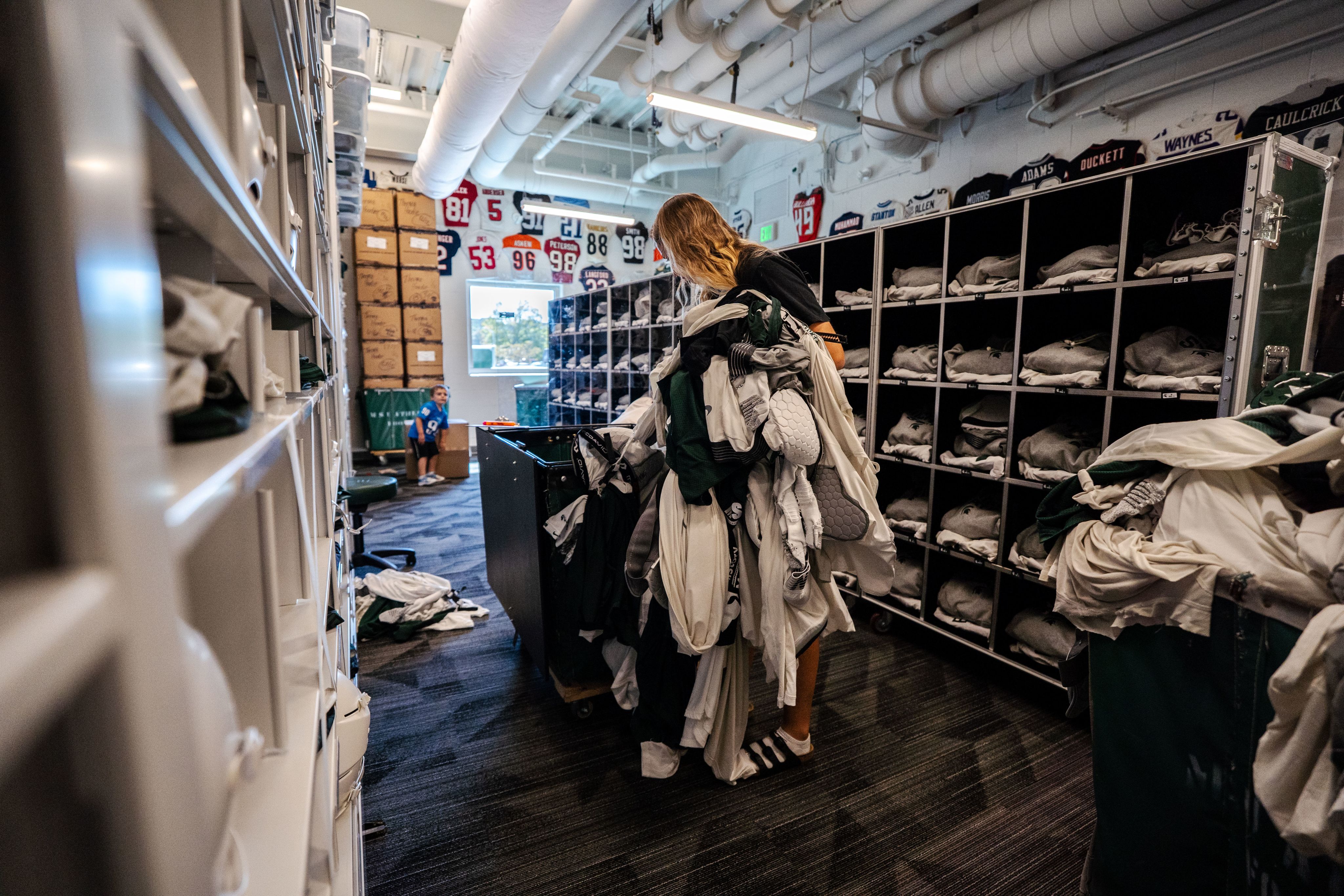
Emma Colby, sorts pregame uniform loops while preparing for Michigan State’s trip to USC on Sept. 15, 2025. She places each piece of clothing on players’ loops, tracks missing items and organizes them into the proper cubbies.
Emma Colby, sorts pregame uniform loops while preparing for Michigan State’s trip to USC on Sept. 15, 2025. She places each piece of clothing on players’ loops, tracks missing items and organizes them into the proper cubbies.
Nebraska (Week 6 – Oct. 4, 2025)
By October, preparation begins to shift with the season. The 1,800-mile round trip to Lincoln, Nebraska, introduces colder weather and longer game days, changing how trunks are packed and staged. Equipment staff load and depart on Thursday, arriving ahead of the team to unload hotel essentials and set up Memorial Stadium.
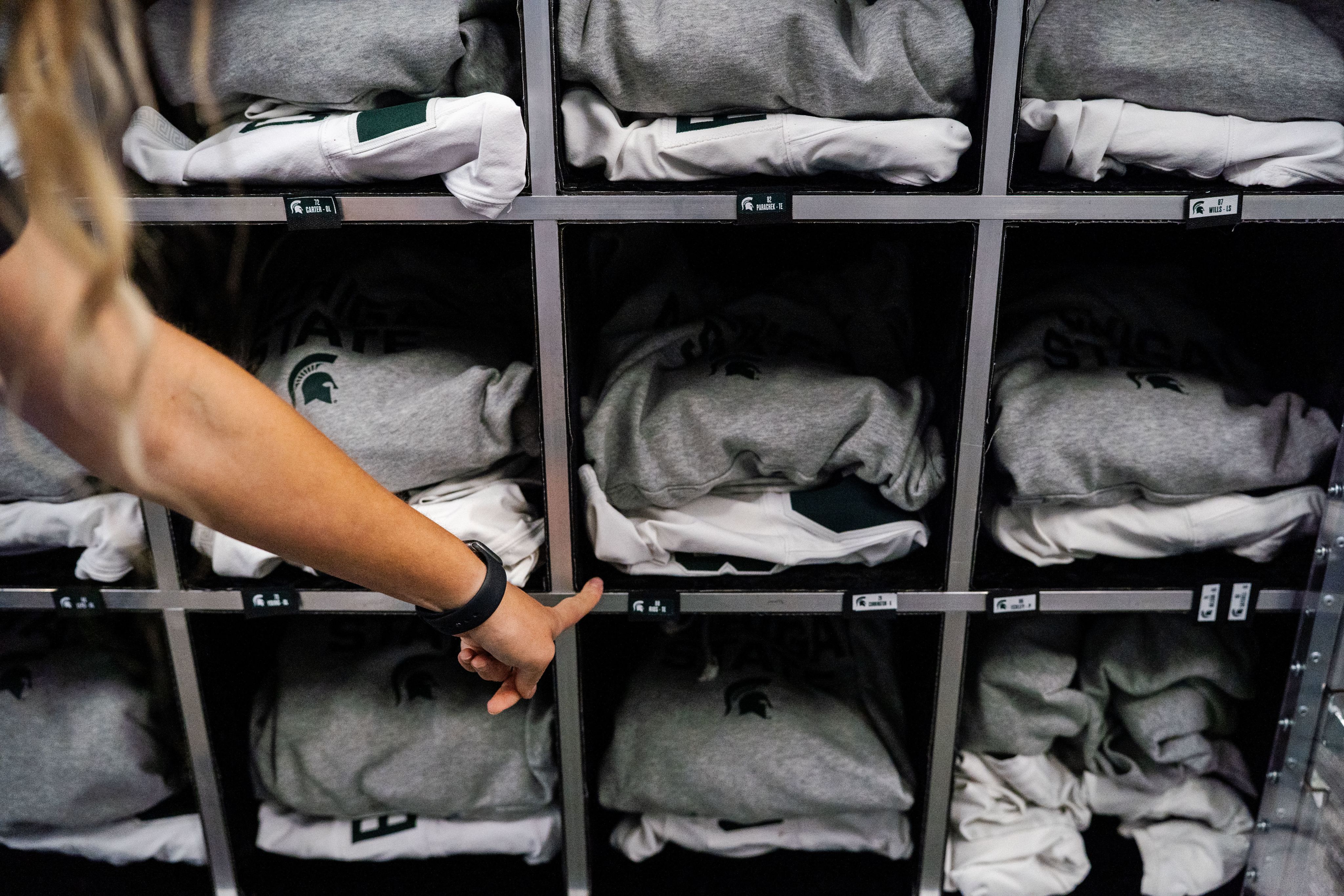
Student equipment manager Emma Colby packs pregame uniforms for the game against USC in the equipment room on Sept. 15, 2025.
Student equipment manager Emma Colby packs pregame uniforms for the game against USC in the equipment room on Sept. 15, 2025.
Kolpacki says the focus remains on anticipation. “If you’re not efficient with your time and knowing what to plan for, you could be behind the eight ball,” he said.
Indiana (Week 8 – Oct. 18, 2025)
Just because a trip is shorter doesn't mean it's more simple. The 620-mile journey to Indiana follows the same deliberate rhythm, with the truck departing on Thursday and meeting the team at the hotel on Friday before moving to the stadium.
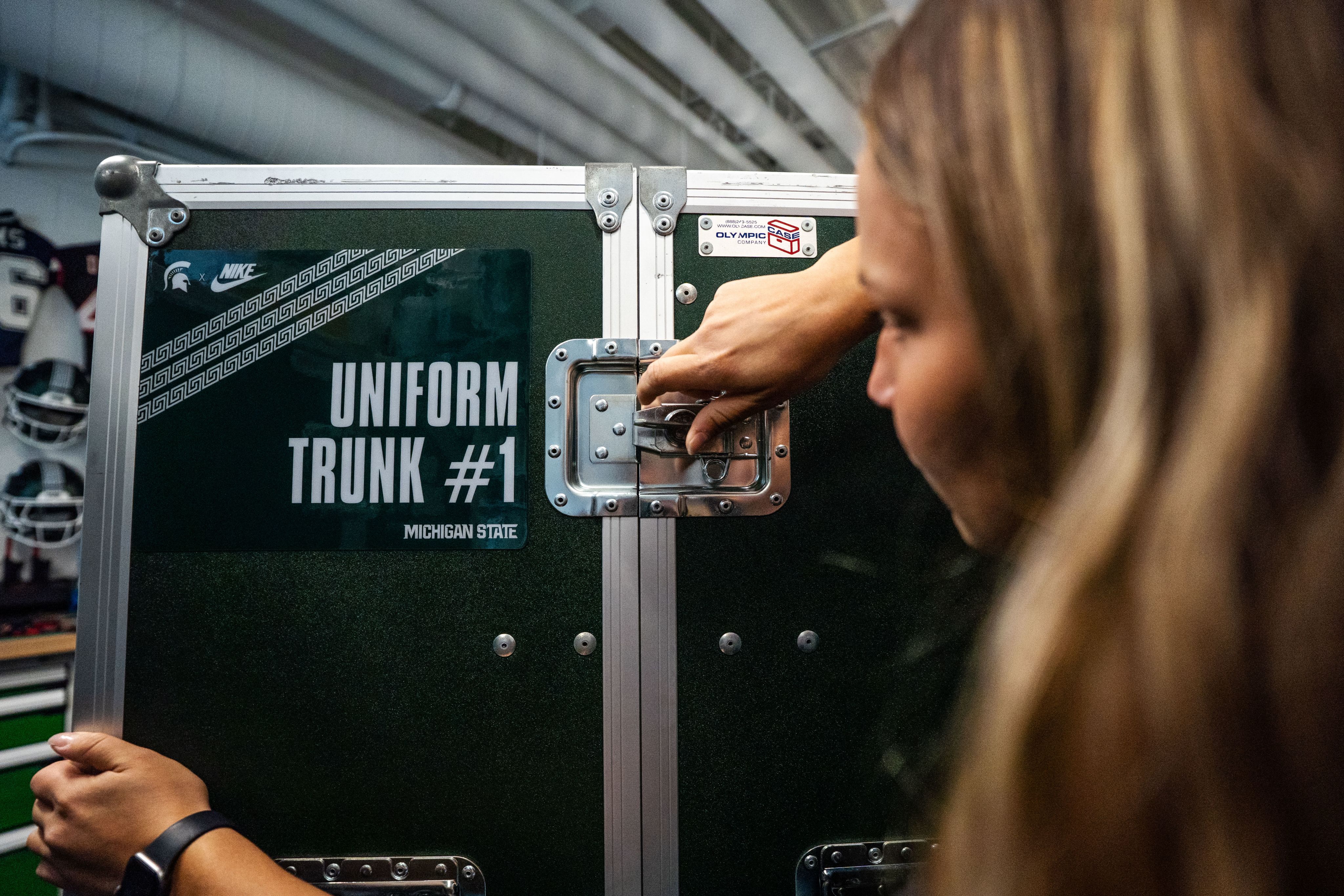
Emma Colby seals one of the uniform trunks for Michigan State’s game against USC in the equipment room on Sept. 15, 2025.
Emma Colby seals one of the uniform trunks for Michigan State’s game against USC in the equipment room on Sept. 15, 2025.
“They not only just drive right from here to the stadium,” Kolpacki said. “They meet us at the hotel. We do unloading at the hotel. Then they go from the hotel to the stadium after that.” The goal is consistency. Meetings, walkthroughs, and routines are designed to feel identical to home, even when they are built inside unfamiliar walls.

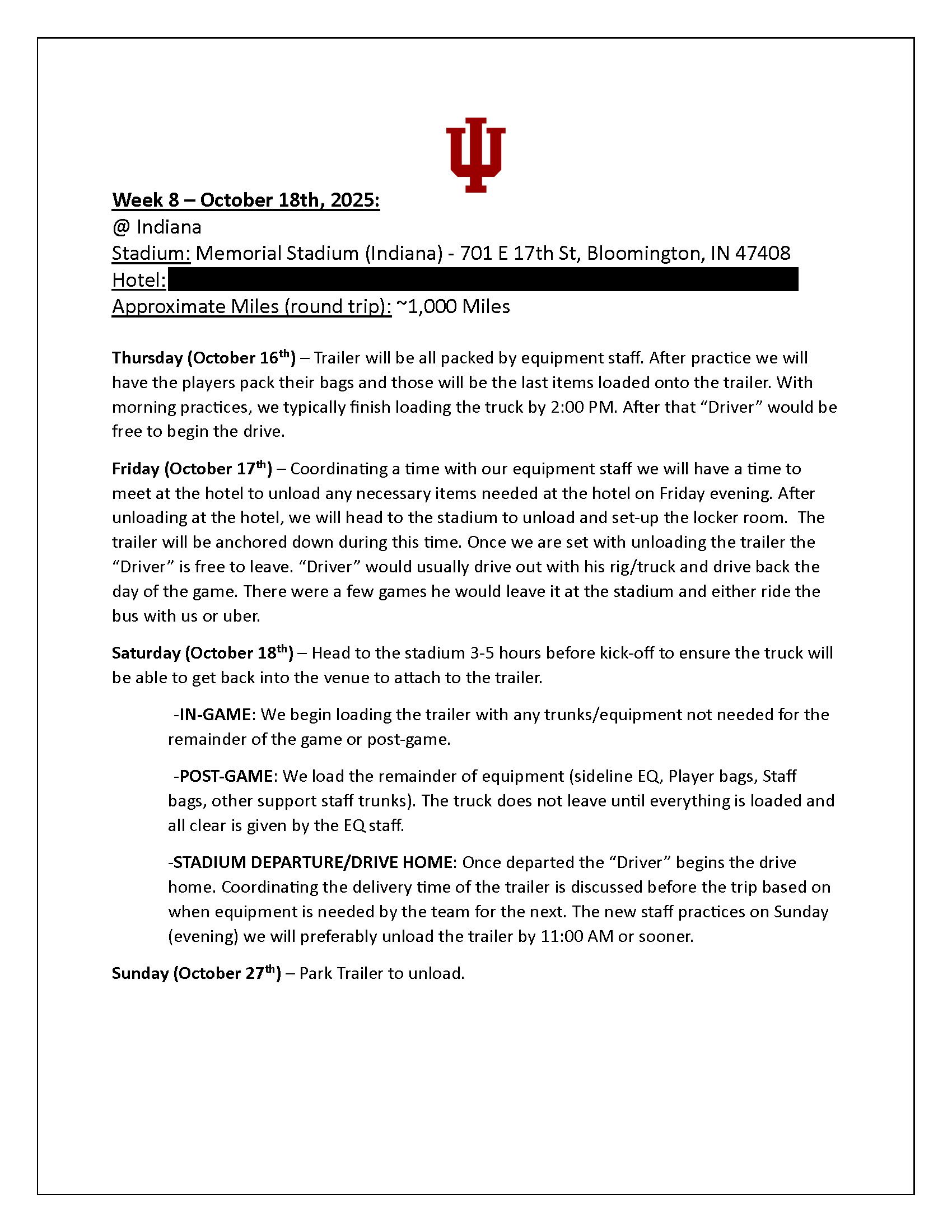
An example of a Truck Transportation memo issued by Kolpacki and his team.
An example of a Truck Transportation memo issued by Kolpacki and his team.
Minnesota (Week 10 – Nov. 1, 2025)
As November approaches, the weather becomes an even more unpredictable element. The 1,600-mile trip to Minneapolis requires packing for late-season conditions and accounting for every variable ahead of time.
Equipment staff arrive early to prepare hotel and stadium spaces, anchoring the trailer until game day. During the game, Kolpacki is not watching the scoreboard. “We’re kind of watching the actual equipment and how it’s performing,” he said. By halftime, loading has already begun, ensuring the overnight drive back to East Lansing can start as soon as the scoreboard clock hits 00:00.
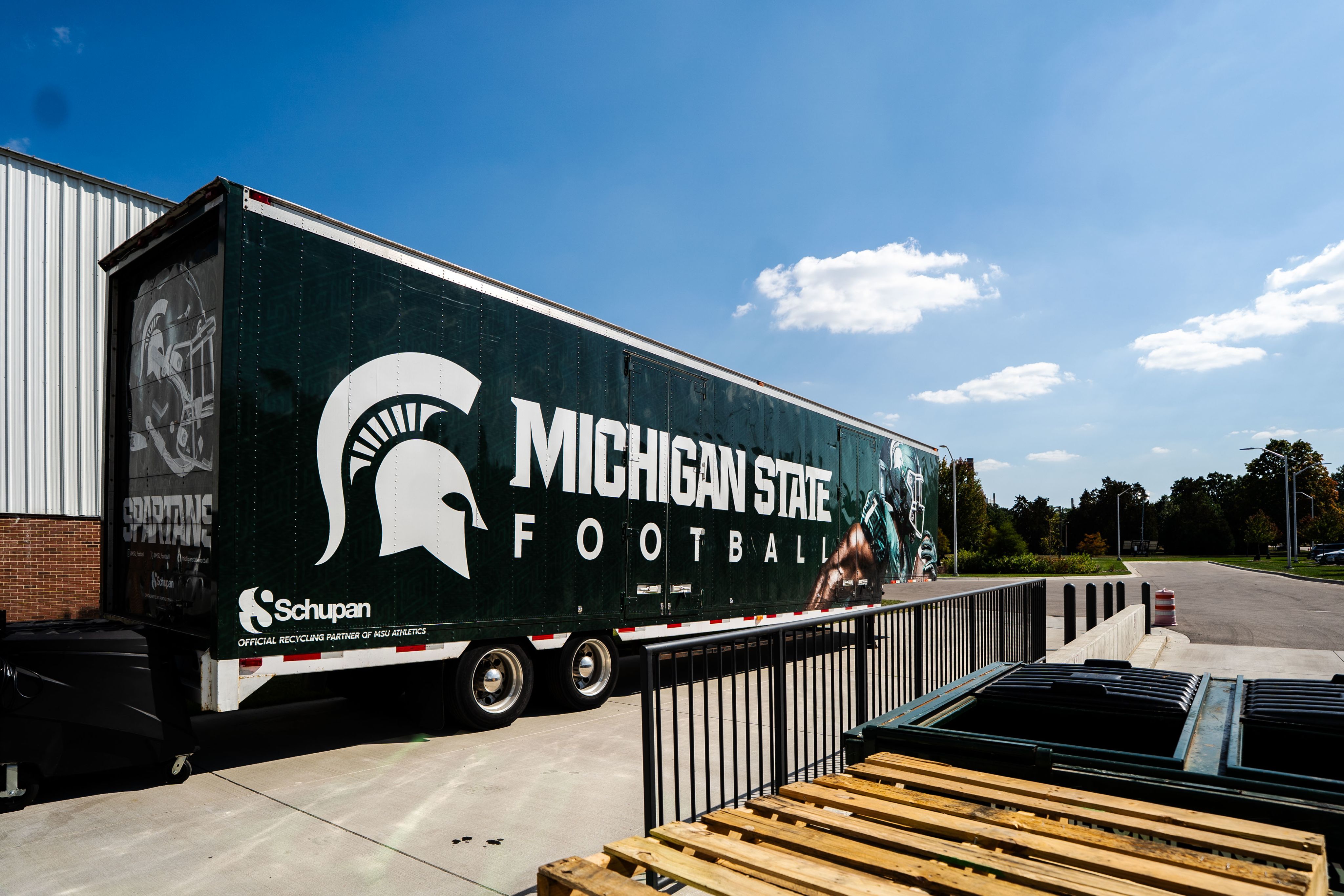
The Michigan State Football equipment truck sits loaded outside the football building before their upcoming game against USC on Sept. 15, 2025.
The Michigan State Football equipment truck sits loaded outside the football building before their upcoming game against USC on Sept. 15, 2025.
Iowa (Week 13 – Nov. 22, 2025)
The final 856-mile road trip of the regular season mirrors months of repetition and refinement. Cold-weather gear is packed on Thursday, and staff arrive early to prepare Kinnick Stadium and the team hotel. By the time players arrive, the infrastructure is already built.
“So when the team gets there, there’s no unnecessary distractions,” Kolpacki said. “Where they’re like, ‘Oh, where’s our meeting room?’ None of that.” After the game, equipment is loaded one last time on the road, and the truck pulls away overnight, carrying thousands of pounds of gear and a season’s worth of invisible preparation.
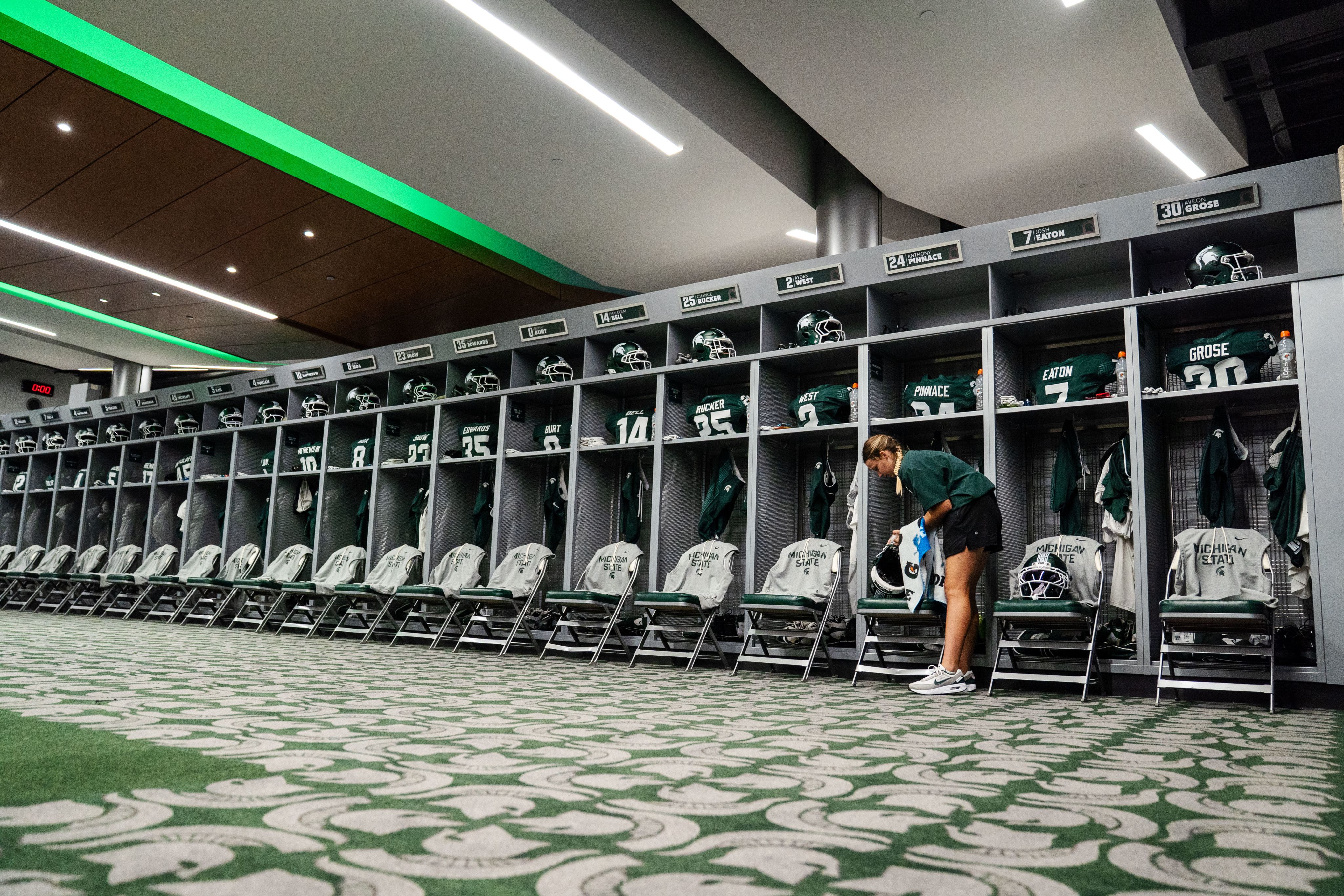
Emma Colby finishes wiping down helmet visors before Michigan State's game against Youngstown State in the Spartan Stadium home locker room on Sept. 13, 2025.
Emma Colby finishes wiping down helmet visors before Michigan State's game against Youngstown State in the Spartan Stadium home locker room on Sept. 13, 2025.
Game Day

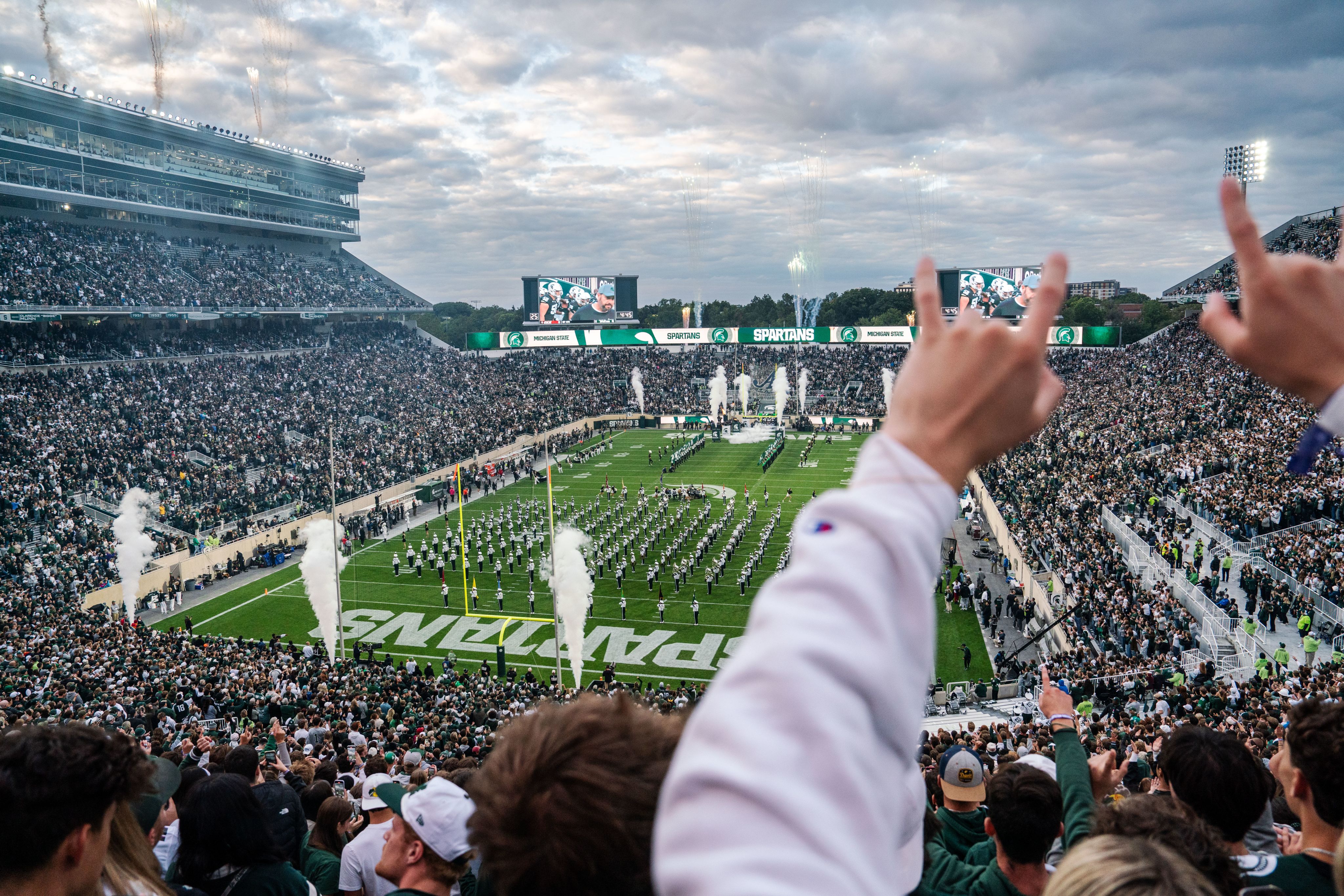
Game day arrives, the stage is set, and it is time for the actors to hit the stage.
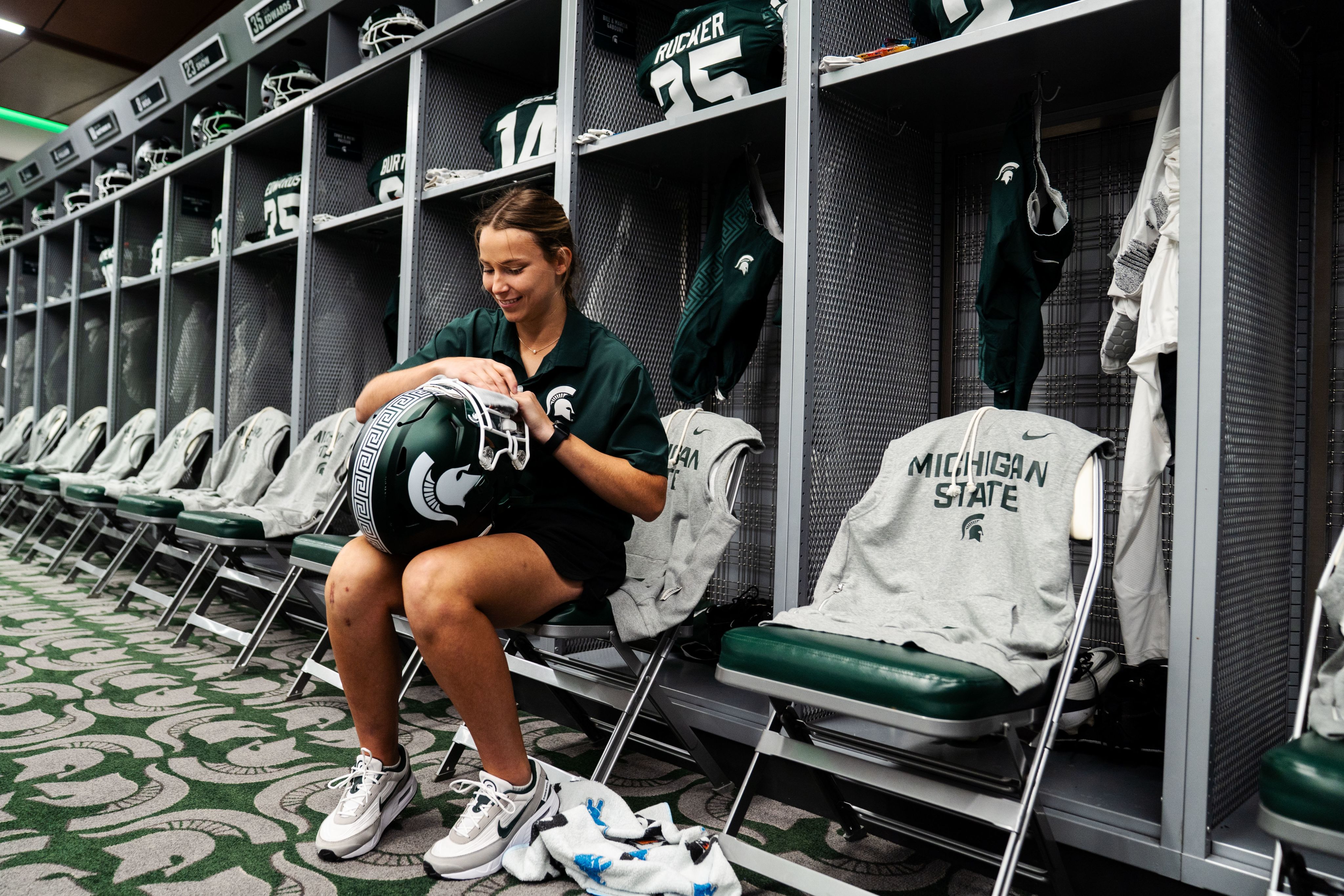
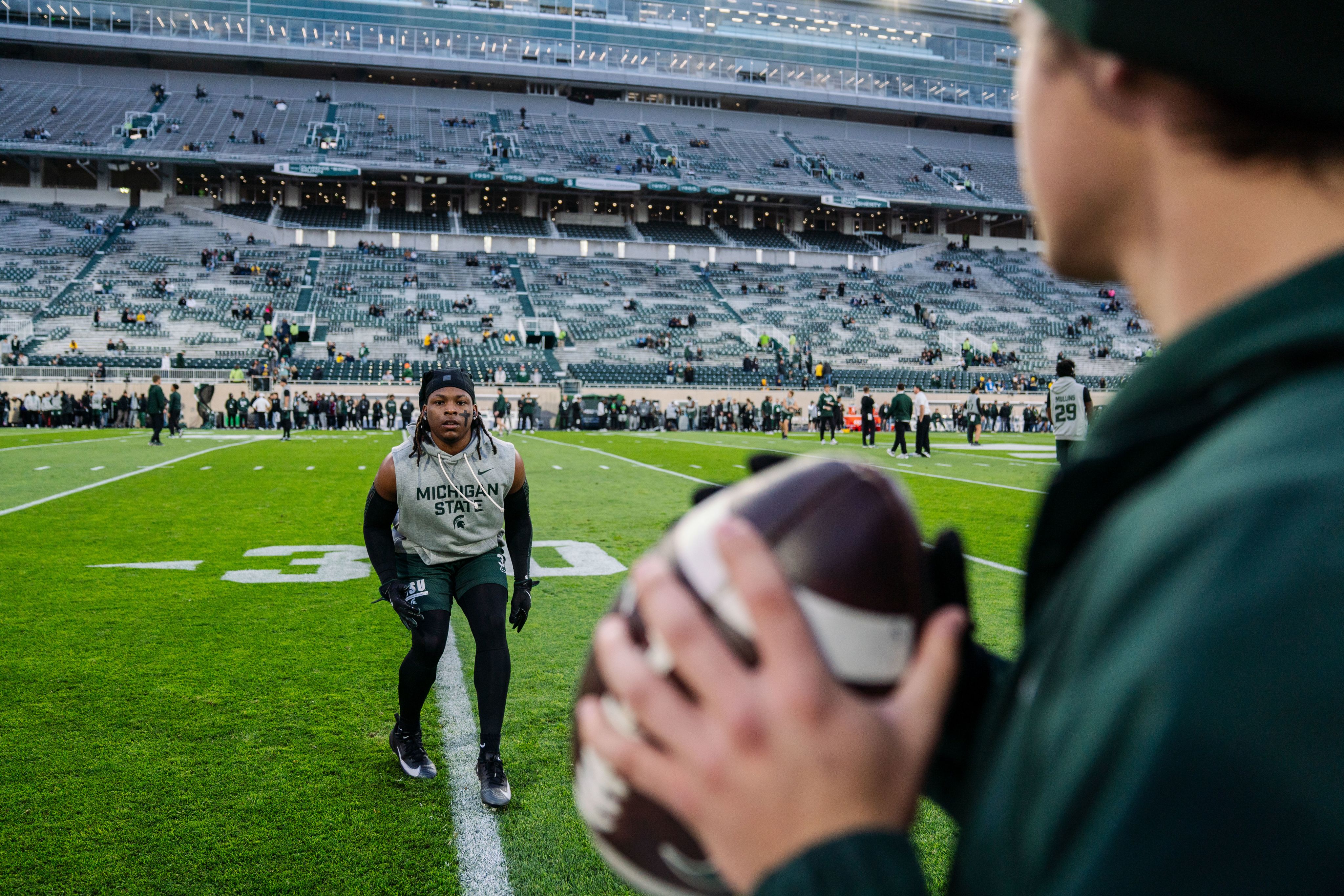
Student managers arrive six hours before kickoff to set up the sideline. The football played every weekend is built on work that happens far from the field, on preparation that rarely reaches the stands. As players take the field, the equipment staff moves continuously along the sideline.

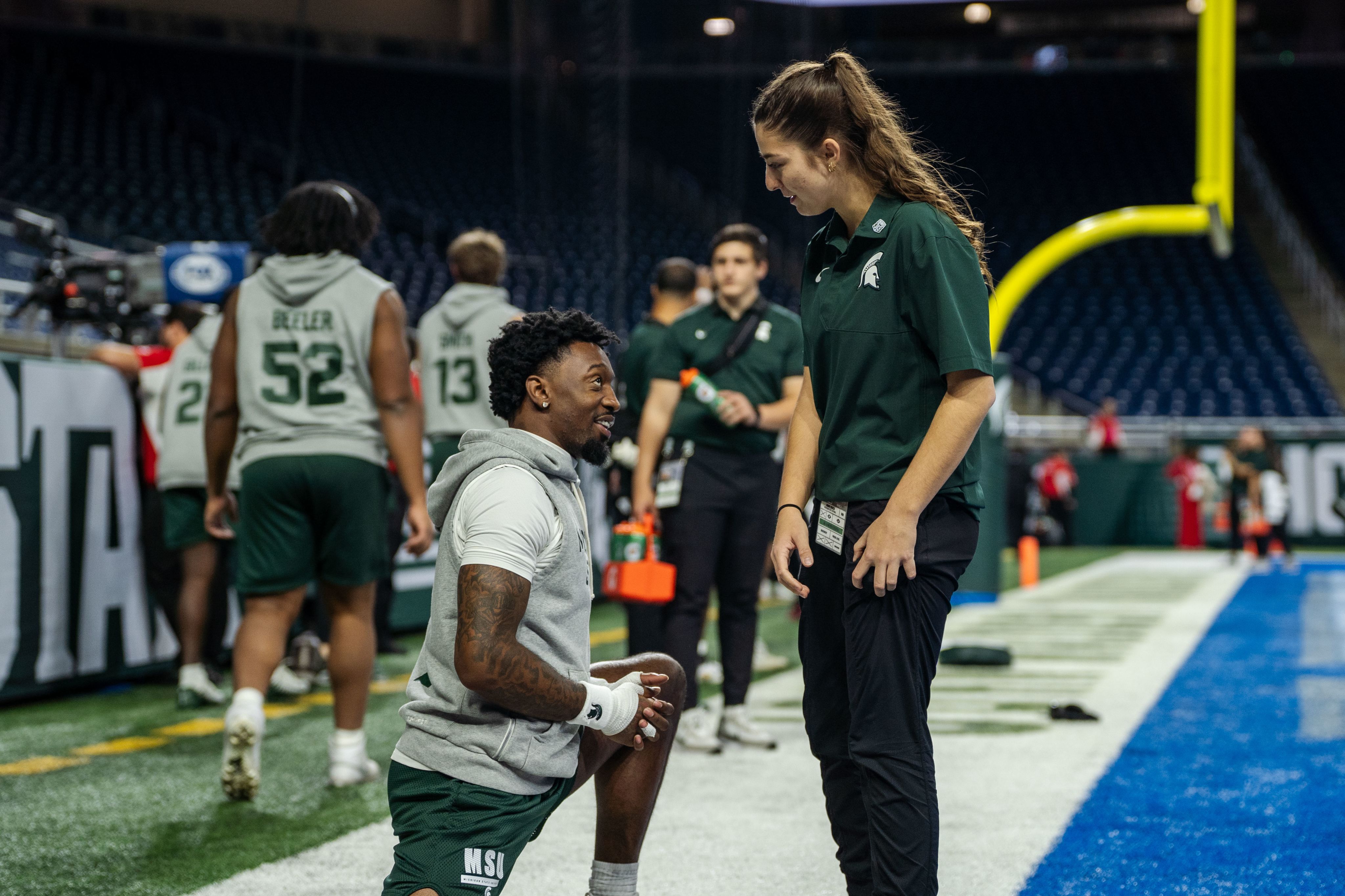
Like stagehands during a live performance, their work is meant to disappear in real time. When everything functions as it should, the game unfolds uninterrupted, and no one notices the people who made it possible.
Are the cleats in each bag?
Did ______ get his thumb splint?
Where are the towels?
Is the quarterback's helmet tuned to the right frequency?

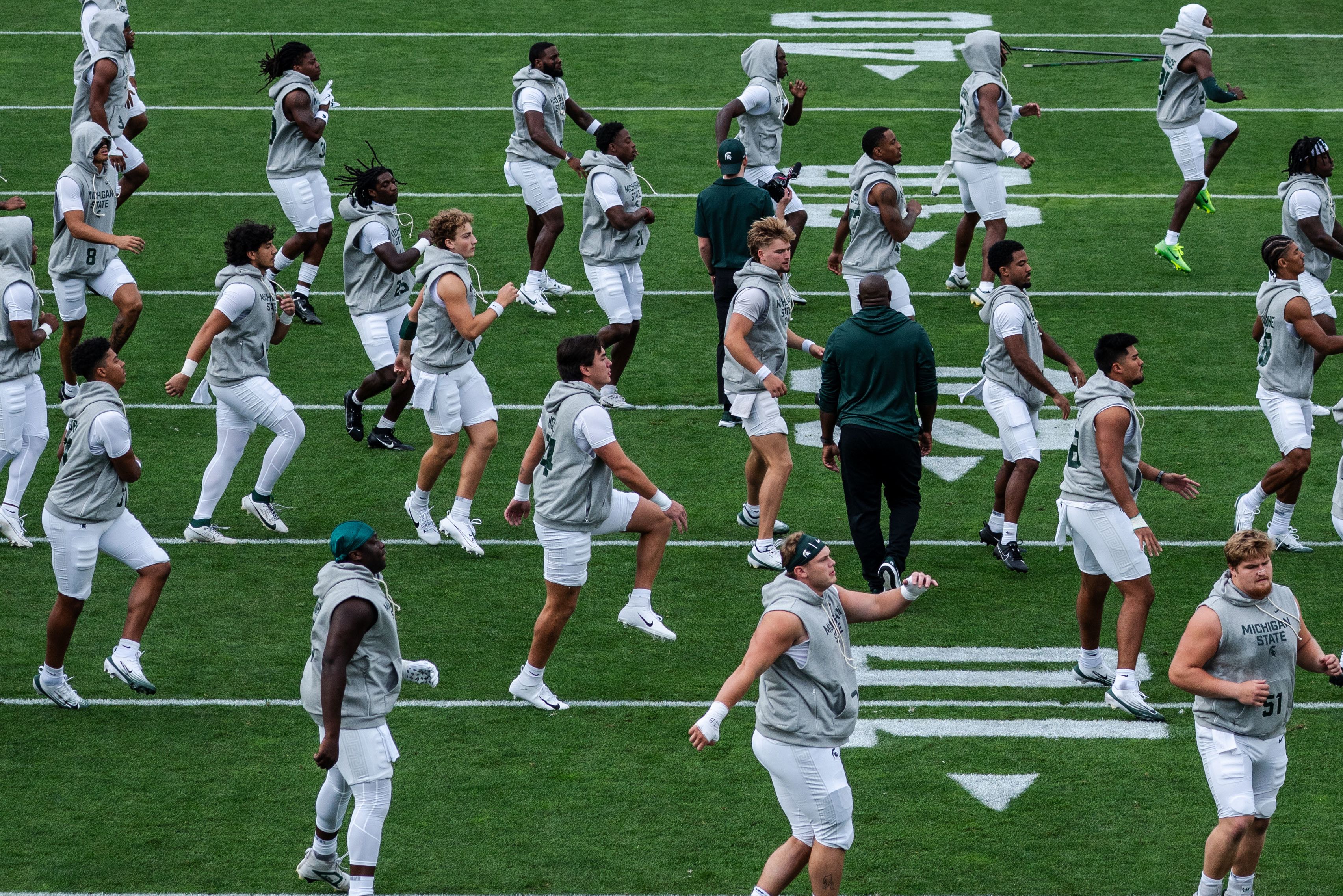
Without the people filling these roles, football would not be the game it is today.

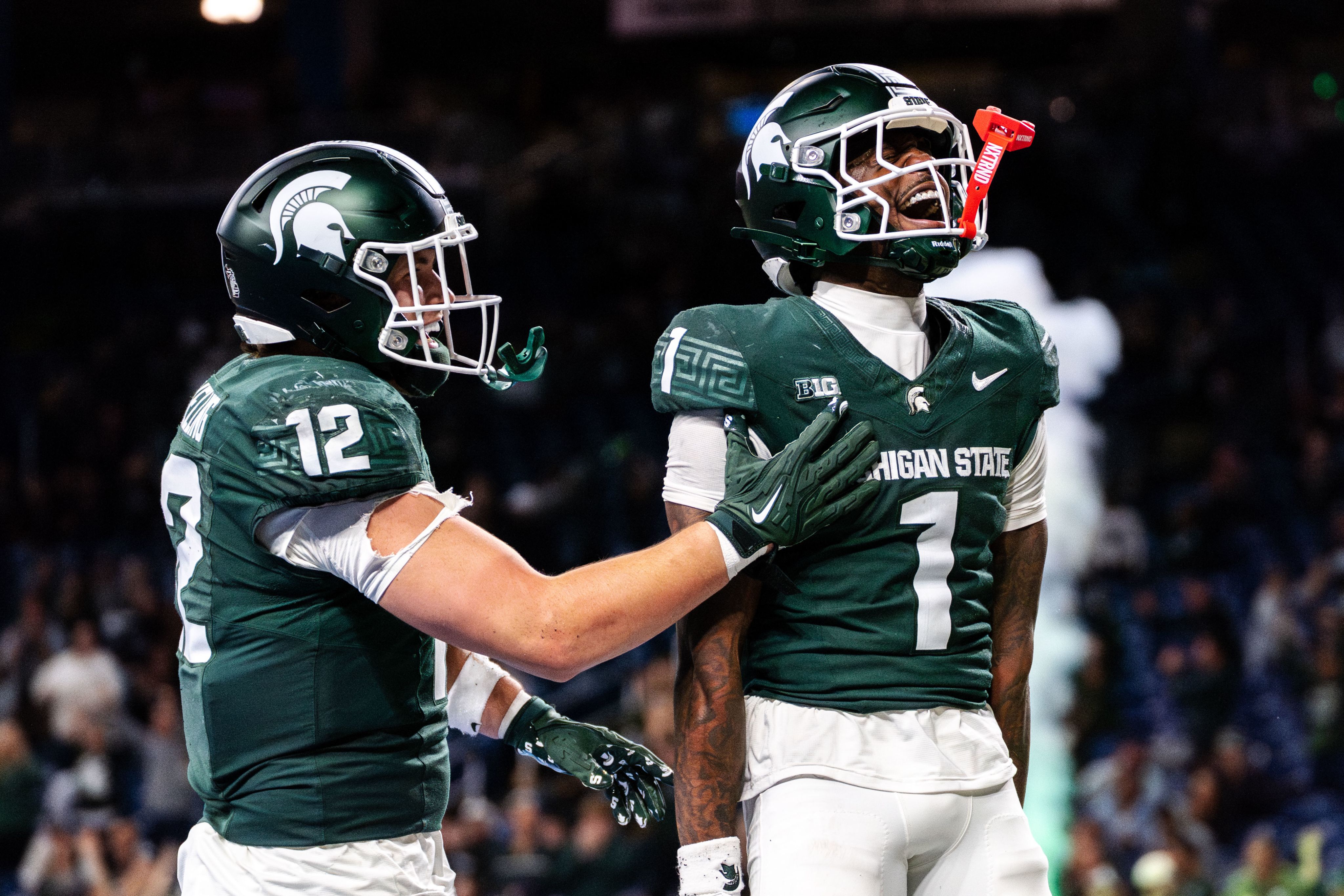














Michigan State wide receiver Omari Kelly (1) celebrates his only touchdown of the game with tight end Jack Veiling (12) against the University of Maryland at Ford Field in Detroit on Nov. 29, 2025. Michigan State beat Maryland 38–28 to finish the season 4–8.
Michigan State wide receiver Omari Kelly (1) celebrates his only touchdown of the game with tight end Jack Veiling (12) against the University of Maryland at Ford Field in Detroit on Nov. 29, 2025. Michigan State beat Maryland 38–28 to finish the season 4–8.
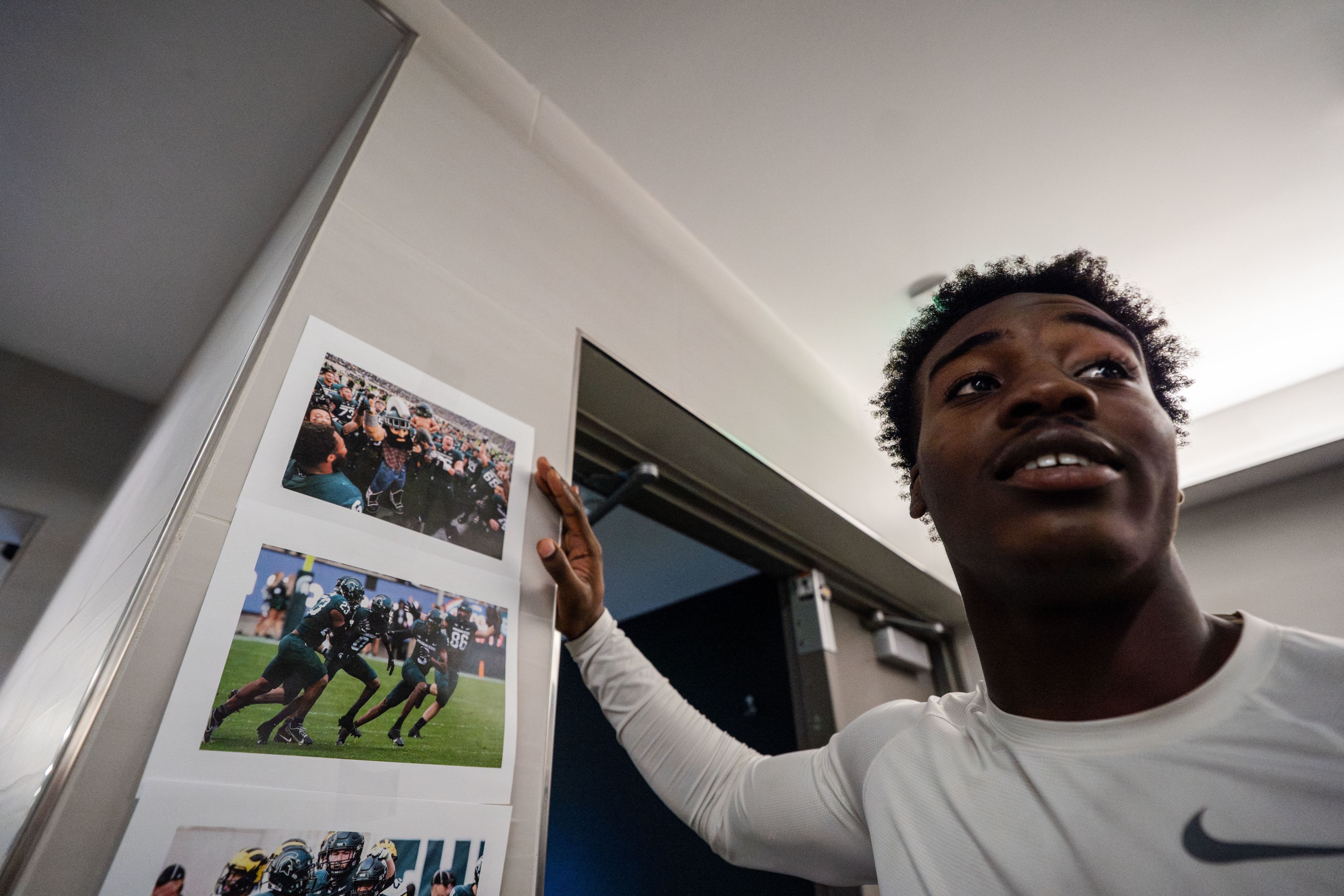
Wide receiver Nick Marsh (6) reacts to the uniforms for the upcoming game against the University of Michigan at the Duffy Daugherty Building on Oct. 24, 2025. For the rivalry game, the equipment staff announced the return of the 2021 uniforms last worn in Michigan State’s most recent win over Michigan.
Wide receiver Nick Marsh (6) reacts to the uniforms for the upcoming game against the University of Michigan at the Duffy Daugherty Building on Oct. 24, 2025. For the rivalry game, the equipment staff announced the return of the 2021 uniforms last worn in Michigan State’s most recent win over Michigan.
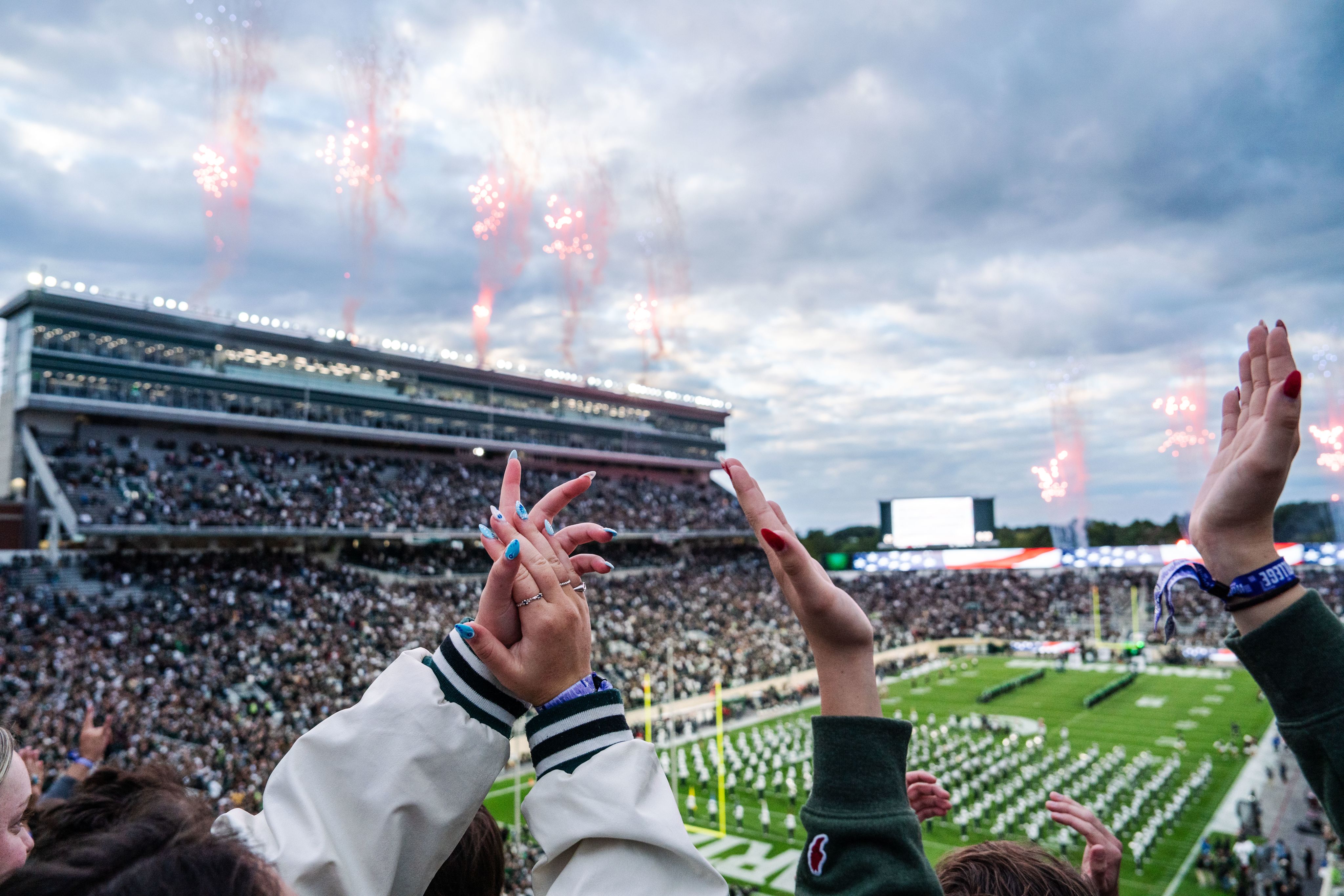
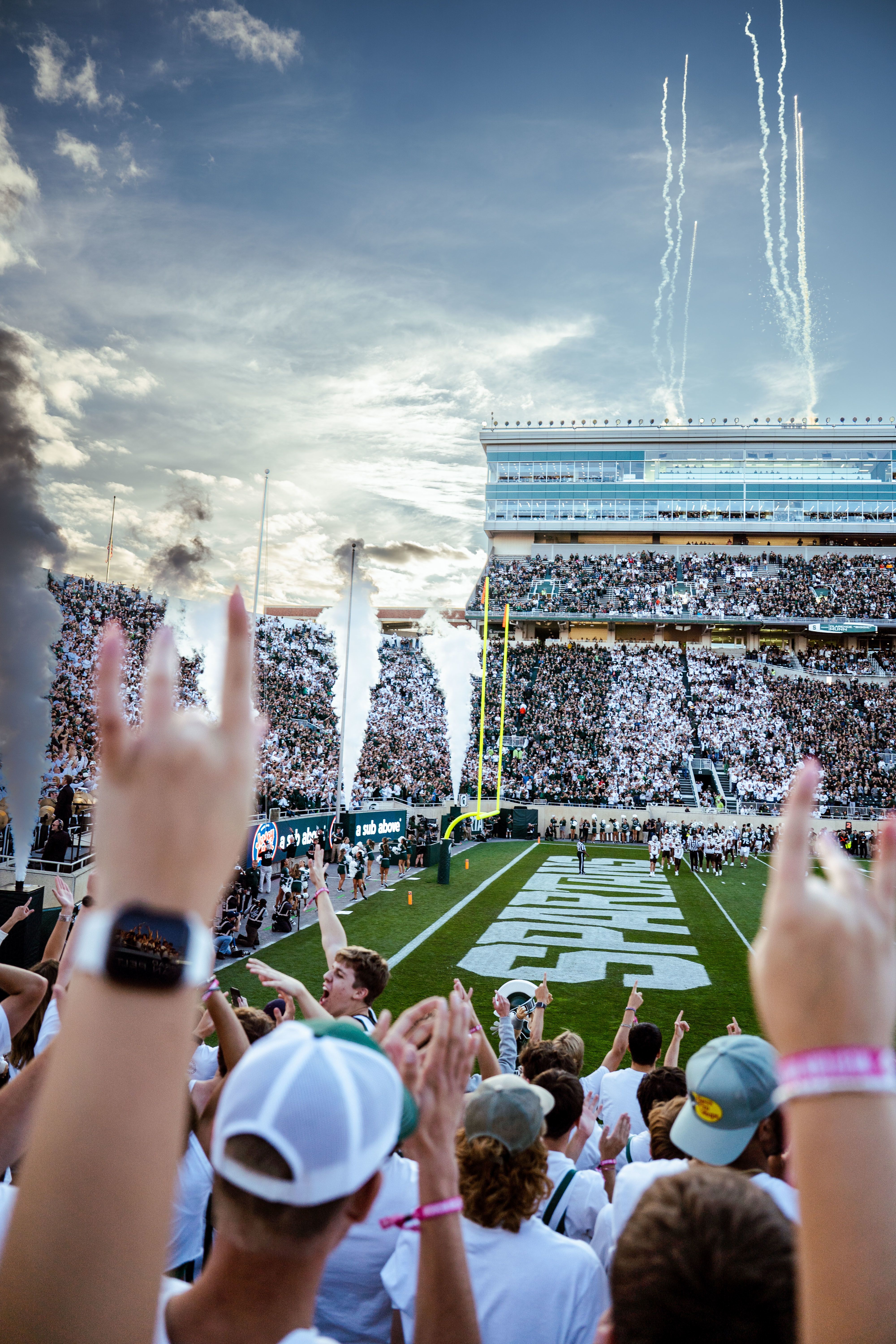
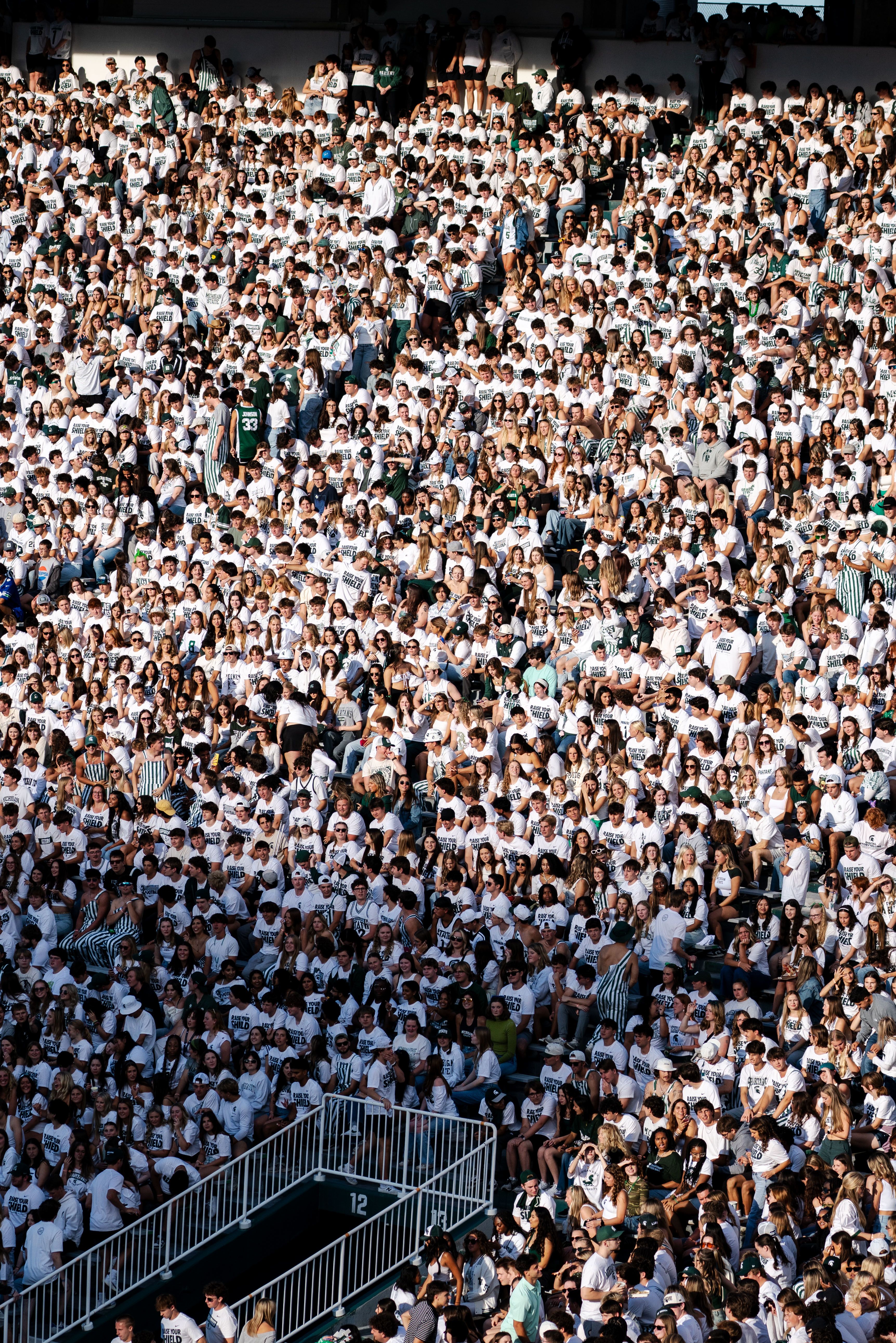
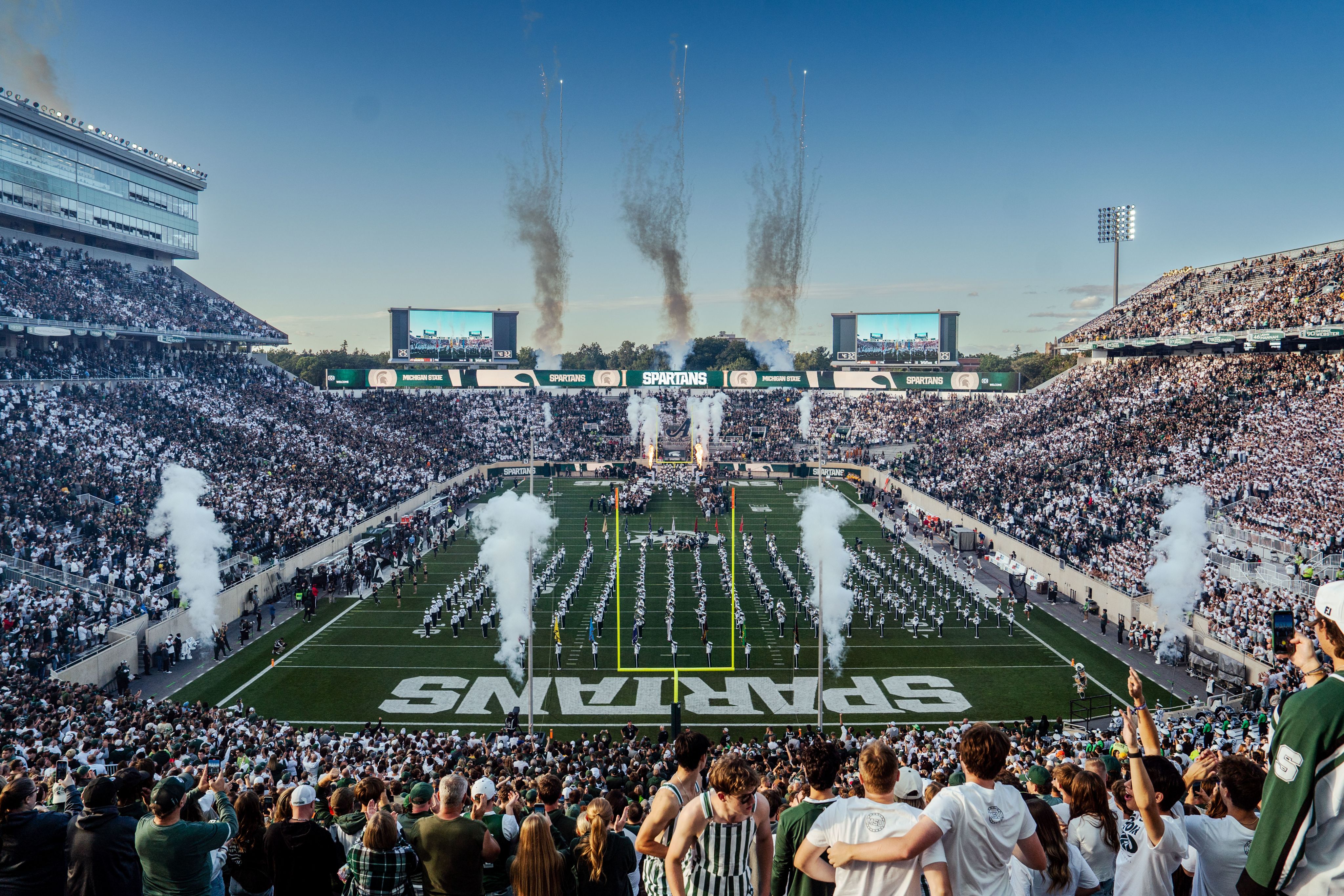
Michigan State’s student section cheers before the Spartans’ game against Boston College at Spartan Stadium on Sept. 6, 2025. Michigan State won 42-40 in double overtime.
Michigan State’s student section cheers before the Spartans’ game against Boston College at Spartan Stadium on Sept. 6, 2025. Michigan State won 42-40 in double overtime.
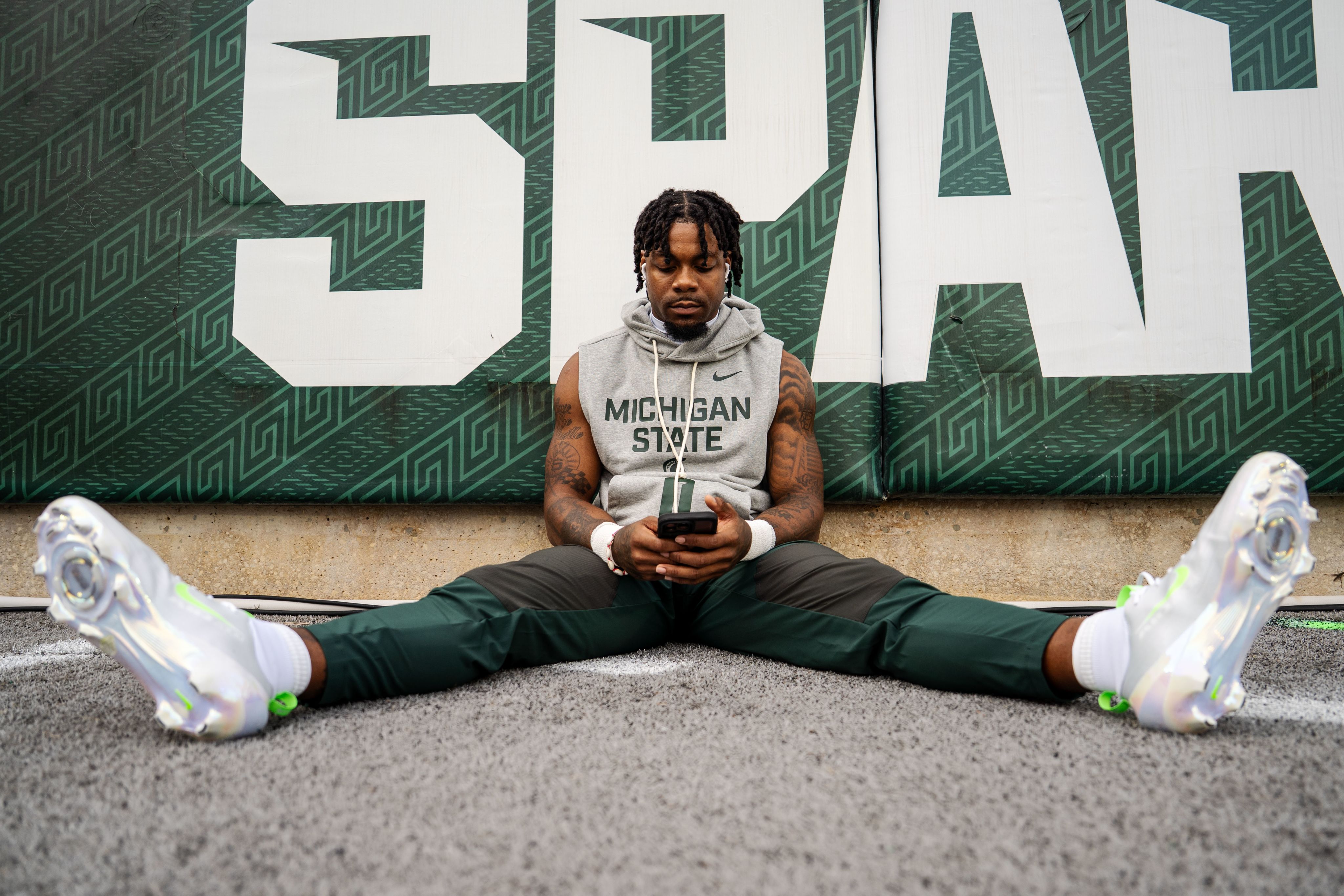
Wide receiver Alante Brown (0) listens to music before the season opener against Western Michigan at Spartan Stadium on Aug. 29, 2025.
Wide receiver Alante Brown (0) listens to music before the season opener against Western Michigan at Spartan Stadium on Aug. 29, 2025.

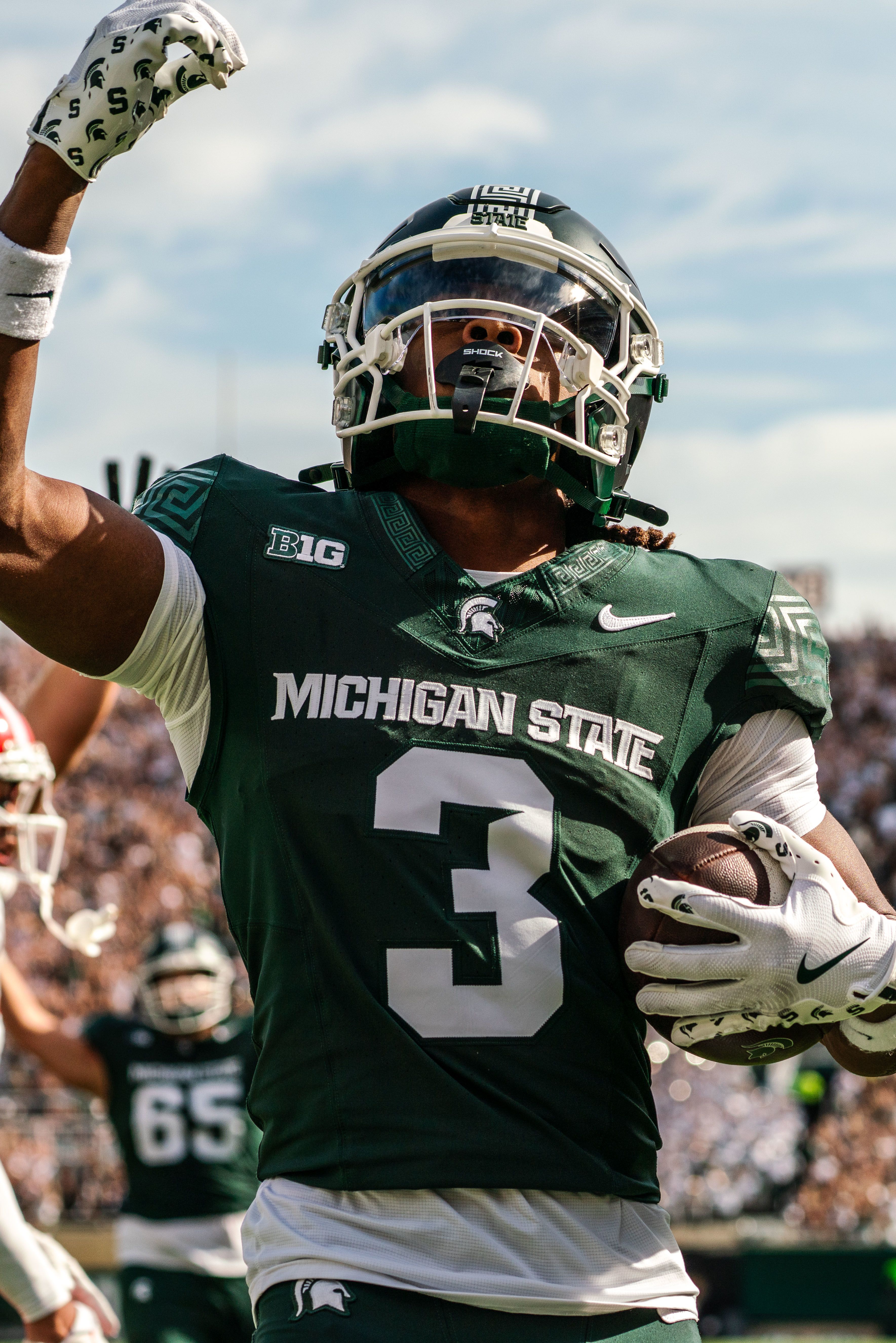
Michigan State wide receiver Rodney Bullard Jr. (3) scores a touchdown against Youngstown State at Spartan Stadium on Sept. 13, 2025.
Michigan State wide receiver Rodney Bullard Jr. (3) scores a touchdown against Youngstown State at Spartan Stadium on Sept. 13, 2025.
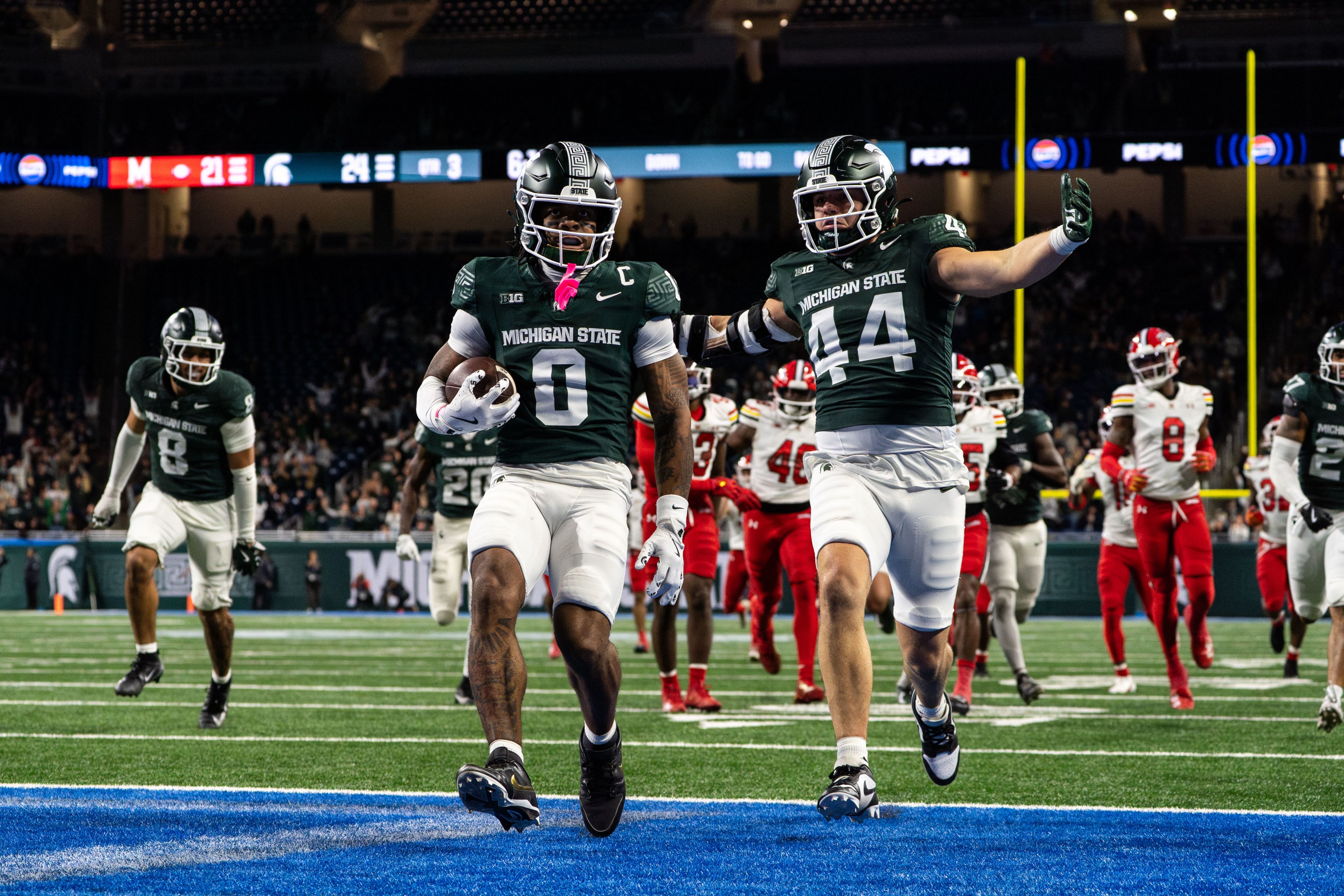
Michigan State wide receiver Alante Brown (0) runs a 92-yard touchdown against the University of Maryland at Ford Field in Detroit on Nov. 29, 2025. Michigan State beat Maryland 38–28 to finish the season 4–8.
Michigan State wide receiver Alante Brown (0) runs a 92-yard touchdown against the University of Maryland at Ford Field in Detroit on Nov. 29, 2025. Michigan State beat Maryland 38–28 to finish the season 4–8.

Michigan State student section celebrates after scoring the first touchdown of the season against Western Michigan at Spartan Stadium on Aug. 29, 2025.
Michigan State student section celebrates after scoring the first touchdown of the season against Western Michigan at Spartan Stadium on Aug. 29, 2025.

Michigan State wide receiver Omari Kelly (1) catches the game-winning touchdown against Boston College on Sept. 6, 2025. Michigan State beat Boston College 42–40 in double overtime.
Michigan State wide receiver Omari Kelly (1) catches the game-winning touchdown against Boston College on Sept. 6, 2025. Michigan State beat Boston College 42–40 in double overtime.
Michigan State defensive end Anelu Lafaele (11) prays beside the goalpost nearest the student section before kickoff against Youngstown State at Spartan Stadium on Sept. 13, 2025. Lafaele performs this ritual before every game.
Michigan State defensive end Anelu Lafaele (11) prays beside the goalpost nearest the student section before kickoff against Youngstown State at Spartan Stadium on Sept. 13, 2025. Lafaele performs this ritual before every game.
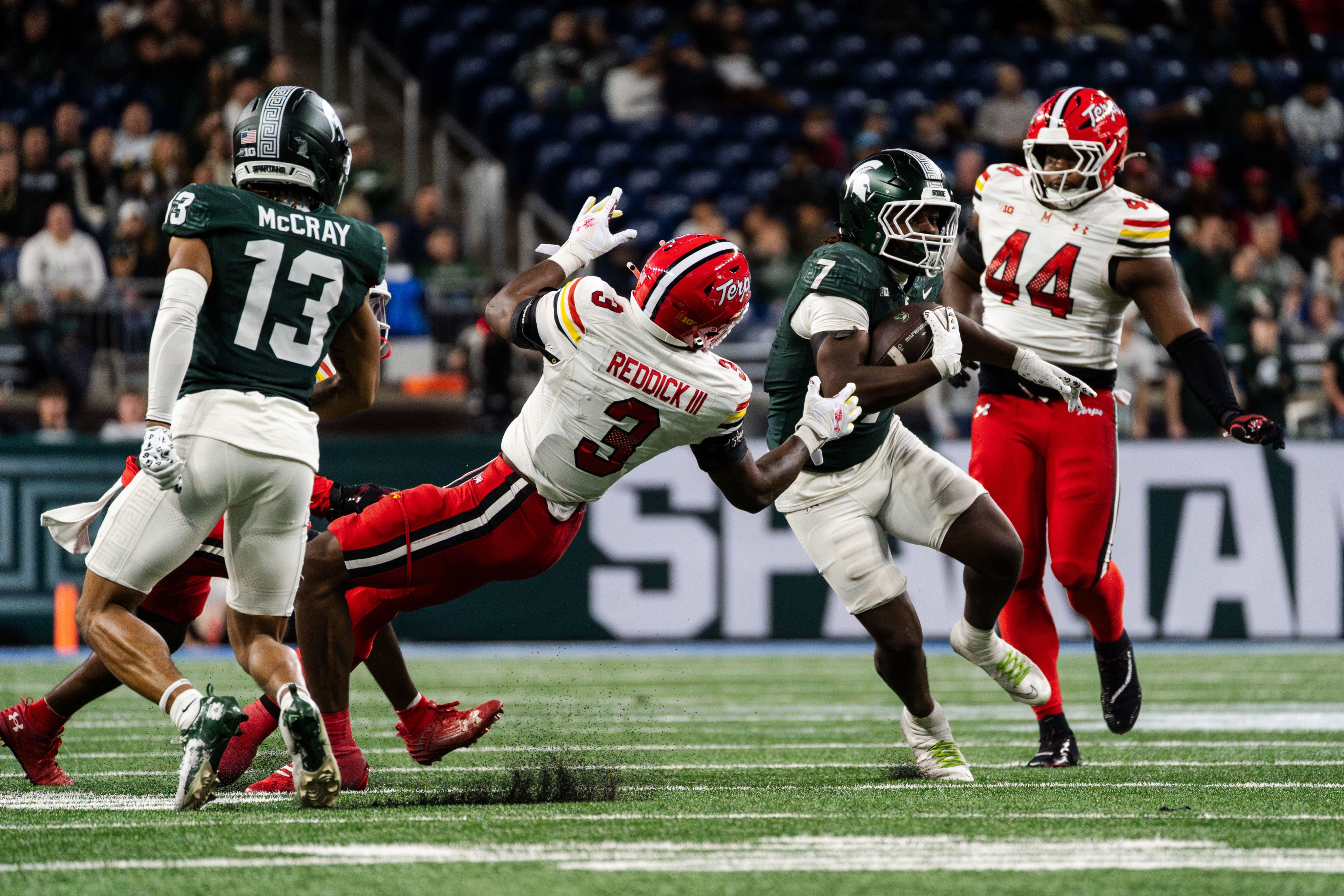
Michigan State running back Brandon Tullis (7) runs past Maryland linebacker Trey Reddick III (3) during their game at Ford Field on Nov. 29, 2025.
Michigan State running back Brandon Tullis (7) runs past Maryland linebacker Trey Reddick III (3) during their game at Ford Field on Nov. 29, 2025.

Michigan State’s student section participates in the “Stripe the Stadium” game against Western Michigan at Spartan Stadium on Aug. 29, 2025. The Spartans won 23–6.
Michigan State’s student section participates in the “Stripe the Stadium” game against Western Michigan at Spartan Stadium on Aug. 29, 2025. The Spartans won 23–6.

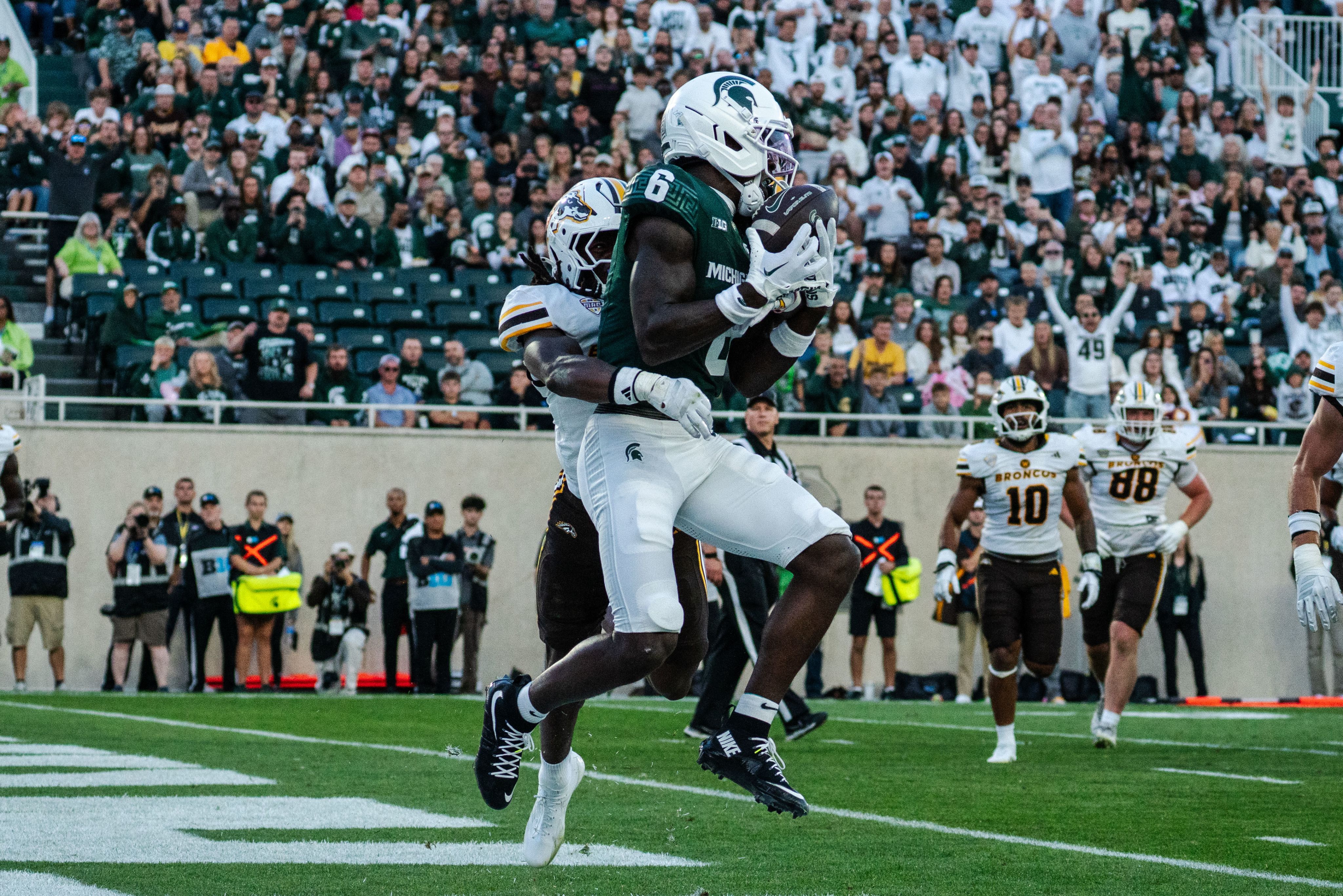
Michigan State wide receiver Nick Marsh catches the first touchdown of the season against Western Michigan at Spartan Stadium on Aug. 29, 2025. Michigan State won 23–6.
Michigan State wide receiver Nick Marsh catches the first touchdown of the season against Western Michigan at Spartan Stadium on Aug. 29, 2025. Michigan State won 23–6.

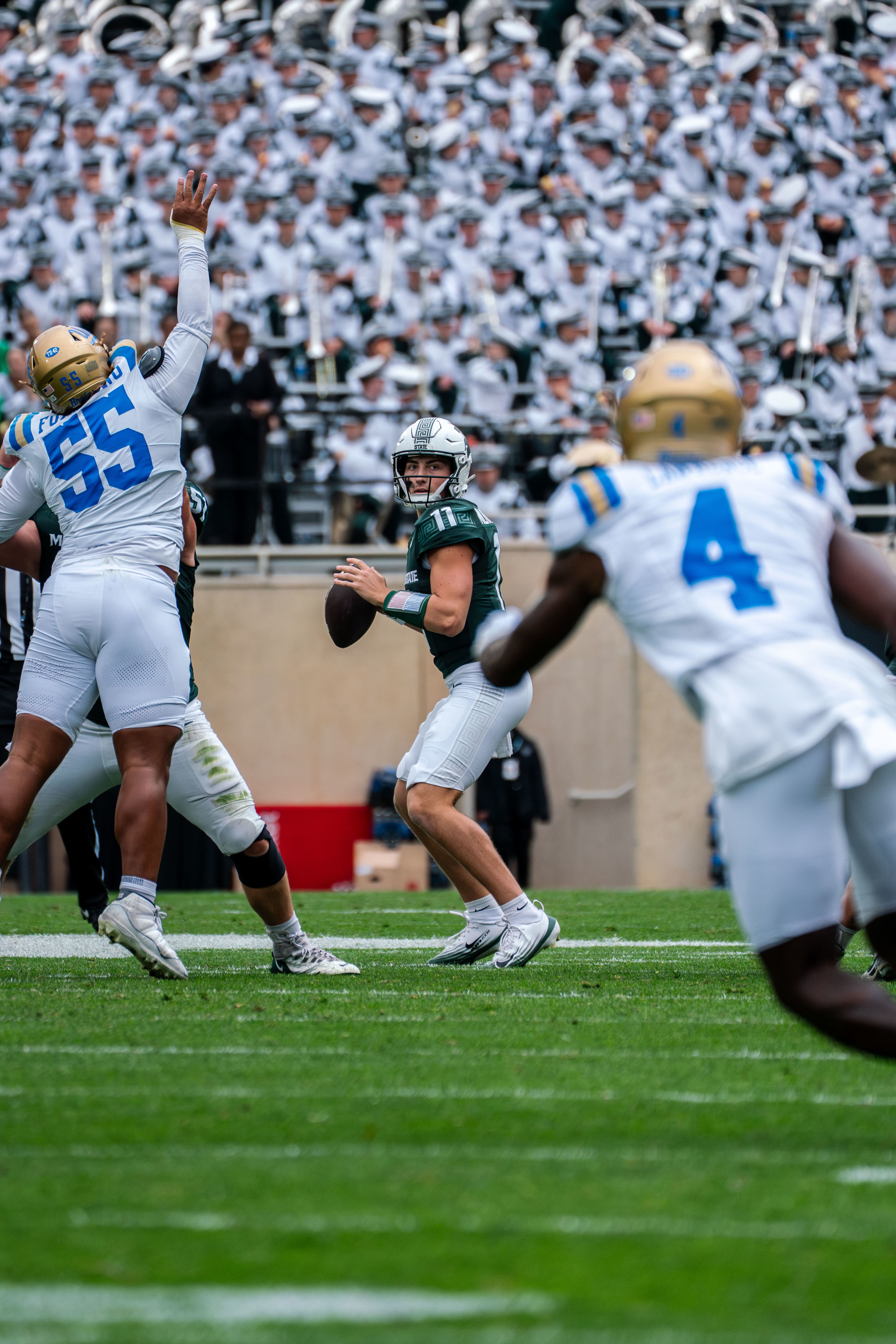
Michigan State quarterback Alessio Milivojevic (11) makes his first start of the season against UCLA at Spartan Stadium on Oct. 11, 2025. Michigan State lost 38–13.
Michigan State quarterback Alessio Milivojevic (11) makes his first start of the season against UCLA at Spartan Stadium on Oct. 11, 2025. Michigan State lost 38–13.
Michigan State runs onto the field before its home opener against Western Michigan at Spartan Stadium on Aug. 29, 2025.
Michigan State runs onto the field before its home opener against Western Michigan at Spartan Stadium on Aug. 29, 2025.
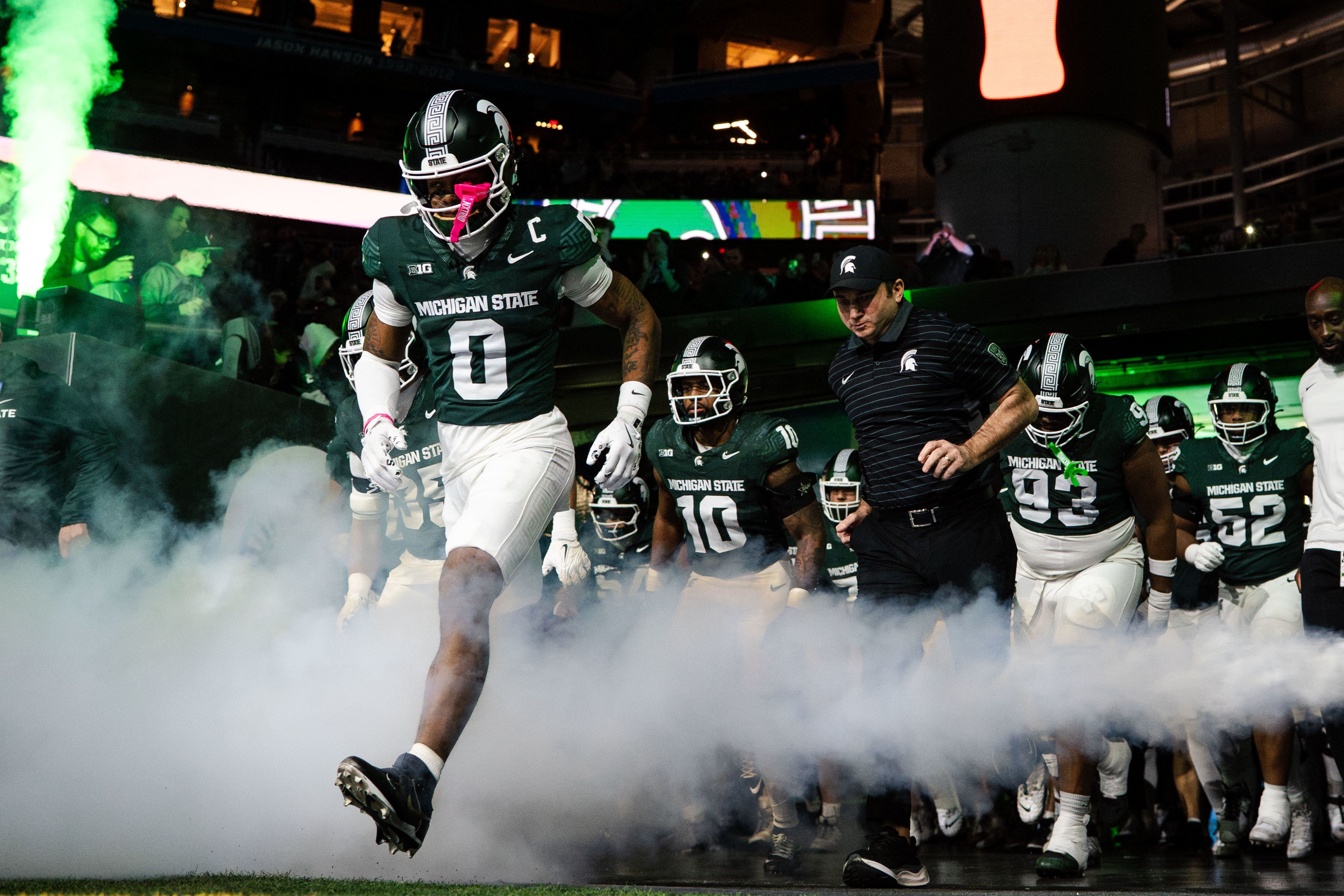
The Michigan State football team runs onto the field with head coach Jonathan Smith before its final game of the season against the University of Maryland at Ford Field on Nov. 29, 2025.
The Michigan State football team runs onto the field with head coach Jonathan Smith before its final game of the season against the University of Maryland at Ford Field on Nov. 29, 2025.
“I wouldn’t trade this for the world,” Emma said. In the long hours, the unseen preparation and the responsibility carried without recognition, her purpose is clear. This is where she belongs, not in the spotlight, but in the work that makes everything else possible.
After all that, it restarts. Over, and over again.




About Maya Kolton
Maya Kolton is junior at Michigan State University majoring in Creative Advertising with a minor in Media Photography. She's a creative who thrives when I’m telling stories visually. When behind the camera, she feels the most like herself: confident, focused, and inspired.
Produced, in part, during the JRN 410: Documentary Photojournalism course, Spring 2026.
 Built with Shorthand